
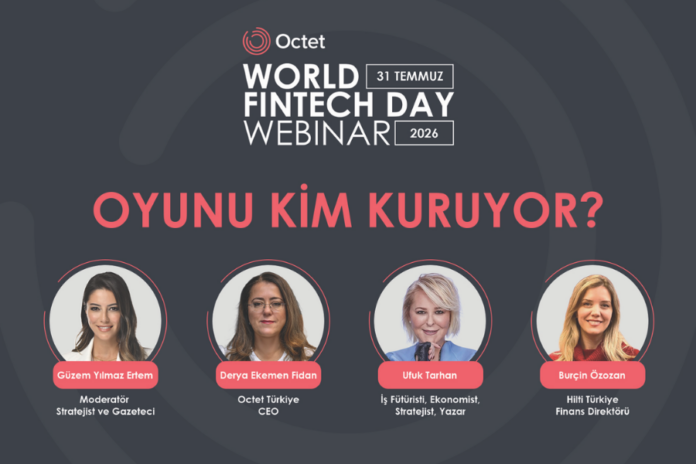
The fourth edition of Octet World Fintech Day, held under the theme “Who’s Setting the Rules? Shared Power, Shared Responsibility,” addressed key transformation topics for the future of B2B finance. Experts emphasized that as the industry moves toward 2030, routine finance operations will increasingly be handled by AI agents, while strategic decision-making, final sign-off, and accountability will remain with humans.
This year’s fourth edition of Octet World Fintech Day was moderated by strategist and journalist Güzem Yılmaz Ertem. Speakers included Octet Türkiye CEO and Board Member Derya Ekemen Fidan, business futurist, economist, and author Ufuk Tarhan, and Hilti Türkiye Finance Director Burçin Özozan.
The event focused on how financial technologies are evolving beyond tools that merely digitize transactions into structures that support companies’ decision-making processes. Speakers noted that banks’ financial infrastructure, the agility of fintechs, the trust created by regulation, and technology’s data-processing capacity can only create value when they come together around genuine customer needs.
“The customer is at the center of the game”
Commenting on the division of roles within the fintech ecosystem, Octet Türkiye CEO and Board Member Derya Ekemen Fidan said banks provide financial infrastructure, fintechs develop agile solutions and strong user experiences, and regulators establish the legal framework. Noting that all of these structures gain meaning only when they respond to a genuine customer need, Ekemen Fidan said: “In today’s world, the customer is the central actor at the heart of the game. Real value emerges from correctly understanding the customer’s need and developing a solution for it. Bringing together data companies hold across different banks, collection, and payment channels into a single point is the first step of digitalization. But bringing data together on its own isn’t enough. This data needs to be used not just for reporting, but to monitor cash flow, catch delays early, evaluate channel performance, and make forward-looking decisions. With this transformation, finance teams are also moving away from being a function that reports on the past and becoming structures that contribute to companies’ strategic processes.”
“We also need to explain the digital experience to SMEs”
Noting that Octet Türkiye is expanding its structure focused on SMEs, Ekemen Fidan said the company has built a dedicated setup for SMEs alongside its work with large-scale companies. Noting that the company has begun reaching SMEs directly through teams established in different regions of Anatolia, Ekemen Fidan said financial literacy needs to be addressed together with knowledge and experience about how digital solutions can be used in business processes.
Emphasizing that customer needs form the foundation of the product development process, Ekemen Fidan pointed to the Direct Debiting System as an example of this approach, continuing: “We need to explain to SMEs not just financial literacy, but also how they can use digital solutions in their business processes. Because the real value of digitalization comes not from the existence of a technology, but from how much it eases a business’s daily operations. In the past, companies had to check their dealer limits at different banks separately. With Octet Türkiye’s solution, this information can now be viewed on a single platform. This allows financial operations to be monitored from a more holistic perspective and managed more effectively. Looking at all of this, competition in the period ahead will be shaped less by offering more screens or features, and more by how much you reduce the customer’s operational complexity and decision-making burden.”
Finance teams are becoming strategic business partners
Responding to Güzem Yılmaz Ertem’s question on how digitalization is changing the role of finance teams, Hilti Türkiye Finance Director Burçin Özozan said that in the past, because financial and operational data resided in different systems, teams spent a significant portion of their time collecting data from various sources, consolidating it, and making it ready for analysis. Noting that integrated systems and automation now allow faster, more holistic access to data, Özozan said: “We can now spend our time interpreting data, evaluating different scenarios, and making faster, more accurate decisions together with business units, rather than preparing data. In the past, finance was largely a function that answered the question ‘What happened?’ Today, it has become a strategic business partner focused on the questions ‘What could happen?’ and ‘How can we make the best decision?’, working together with sales, marketing, and operations teams. But the goal here isn’t to incorporate every new technology into the system — it’s to correctly use the solutions that create real value for our business and our customers. Every improvement made in our processes not only increases internal efficiency, but is also directly reflected in the customer experience. That’s why we see technology not just as a tool that speeds up operations, but as a strategic investment that strengthens the quality of decisions and creates value for the customer.”
“Responsibility cannot be delegated to an algorithm”
Business futurist, economist, and author Ufuk Tarhan said AI agents will take on increasing responsibility in the day-to-day operations of finance teams, noting that repetitive tasks such as invoice and order matching, cash flow forecasting, comparing maturity and payment options, and generating reports and recommendations could be carried out by AI agents. However, she emphasized that this transformation will not remove human decision-making from the process.
According to Tarhan, the finance managers of the future will move away from carrying out each transaction individually and instead become conductors who set goals, authority levels, and boundaries for action, ensuring alignment between people and the digital workforce. Noting that while AI can calculate the most suitable options, humans will continue to decide when exceptions should apply, how to approach a given customer, and when intervention is needed, Tarhan said: “AI will significantly ease our work by providing us with reports, forecasts, and recommendations. Agents will be able to calculate the most suitable option, take on repetitive tasks, and speed up decision-making processes. But strategic decisions cannot be left entirely to technology. It will be up to humans to determine who to say no to, how to act in a particular special circumstance, and when to intervene on a given signal. That’s why the managers who will make a difference in the future will be those who master both the technology and the essence of their work, and who can properly orchestrate the relationship between people and AI agents. Let’s trust the algorithm and work with it — but we have to keep control, the ability to recognize exceptions, and responsibility in human hands. No matter how advanced technology becomes, the human will remain at the center of the final decision and accountability.”
Touching on AI ethics and accountability, Tarhan said the responsibility for actions carried out by systems cannot be assigned to an algorithm. She noted that while automation can manage standard processes, it is experienced humans who can recognize unexpected situations, exceptions, and developments that require early intervention.
“In 2030, the final signature will still belong to a human”
Closing the panel, speakers responding to Güzem Yılmaz Ertem’s question on how B2B finance will take shape by 2030 envisioned a future in which technology becomes invisible, while responsibility remains more clearly in human hands.
Derya Ekemen Fidan said that what will matter going forward is not how many banks a company works with, but how integrated its overall financial ecosystem is and how it uses data. Ekemen Fidan said a model in which information from different channels is interpreted within a single structure and turned into decision-making processes would come to the fore.
Ufuk Tarhan said an invisible decision network would emerge in which AI agents carry out routine payment and collection transactions, while the boundaries of action are set by humans. According to Tarhan, systems will present options, speed up transactions, and develop recommendations — but the final signature and accountability will remain with humans.
Burçin Özozan said finance would move away from being a separate, supporting process within a company and become a natural part of the customer experience. Özozan noted that as routine operations are taken over by technology, finance teams will focus more on strategy, foresight, decision quality, and business partnership.
The Octet World Fintech Day event can be watched here: https://www.youtube.com/live/X-S-2dxhT6s

