
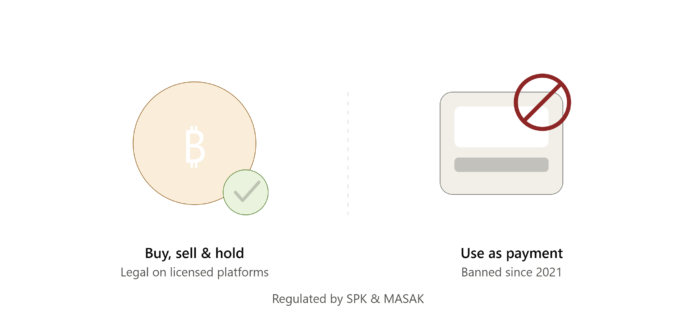
Yes, buying, selling, and holding cryptocurrency as an investment is legal in Turkey. What is not legal is using cryptocurrency as a means of payment for goods and services — a distinction that trips up many newcomers to the Turkish market. Trading and custody of crypto assets are regulated primarily by the Capital Markets Board (SPK/CMB) and the Financial Crimes Investigation Board (MASAK), while a specific tax framework for crypto gains is still under legislative discussion.
The Core Legal Distinction: Investment vs. Payment
Turkey’s regulatory approach to crypto rests on a clear split between two separate activities:
- Trading, holding, and investing in crypto assets: legal. Individuals and institutions can freely buy, sell, and hold cryptocurrencies through licensed platforms.
- Using crypto as a payment method: banned. Since a TCMB regulation published in the Official Gazette on 16 April 2021 (“Regulation on the Non-Use of Crypto Assets in Payments”), it has been explicitly prohibited to pay for goods or services directly with cryptocurrency, and payment service providers are barred from facilitating such payments. You cannot, for example, pay for a coffee or a subscription directly in Bitcoin — but you can buy, sell, and hold Bitcoin as an investment without restriction.
The Regulatory Framework
Turkey’s crypto regulation developed through several distinct legal instruments rather than a single comprehensive crypto law:
- Law No. 7518 (27 June 2024): This amendment to the Capital Markets Law (Law No. 6362) gave crypto assets their first formal legal definition in Turkish law, and created the legal status of “Crypto Asset Service Provider” (Kripto Varlık Hizmet Sağlayıcısı, KVHS) — covering exchanges, custody providers, and other platforms facilitating crypto transactions.
- SPK licensing requirement: Following Law No. 7518, crypto asset platforms operating in Turkey must obtain a license from the Capital Markets Board. Licensed platforms must also meet technical infrastructure standards reviewed by TÜBİTAK (Turkey’s national scientific research institution).
- MASAK oversight: Crypto Asset Service Providers are treated as obligated parties under Turkey’s anti-money-laundering framework (Law No. 5549). This means mandatory customer identification (KYC), suspicious transaction reporting, and — as of 2025 — compliance with the international Travel Rule for cross-border crypto transfers.
- TCMB payment ban (April 2021): As noted above, this regulation bans the use of crypto assets as a means of payment, though it does not restrict investment activity. The regulation has faced legal challenges at the Council of State (Danıştay), though it remains in force.
Taxation: Still an Open Question
As of 2026, Turkey does not have a dedicated tax law specifically governing gains from cryptocurrency trading. A comprehensive tax bill covering crypto assets was submitted to the Turkish Grand National Assembly in March 2026, but the crypto-specific provisions were removed from the bill during general session deliberations later that month. This means the tax treatment of crypto gains remains a legislative gray area rather than a settled framework — a point that foreign investors and Turkish crypto users alike should watch closely, since new legislation could be reintroduced at any time.
Who Regulates What
| Regulator | Role in Crypto |
|---|---|
| SPK (Capital Markets Board) | Licenses Crypto Asset Service Providers, sets operating standards and capital requirements |
| MASAK | AML/KYC compliance, suspicious transaction monitoring, Travel Rule enforcement |
| TCMB (Central Bank) | Enforces the ban on crypto as a payment method |
| TÜBİTAK | Reviews and certifies the technical infrastructure of licensed platforms |
| MKK (Central Securities Depository) | Operates KVMKS, Turkey’s Crypto Asset Central Registry System, publishing baseline market data |
What This Means in Practice
For a retail user in Turkey, the practical effect of this framework is straightforward: you can open an account on an SPK-licensed exchange, complete KYC verification, and buy, sell, or hold crypto assets freely. What you cannot do is spend that crypto directly at a merchant, or use a payment service provider to route a crypto payment on your behalf. For businesses and fintech platforms, this means crypto-native payment products must structure themselves as investment or custody services rather than payment rails — a distinction that shapes product design across the Turkish crypto industry.
Frequently Asked Questions
Can I legally buy Bitcoin in Turkey? Yes. Buying, selling, and holding Bitcoin and other cryptocurrencies through a licensed platform is legal in Turkey.
Can I pay for goods or services with cryptocurrency in Turkey? No. Since April 2021, TCMB regulation has explicitly banned using crypto assets as a means of payment.
Do I need a license to operate a crypto exchange in Turkey? Yes. Since Law No. 7518 (2024), Crypto Asset Service Providers must obtain a license from the Capital Markets Board (SPK) and meet technical infrastructure standards.
Is there a specific tax on crypto gains in Turkey? Not yet, as of 2026. A proposed tax framework was removed from a legislative bill in March 2026, leaving the taxation of crypto gains without a dedicated law.
Which regulator handles anti-money-laundering compliance for crypto in Turkey? MASAK (the Financial Crimes Investigation Board), which requires licensed crypto platforms to perform KYC checks and report suspicious transactions.
This article reflects Turkey’s crypto regulatory framework as of 2026 and is provided for informational purposes; it is not legal or tax advice. For more on Turkey’s digital asset landscape, explore our Blockchain & Crypto and Regtech & Compliance sections.

