
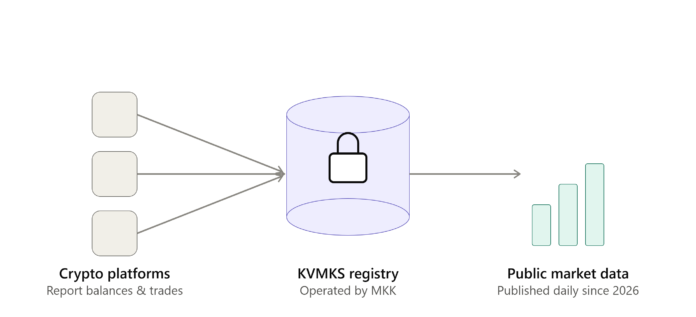
KVMKS (Kripto Varlık Merkezi Kayıt Sistemi, “Crypto Asset Central Registry System”) is Turkey’s official central registry for crypto asset transactions and balances, developed and operated by MKK (Merkezi Kayıt Kuruluşu — the Central Securities Depository of Türkiye) under regulations set by the Capital Markets Board (SPK/CMB). It records the transaction and balance data reported by licensed Crypto Asset Service Providers (KVHS), enabling official oversight, cross-platform reconciliation, and — since July 2026 — publicly available aggregate market statistics.
Why Turkey Built a Central Crypto Registry
Before KVMKS, crypto asset holdings and transactions in Turkey existed only inside the internal systems of individual exchanges and custody providers, with no unified, regulator-accessible record. This created two practical problems: regulators had no consolidated view of the crypto market’s size or risk profile, and there was no standardized mechanism for reconciling balances between platforms and custodians. KVMKS was built to close that gap — giving Turkey what MKK has described as a pioneering official tracking mechanism for crypto markets.
The Regulatory Basis
KVMKS operates under a specific legal framework established by the Capital Markets Board:
- Communiqué on the Establishment and Operating Principles of Crypto Asset Service Providers
- Communiqué on the Operating Procedures, Principles, and Capital Adequacy of Crypto Asset Service Providers
Both communiqués were published in the Official Gazette on 13 March 2025, formally defining MKK’s role in integrating Crypto Asset Service Providers (Kripto Varlık Hizmet Sağlayıcıları, KVHS) into a centralized registry system. This built on the broader legal foundation created by Law No. 7518 (2024), which first gave crypto assets formal recognition under Turkish capital markets law.
What Data KVMKS Records
Licensed platforms and custody providers report several categories of data to KVMKS:
- Customer balances: how much of each crypto asset each investor holds
- Buy and sell transactions
- Transfers between accounts or platforms
- Deposits and withdrawals, and the custody data these require
This data is recorded under MKK’s institutional guarantee, creating a system where balances can be reconciled across different platforms and custodians rather than existing only within each provider’s isolated internal records.
Who Has to Report to KVMKS
Integration with KVMKS is mandatory for Crypto Asset Service Providers (KVHS) licensed by the SPK. As of mid-2026, 53 KVHS entities had completed integration — made up of 7 custody institutions and 46 trading platforms. This covers effectively the entire licensed Turkish crypto exchange and custody industry, since operating without SPK licensing (and by extension, without KVMKS integration) is not a legal option under Turkey’s post-2024 crypto framework.
Public Market Data: What Changed in July 2026
For its first year of operation, KVMKS data was used primarily for regulatory oversight and internal reconciliation. That changed on 16 July 2026, when MKK began publishing daily, aggregated crypto market statistics publicly through its “MKK Piyasa Verileri” (MKK Market Data) page. The published indicators include:
- Total market value of crypto assets held on Turkish platforms
- Number of investors with active balances
- Number of distinct crypto assets held across investor balances
- Number of MKK-affiliated crypto trading platforms
According to the data published as of 15 July 2026, approximately 5.6 million investors have transacted on Turkish crypto platforms at some point, with around 3.2 million holding active balances across roughly 1,500 different crypto assets. This represents one of the first instances globally of a capital markets registry authority publishing standardized, official crypto market statistics on a recurring public basis.
How Investors Interact With KVMKS
Individual investors do not report to KVMKS directly — that obligation sits with licensed platforms and custodians. However, investors can monitor their own crypto asset holdings through MKK’s e-YATIRIMCI application, which draws on the same underlying registry data, giving retail users an official, regulator-backed way to verify their holdings independent of any single exchange’s internal reporting.
Why KVMKS Matters for Turkey’s Fintech Ecosystem
For foreign investors and analysts assessing Turkey’s crypto market, KVMKS offers something rare: an official, regulator-published, standardized dataset rather than estimates pieced together from individual exchange disclosures. For the domestic industry, it signals that Turkey’s crypto regulatory framework has moved from initial licensing (2024) into an operational oversight phase with real reconciliation and reporting infrastructure (2025–2026) — a maturity marker that distinguishes Turkey’s approach from jurisdictions where crypto remains regulated only at the point of licensing, without an ongoing centralized registry layer.
Frequently Asked Questions
What does KVMKS stand for? Kripto Varlık Merkezi Kayıt Sistemi, which translates to Crypto Asset Central Registry System.
Who operates KVMKS? MKK (Merkezi Kayıt Kuruluşu), Turkey’s Central Securities Depository, under regulations set by the Capital Markets Board (SPK).
Do individual crypto investors need to register with KVMKS themselves? No. Reporting obligations fall on licensed Crypto Asset Service Providers (exchanges and custody institutions), not individual investors. Investors can view their own holdings via MKK’s e-YATIRIMCI app.
Is KVMKS data publicly available? Yes, as of 16 July 2026. MKK publishes daily aggregate statistics — including total market value, active investor counts, and the number of distinct crypto assets held — through its MKK Piyasa Verileri page.
How many platforms are integrated with KVMKS? As of mid-2026, 53 licensed Crypto Asset Service Providers were integrated, comprising 7 custody institutions and 46 trading platforms.
This article is part of Fintech in Türkiye’s ongoing coverage of Turkey’s crypto regulatory infrastructure. For more on Turkey’s digital asset market, explore our Blockchain & Crypto section.

