
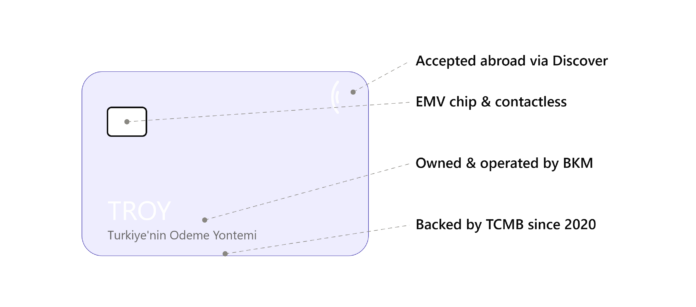
TROY (an acronym for “Türkiye’nin Ödeme Yöntemi,” or “Turkey’s Payment Method”) is Turkey’s domestic card payment scheme, developed, owned, and operated by BKM (Bankalararası Kart Merkezi A.Ş.), the Interbank Card Center. Introduced on 1 April 2016 and rolled out commercially in 2017, TROY was built to give Turkey a homegrown alternative to Visa and Mastercard — one that keeps transaction fees inside the domestic financial system and reduces reliance on foreign card networks.
Who Owns and Operates TROY
TROY belongs to BKM, and BKM’s ownership structure directly shapes who stands behind TROY. BKM’s shareholders include Turkey’s leading public and private banks — among them Halkbank, Ziraat Bankası, Garanti BBVA, Akbank, İş Bankası, Yapı Kredi, VakıfBank, QNB Finansbank, ING, and TEB — with the Central Bank of the Republic of Turkey (TCMB) holding the controlling shareholder position since 2020. This means TROY is not a separate company from BKM; it is BKM’s card scheme, operating under BKM’s institutional and regulatory backing.
Why Turkey Built a National Card Scheme
The core motivation behind TROY is financial independence. When Turkish consumers use Visa or Mastercard, a portion of every transaction fee flows to those international networks. TROY keeps that revenue inside Turkey’s financial system, while also giving the country a payment rail that isn’t exposed to the kind of geopolitical disruption that can affect access to international card networks — a concern that gained visibility after international sanctions cut off Visa and Mastercard access in some markets in recent years, prompting renewed policy attention to domestic payment infrastructure across several countries, including Turkey.
How TROY Works for Cardholders
From a user’s perspective, TROY is designed to feel identical to using a Visa or Mastercard:
- Full EMV chip and contactless support: TROY cards work with the same tap-to-pay and chip-and-PIN infrastructure used globally.
- Universal domestic acceptance: TROY cards function at every ATM and POS terminal in Turkey.
- Available across card types: TROY is issued as a credit card, debit (bank) card, or prepaid card, for both individual and commercial account holders.
- Issued through banks and e-money institutions: Consumers can obtain a TROY card through their bank’s branch network, mobile app, or internet banking — TROY works with dozens of banks and licensed e-money institutions.
Can TROY Be Used Internationally?
Yes, though with some conditions. Since a 2017 partnership with Discover, cards carrying the TROY logo can be used for international transactions through the Discover global network. Separately, some TROY cards are issued as co-badged cards, carrying both the TROY logo and a Visa or Mastercard logo, which extends acceptance to those networks’ international footprints as well. This dual approach — a pure domestic scheme plus selective international interoperability — lets TROY serve as a full replacement for everyday domestic spending while still supporting cross-border use when needed.
TROY’s Market Growth
TROY adoption accelerated significantly starting around 2022, as geopolitical disruptions to international card networks drew broader attention to domestic payment alternatives, and it continued climbing through 2025 amid renewed public interest in Turkish-owned payment infrastructure. By early 2025, TROY’s market share by card count had reached approximately 12%, according to data drawn from BKM’s shareholder base — a meaningful position for a scheme that only launched commercially in 2017, and one that continues to grow as more banks promote TROY issuance to customers.
TROY vs. Visa and Mastercard: The Key Difference
For a cardholder, day-to-day use of a TROY card looks the same as using any other card. The meaningful differences are structural, not experiential:
- Fee flows: Domestic TROY transactions avoid the international network fees charged by Visa and Mastercard, since the entire transaction is processed within Turkey’s own infrastructure.
- Governance: TROY’s rules, pricing, and operating policies are set domestically by BKM under TCMB’s controlling ownership, rather than by a foreign card network.
- International reach: Visa and Mastercard offer broader native international acceptance; TROY relies on its Discover partnership and co-badged cards to extend beyond Turkey’s borders.
Frequently Asked Questions
What does TROY stand for? TROY stands for “Türkiye’nin Ödeme Yöntemi,” meaning “Turkey’s Payment Method.”
Who owns TROY? TROY is owned and operated by BKM (Bankalararası Kart Merkezi A.Ş.), whose shareholders are major Turkish banks, with the Central Bank of the Republic of Turkey (TCMB) holding the controlling stake since 2020.
Can I use a TROY card outside Turkey? Yes, in two ways: through BKM’s 2017 partnership with Discover’s international network, or by using a co-badged TROY card that also carries a Visa or Mastercard logo.
Is a TROY card the same as a debit or credit card? TROY is a card scheme, not a card type. It is available as a credit card, debit (bank) card, or prepaid card, issued through Turkish banks and e-money institutions.
What market share does TROY have in Turkey? As of early 2025, TROY held approximately 12% market share by card count, with adoption continuing to grow.
This article is part of Fintech in Türkiye’s ongoing coverage of Turkey’s payments infrastructure. For more on Turkey’s card and digital payment landscape, explore our Payments section.

