
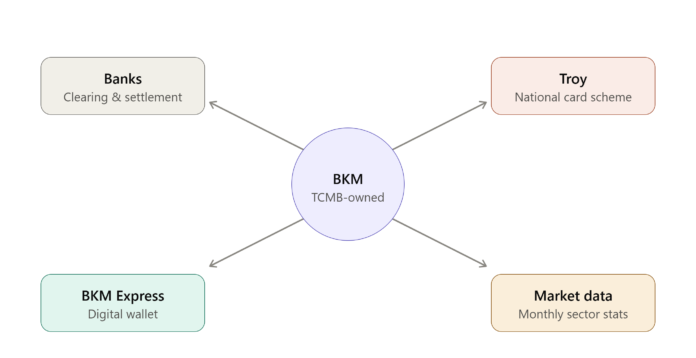
BKM (Bankalararası Kart Merkezi, “Interbank Card Center”) is the non-profit institution that builds, operates, and develops the shared infrastructure behind card and cashless payments in Turkey. Founded in 1990 by 13 public and private Turkish banks, BKM has since 30 April 2020 been majority-owned by the Central Bank of the Republic of Turkey (TCMB), giving it a hybrid identity: an industry-founded utility now under central bank control. It is best known internationally for developing Troy, Turkey’s national card scheme, and for publishing the country’s most closely watched monthly card payment statistics.
What BKM Actually Does
BKM’s mandate is broad: build and run any system, platform, or infrastructure needed to enable cashless payments and transfers in Turkey without requiring cash. In practice, this breaks down into a few core functions:
- Interbank clearing and settlement: BKM operates the Domestic Clearing and Settlement System (Yurtiçi Takas ve Hesaplaşma Sistemi, YTHS), which processes the payments due between banks and other card-issuing institutions resulting from credit card, debit card, and prepaid card transactions.
- Standard-setting: BKM develops shared rules and technical standards that participating banks follow for card transactions, reducing fragmentation across the Turkish card payments ecosystem.
- Sector statistics: BKM compiles and publishes Turkey’s most-cited monthly card payment data — POS transaction volumes, credit and debit card usage statistics, and e-commerce payment figures — available publicly via bkm.com.tr.
- R&D and innovation: BKM runs research and development work aimed at automating processes, reducing operational overhead, and building new payment infrastructure, often in partnership with TCMB on projects framed as “innovative infrastructure and platform services.”
Troy: Turkey’s National Card Scheme
BKM’s best-known product is Troy, Turkey’s homegrown card scheme, developed in 2016 as a domestic alternative to Visa and Mastercard. Troy cards work at every ATM and POS terminal within Turkey, and select Troy cards carry a co-badge with Visa or Mastercard to extend acceptance internationally. A key commercial advantage of Troy is that purely domestic transactions are not subject to the international network fees charged by global card schemes. In 2021, Troy was spun off from BKM into an independent company, though it remains closely tied to BKM’s broader payments infrastructure.
BKM Express: Turkey’s First Digital Wallet
Launched in 2012, BKM Express was Turkey’s first digital wallet, built jointly with banks and major e-commerce companies. It lets users check out online without re-entering card details each time — authenticating instead with just a Turkish ID number or phone number — and supports in-store QR code payments at partner merchants. Because no card number or cash changes hands directly during a transaction, BKM Express was designed with reduced exposure to card-data theft as a core security advantage.
TR Karekod: The National QR Payment Standard
BKM is also responsible for defining Turkey’s standardized QR code payment format, TR Karekod, which allows different banks’ and providers’ QR-based payment apps to interoperate at the same point-of-sale terminal rather than requiring merchants to support a separate QR standard for each provider.
Why BKM’s Central Bank Ownership Matters
TCMB becoming BKM’s controlling shareholder in 2020 shifted BKM’s positioning from a purely industry-owned utility to an institution more directly integrated with Turkey’s monetary and payments authority. This ownership structure is part of why BKM’s infrastructure projects are frequently developed in direct coordination with TCMB — supporting the broader goal of building a competitive, innovative payments ecosystem while managing systemic risk across Turkey’s card payment networks.
BKM’s Data as a Fintech Industry Benchmark
For anyone tracking Turkey’s payments sector — investors, journalists, or fintech founders — BKM’s monthly statistics function as the closest thing Turkey has to an official card payments benchmark. Contactless payment adoption rates, e-commerce transaction growth, and overall card usage trends are all regularly reported through BKM’s published data, making it a recurring primary source for coverage of Turkey’s payments landscape.
Frequently Asked Questions
What does BKM stand for? Bankalararası Kart Merkezi, which translates to Interbank Card Center.
Who owns BKM? BKM was founded in 1990 by 13 Turkish banks. Since 30 April 2020, the Central Bank of the Republic of Turkey (TCMB) has held a controlling ownership stake.
Is Troy the same company as BKM? No, not anymore. Troy was developed by BKM in 2016 but was spun off into an independent company in 2021, though the two remain closely linked in Turkey’s card payments ecosystem.
What is BKM Express used for? BKM Express is Turkey’s first digital wallet, launched in 2012, allowing online checkout without re-entering card details and supporting in-store QR code payments.
Where can I find BKM’s payment statistics? BKM publishes monthly card payment data, including POS transaction volumes and e-commerce statistics, on bkm.com.tr.
This article is part of Fintech in Türkiye’s ongoing coverage of Turkey’s payments infrastructure. For more on Turkey’s card and digital payment landscape, explore our Payments section.

