
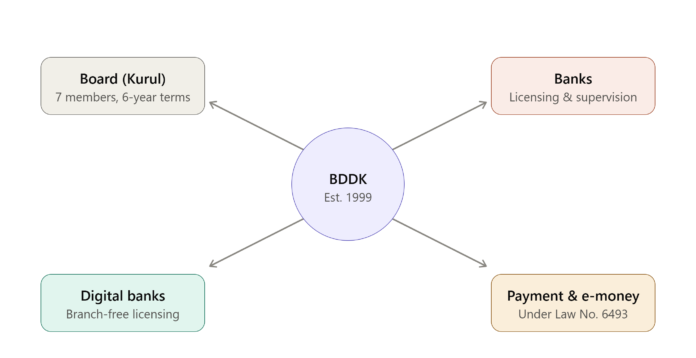
BRSA (Bankacılık Düzenleme ve Denetleme Kurumu, “Banking Regulation and Supervision Agency,” commonly known by its Turkish acronym BDDK) is Turkey’s independent regulator for banks and much of the country’s licensed financial technology sector, including digital-only banks and payment and e-money institutions. Established on 23 June 1999 under Law No. 4389, with its authority expanded and consolidated under Banking Law No. 5411 in 2005, BDDK operates as a public legal entity with financial and administrative autonomy — meaning no other government body, official, or individual is legally permitted to instruct it on its regulatory decisions.
BDDK’s Legal Mandate
Article 93 of Banking Law No. 5411 sets out BDDK’s core objectives: ensuring confidence and stability in financial markets, safeguarding the proper functioning of the credit system, and protecting the rights and interests of depositors and savers. These objectives sit above BDDK’s more visible day-to-day function — licensing and supervising banks — as the underlying rationale for everything the agency does.
Organizational Structure: Board and Presidency
BDDK is composed of two bodies:
- The Banking Regulation and Supervision Board (Kurul): BDDK’s top decision-making body, made up of a Chairman, a Second Chairman, and five additional members — seven in total. Board members are appointed by Presidential decision for six-year terms.
- The Presidency (Başkanlık): The administrative and executive arm that carries out the Board’s decisions and manages BDDK’s day-to-day regulatory and supervisory operations.
BDDK’s leadership saw changes in early 2026: under Presidential Decision No. 2026/44, published in the Official Gazette on 6 February 2026, Yakup Asarkaya was appointed Second Chairman of the Board, while Olcay Turan and Social Security Institution President Raci Kaya were appointed as Board members — a reshuffling of the Board’s composition that continued under Şahap Kavcıoğlu’s chairmanship.
What BDDK Actually Regulates
For anyone tracking Turkey’s fintech sector, BDDK’s remit extends well beyond traditional branch banking:
- Traditional banks: No bank can be established in Turkey — domestic or foreign-owned — without BDDK’s permission. This includes ongoing supervision of capital adequacy, governance, and risk management once a bank is operating.
- Digital-only banks: BDDK has issued specific licensing provisions for branch-free digital banks, distinct from traditional branch-based licensing, reflecting the growth of neobank-style models in Turkey.
- Payment and e-money institutions: Under Law No. 6493, BDDK is the licensing authority for Payment Institutions and Electronic Money Institutions — the license category that covers most non-bank fintech companies handling customer funds or facilitating payments, including many companies in Turkey’s payments and open banking ecosystem.
This means a large share of Turkey’s fintech sector — not just banks in the traditional sense — falls under BDDK’s direct licensing and supervisory authority.
BDDK’s Independence, in Practice
The legal language establishing BDDK’s independence is unusually direct for a Turkish regulatory body: no organ, authority, office, or person may give instructions aimed at influencing the institution’s decisions. In practice, this is reflected in BDDK’s financial structure as well — the agency funds itself from its own budget rather than depending on general government appropriations, and any budget surplus at year-end is transferred to the general treasury rather than the reverse. This financial and legal separation is intended to keep supervisory decisions — including licensing approvals, capital requirements, and enforcement actions — insulated from short-term political pressure.
BDDK vs. Turkey’s Other Fintech Regulators
BDDK is one of four main regulators shaping Turkey’s fintech environment, alongside the Capital Markets Board (SPK), the Financial Crimes Investigation Board (MASAK), and the Central Bank (TCMB) — each with a distinct jurisdiction, as covered in our guide to Turkey’s fintech regulatory framework. The simplest way to distinguish BDDK’s role: if a company is a bank, a digital bank, a payment institution, or an e-money institution, BDDK is very likely the primary licensing authority — separate from SPK’s jurisdiction over crypto and capital markets, or MASAK’s cross-cutting AML oversight.
Frequently Asked Questions
What does BDDK stand for? Bankacılık Düzenleme ve Denetleme Kurumu, translated as the Banking Regulation and Supervision Agency (BRSA).
When was BDDK established? 23 June 1999, under Law No. 4389, with its powers later expanded under Banking Law No. 5411 in 2005.
Does BDDK only regulate traditional banks? No. BDDK also licenses digital-only banks and, under Law No. 6493, is the licensing authority for Payment Institutions and Electronic Money Institutions — covering a large portion of Turkey’s non-bank fintech sector.
How many members are on BDDK’s Board? Seven: a Chairman, a Second Chairman, and five additional members, each appointed by Presidential decision for six-year terms.
Is BDDK independent from the Turkish government? Yes, by law. BDDK is a public legal entity with financial and administrative autonomy, and no government organ or official is legally permitted to instruct it on its regulatory decisions.
This article is part of Fintech in Türkiye’s ongoing coverage of Turkey’s fintech regulatory landscape. For more on how Turkey’s regulators work together, explore our Regtech & Compliance section.

