
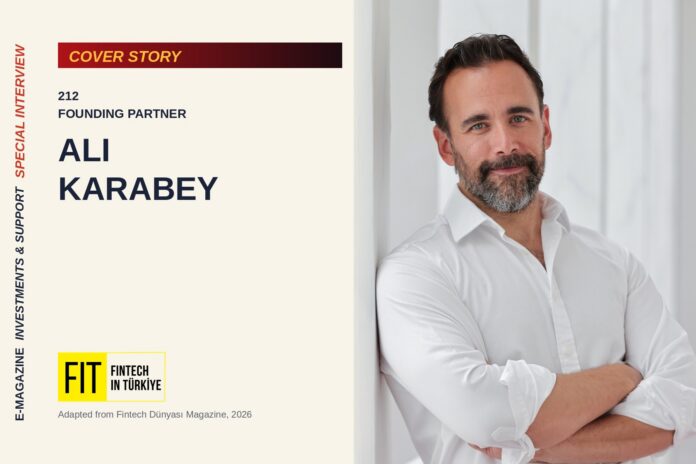
Originally published in: Fintech Dünyası magazine, 2026 June issue (Turkish edition) — adapted and translated for Fintech in Türkiye
Quick Answer
212, founded 15 years ago as Turkey’s first venture capital fund, invests in early-stage, globally scalable B2B startups in AI-driven enterprise software, cybersecurity, marketing technology, and deep tech. Founding Partner Ali Karabey says the firm’s two clearest “game-changer” investments are Insider One and iyzico — each what 212 calls a “dragon investment,” a single exit large enough to return an entire fund on its own. The portfolio also includes RemotePass (Series A at a $70 million valuation in 2025), Trio Mobil ($26.5 million Series B in 2024), SOCRadar ($25.2 million Series B in 2024), Bolt Insight (£7 million Series A in 2025, a 7x valuation increase), and 123FormBuilder, acquired by Silicon Valley-based Kiteworks in 2024 at more than 2.5x return. Karabey argues international investors increasingly judge Turkish founding teams on their global thinking and execution capacity rather than geography alone.
Interview
Fintech Dünyası: How has 212’s investment approach evolved over the years? What’s the core investment thesis defining your fund today?
Ali Karabey: 212 was founded 15 years ago as Turkey’s first venture capital fund, and since then, the essence of our approach has been identifying high-potential early-stage technology companies and creating long-term value with them. Over time, the geographic and sectoral scope of this approach naturally expanded — we now cover a more regional and global investment space that includes companies operating in Turkey as well as Europe and the MENA region, alongside companies founded by entrepreneurs with ties to Turkey who have built companies in developed markets, particularly the US and Western Europe. Today, 212’s core investment thesis centers on catching early-stage, globally scalable B2B companies in AI-driven enterprise software, cybersecurity, marketing technology, and deep tech, and supporting them through their long-term growth journey.
Fintech Dünyası: What signals does 212 look for in early-stage investments? How do you evaluate startups that show promise but aren’t yet generating revenue?
Ali Karabey: At 212, in early-stage investments, we focus more on future signals than on current metrics. Especially in startups that aren’t yet generating revenue, the founding team’s connection to the problem, their learning speed, and their ability to adapt matter enormously to us. That’s because at an early stage, the product, market, and business model can all change over time. The team’s ability to correctly read market feedback and pivot when necessary is a critical signal at this point. Beyond that, globalization potential, technical depth, execution speed, and user behavior are also among the key indicators we evaluate.
Fintech Dünyası: Looking at your portfolio, you clearly focus on startups with strong potential to expand into global markets. What criteria do you use to evaluate a startup’s international scalability?
Ali Karabey: First, what the founder is giving up to pursue this — their opportunity cost — is an important indicator for us. Why a founder chose this particular problem, despite the alternatives available to them, is actually a strong signal of focus and determination. Second, whether the problem the startup addresses is a “local need” or a “global problem” is critical. We care about startups preparing as if for the Olympics in a sense — focused on solving a problem on a global scale, meaning they think globally from day one. Within this framework, we evaluate both the founder’s motivation and the problem’s global relevance together. Beyond that, the scalability of the business model and the team’s ability to adapt to different markets are natural complements to this process. When evaluating scalability, we don’t just look at market potential — we look at several core dimensions together.
Fintech Dünyası: Among all the investments 212 has made, are there examples you’d describe as true “game-changers”?
Ali Karabey: The strongest examples that stand out as game-changers in 212’s portfolio are Insider One and iyzico. These two investments also represent what we call a “dragon investment” — a structure where a single exit is large enough to return the entire fund’s performance on its own. Both companies were, in this sense, the most concrete and powerful validations of 212’s early-stage investment thesis. Beyond that, other startups in our portfolio also stand out with strong scaling stories.
[Editor’s note: iyzico is a Turkish payment infrastructure company acquired by PayU in 2019 — one of Turkish fintech’s best-known exits. Insider is a Turkey-founded global marketing technology (MarTech) company that has raised funding at unicorn valuation.]
RemotePass raised a Series A at a $70 million valuation in 2025, offering solutions in more than 150 countries, while Trio Mobil accelerated its growth with a $26.5 million Series B in 2024. SOCRadar strengthened its international position in cybersecurity with a $25.2 million Series B, also in 2024.
Bolt Insight completed a £7 million Series A round in 2025, achieving a 7x increase in valuation and becoming a solution partner for global brands across 90 markets. Separately, 123FormBuilder, which we added to our portfolio in 2020, was acquired by Silicon Valley-based Kiteworks in 2024, generating a return of more than 2.5x on that investment.
Beyond these, we also have early-stage portfolio companies that have captured strong growth momentum and carry high potential. The key factors that set these startups apart are a focus on global problems rather than being confined to a single market, business models built for scale from day one, and founding teams with an international growth vision.
Fintech Dünyası: In which areas does Turkey need to develop further for sustainable startup growth?
Ali Karabey: Turkey’s startup ecosystem has matured significantly in recent years, both in terms of investment volume and startup quality. In particular, the growing number of founders with prior startup experience, strengthening connections with Turkish entrepreneurs living abroad, and startups thinking globally from day one are all valuable developments for the ecosystem.
Today, many teams coming out of Turkey are focused not just on solving a local problem, but on building products that can resonate in global markets. The growing number of highly technically skilled teams, particularly in AI, fintech, cybersecurity, and B2B SaaS, is also driving a notable transformation. That said, there are still areas that need to develop for sustainable growth. More successful exit stories are critically important for the capital and know-how that flow back into the ecosystem.
Stronger access to late-stage investment capital is also one of the key needs. Turkey’s dynamic and challenging environment gives founders high adaptability. Supporting that with stronger global networks and access to capital will be one of the key factors shaping the ecosystem’s next growth phase.
Fintech Dünyası: As a fund in regular contact with global investors, how would you assess international investor perception of startups coming out of Turkey?
Ali Karabey: As a fund in regular contact with global investors, we see that the international perception of startups coming out of Turkey has changed noticeably in recent years. Turkey is no longer viewed merely as a local market — it’s increasingly seen as an ecosystem that produces founders who develop resilience under difficult conditions, execute quickly, and can ship products at a global scale.
Beyond that, the success stories built by Turkish founders living and building companies abroad have also been an important factor strengthening this perception. The growing number of Turkish entrepreneurs founding companies abroad or scaling in global markets is prompting international investors to take a closer look at Turkey-origin teams. In particular, investors are increasingly focused not just on geography, but on a team’s capacity for global thinking and execution.
Frequently Asked Questions
What is 212’s core investment focus? 212 invests in early-stage, globally scalable B2B startups in AI-driven enterprise software, cybersecurity, marketing technology, and deep tech, with a thesis built around startups solving global rather than purely local problems.
What does 212 mean by a “dragon investment”? A “dragon investment” is 212’s term for a single exit large enough to return the performance of an entire fund on its own. Founding Partner Ali Karabey names Insider One and iyzico as the fund’s clearest examples.
Which 212 portfolio companies have raised notable funding rounds recently? Recent rounds include RemotePass (Series A at a $70 million valuation, 2025), Trio Mobil ($26.5 million Series B, 2024), SOCRadar ($25.2 million Series B, 2024), and Bolt Insight (£7 million Series A with a 7x valuation increase, 2025).
What was 212’s return on its 123FormBuilder investment? 123FormBuilder, which 212 invested in in 2020, was acquired by Silicon Valley-based Kiteworks in 2024, generating a return of more than 2.5x for 212.
How does 212 evaluate early-stage startups that aren’t yet generating revenue? 212 focuses on forward-looking signals rather than current metrics — particularly the founding team’s connection to the problem, learning speed, adaptability, technical depth, and ability to think and scale globally from day one.
This article is based on an interview originally conducted by Fintech Dünyası in Turkish. It has been translated and adapted for an international audience by Fintech in Türkiye.

