
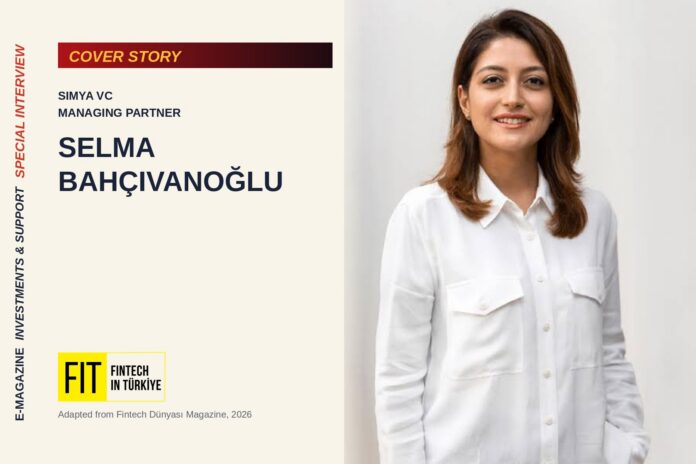
Originally published in: Fintech Dünyası magazine, 2026 June issue (Turkish edition) — adapted and translated for Fintech in Türkiye
Quick Answer
Simya VC Managing Partner Selma Bahçıvanoğlu says the fund’s core differentiator isn’t just investing capital, but actively accelerating portfolio startups’ expansion into global markets — largely through a partnership with San Francisco-based Alchemist Accelerator, whose roughly 30,000-person mentor network gives Simya’s startups faster, more direct access to international markets. Founded in 2022 under the 212 umbrella and co-managed with Çağdaş Yıldız, Simya VC has invested in 16 early-stage, globally scalable B2B technology startups to date, including Agrotics, B2Metric, Hardal, Juphy, and Robolaunch. The fund plans to close its third fund this year, with a mid-term goal of launching a new fund roughly every two years.
Interview
Fintech Dünyası: Can you share Simya VC’s founding story and investment vision? What’s the core approach that sets your fund apart from other venture capital structures?
Selma Bahçıvanoğlu: Simya VC is an international accelerator fund founded in 2022 under the 212 umbrella, focused on investing in early-stage startups. Our focus is on B2B technology startups that carry globalization potential or solve a global problem. I co-manage the fund together with Çağdaş Yıldız. The core approach that sets us apart is that we’re not just a structure that invests — we offer a model that actively accelerates startups’ expansion into global markets.
[Editor’s note: 212 is one of Turkey’s most established venture capital funds, founded in 2011. Simya VC operates as a related early-stage accelerator fund under the same umbrella.]
To that end, we partner with Alchemist Accelerator, one of the world’s leading acceleration programs. Thanks to Alchemist’s strong mentor network and programs spanning multiple geographies, our startups gain the opportunity to gain experience in international markets and work directly with global leaders.
Our core motivation at Simya VC isn’t just to grow the startups in our portfolio — it’s to be a venture capital fund that supports them with concrete business plans and strategic networks that turn them into global players.
Fintech Dünyası: How would you describe your investment strategy? Which sectors, business models, and growth stages are priorities for you?
Selma Bahçıvanoğlu: We define Simya VC’s investment strategy as focusing on early-stage B2B technology startups with the potential to scale globally. Our priority is early-stage startups solving a clearly defined problem, with a validated product, ready to enter their growth path. SaaS, AI, and data-driven business models stand out in particular within this scope. Our core approach is catching strong teams early and helping them become scalable in international markets.
Fintech Dünyası: When evaluating a startup, how do you balance team, technology, and market potential? What are the core characteristics of an “investable” startup for you?
Selma Bahçıvanoğlu: At Simya VC, we generally look first at the team, then at the reality of the problem, and then at market size. That’s because at the pre-seed and seed stages, the technology can evolve over time, the product can change, and even the target market can shift toward a more accurate segment.
That said, the founding team’s learning speed, resilience, knowledge of the problem, and ability to gather the right people around them are far more decisive. For us, a strong team doesn’t just mean a good résumé. We’re talking about teams that can clearly articulate why they’re solving this particular problem, that genuinely listen to customers, that rapidly evolve the product based on feedback, and that have the appetite to build a company at a global scale.
Beyond that, we evaluate whether the technology genuinely makes a difference — whether it offers a defensible advantage or is just a surface-level innovation. Finally, market size is critically important; we look for opportunities that are large enough, undergoing transformation, and meaningful at a global scale.
Fintech Dünyası: Could you tell us about the startups in Simya VC’s portfolio? What are the common traits and success factors behind these investments?
Selma Bahçıvanoğlu: Since our founding, we’ve invested in a total of 16 startups. Our portfolio includes Agrotics, B2Metric, Hardal, Juphy, Eluvium, Evercopy, Keyrails, Kheanda, PhiTech, Reprai, Robolaunch, Rudiq, Surveill, Syntonym, Voltfox, and Werover.
What these startups have in common is that they’re B2B-focused, technology-producing, and built on globally scalable business models. The large majority are driving transformation across different sectors through solutions in data, AI, and automation. Their success factors center on strong early-stage teams, a clearly defined problem, and fast product-market fit.
Fintech Dünyası: What kind of support do you provide founders in the post-investment process?
Selma Bahçıvanoğlu: At Simya VC, we position ourselves not just as an investor providing capital, but as a structure that actively supports startups’ growth journey. We believe that in the early stage, the most critical contribution is often not financing itself, but connecting with the right customer, entering the market, and building the initial sales structure. Within this scope, we support our portfolio companies in areas like market entry strategy, clarifying the target customer segment, connections to enterprise customers and pilot projects, access to international networks, and preparation for the next investment round.
Our partnership with Alchemist Accelerator is one of the strongest levers in this process. Thanks to San Francisco-based Alchemist’s mentor network of roughly 30,000 people and its region-focused program structure, our startups get the opportunity to expand into global markets faster and more accurately, and to work directly with experienced leaders. We also build a structure where founders share experience, learn from one another, and become part of a strong ecosystem — offering not just investment, but a sustainable growth network.
Fintech Dünyası: How do you assess the development of Turkey’s startup ecosystem in recent years?
Selma Bahçıvanoğlu: Turkey’s startup ecosystem has clearly matured in recent years, both in terms of startup quality and investor diversity. In particular, the rise of more professional fund structures in early-stage investment and institutional capital entering the ecosystem more actively created an important transformation. At the same time, on the startup side, we’re seeing business models that target the global market from the very beginning become far more common, not just local ones.
Fintech Dünyası: Looking at a global scale, what do you see as the most critical factors in startups’ growth and scaling journey? How do you view Turkish startups’ competitiveness on this front?
Selma Bahçıvanoğlu: The most critical factors in startups’ global growth and scaling are a strong team structure, a clearly defined problem being solved, and the ability to enter the right market quickly. We find Turkish startups quite strong on this front — they particularly stand out in technical competence and product development speed.
When supported with the right global connections and market access opportunities, we clearly observe this potential turning into a much higher level of competitiveness.
Fintech Dünyası: Will there be changes in Simya VC’s investment focus going forward? Are new funds, new sectors, or different investment models on your agenda?
Selma Bahçıvanoğlu: At Simya VC, we plan to launch our third fund this year. We’re strengthening our partnerships with international accelerators, particularly Alchemist, to accelerate our portfolio companies’ expansion into global markets. In the medium term, our goal is to build a sustainable fund structure by launching a new fund roughly every two years, developing more flexible and increasingly differentiated investment strategies.
Frequently Asked Questions
When was Simya VC founded, and who manages it? Simya VC was founded in 2022 under the 212 umbrella as an international accelerator fund, co-managed by Selma Bahçıvanoğlu and Çağdaş Yıldız.
How many startups has Simya VC invested in, and what do they have in common? Simya VC has invested in 16 startups since its founding, including Agrotics, B2Metric, Hardal, Juphy, and Robolaunch. They share a B2B focus, technology-driven products, and globally scalable business models, largely centered on data, AI, and automation.
What role does Alchemist Accelerator play in Simya VC’s model? Alchemist Accelerator, a San Francisco-based accelerator with a mentor network of roughly 30,000 people, is a core partner that helps Simya VC’s portfolio startups access international markets faster and work directly with experienced global leaders.
What does Simya VC prioritize when evaluating early-stage startups? Simya VC evaluates the founding team first, followed by the reality of the problem being solved and market size — prioritizing teams with fast learning speed, resilience, deep problem knowledge, and a defensible technological advantage.
What are Simya VC’s plans for 2026 and beyond? Simya VC plans to close its third fund this year and aims to launch a new fund roughly every two years over the medium term, building an increasingly flexible and differentiated investment strategy.
This article is based on an interview originally conducted by Fintech Dünyası in Turkish. It has been translated and adapted for an international audience by Fintech in Türkiye.

