
Foreign nationals and foreign companies can establish and fully own a fintech company in Turkey, under the same rules that apply to domestic investors. This “national treatment” principle is set out in Turkey’s Foreign Direct Investment Law (Law No. 4875), which permits 100% foreign ownership in most sectors, does not require a residence permit to found a company, and requires only a notification — not a separate approval — to the Ministry of Industry and Technology once the company is registered. What foreign founders do need to plan for carefully is the two-layer structure that applies to any regulated fintech: setting up the underlying company, and separately obtaining the sector-specific license required to operate.
Two Separate Processes: Company Formation vs. Fintech Licensing
It’s worth separating these clearly upfront, because founders often conflate them:
- Company formation — registering a legal entity in Turkey under the Turkish Commercial Code (TTK). This is a standard corporate process available to any business, fintech or otherwise.
- Sector-specific licensing — if the company will conduct regulated activity (banking, payments, e-money, crypto asset services, investment services), it must additionally obtain a license from the relevant regulator (BDDK, SPK) before beginning that activity, as covered in our guide to Turkey’s fintech regulatory framework.
A company can complete step one in a matter of weeks; step two, for a regulated financial license, typically takes considerably longer and involves capital adequacy, governance, and technical infrastructure review.
Choosing a Company Structure: Ltd. Şti. vs. A.Ş.
Turkey’s Commercial Code allows several company forms, but two dominate in practice:
- Limited Şirket (Ltd. Şti.): The most commonly used structure for small and mid-sized businesses. Requires at least one shareholder (up to a maximum of 50), a minimum capital of 10,000 TL, and limits shareholder liability to their committed capital contribution.
- Anonim Şirket (A.Ş.): The preferred structure for larger-scale investment, easier share transfers, and future fundraising or public listing. A.Ş. requires a higher minimum capital than Ltd. Şti. and additional governance formalities.
For regulated fintech activity, the choice usually isn’t optional. BDDK and SPK licensing regimes for banks, payment institutions, e-money institutions, and crypto asset service providers generally require the licensed entity to be structured as an Anonim Şirket, given its clearer governance and capital structure. Founders planning to eventually apply for a financial license should generally incorporate as an A.Ş. from the outset, even if it means a larger initial capital commitment than a Ltd. Şti. would require.
Step-by-Step: Registering the Company
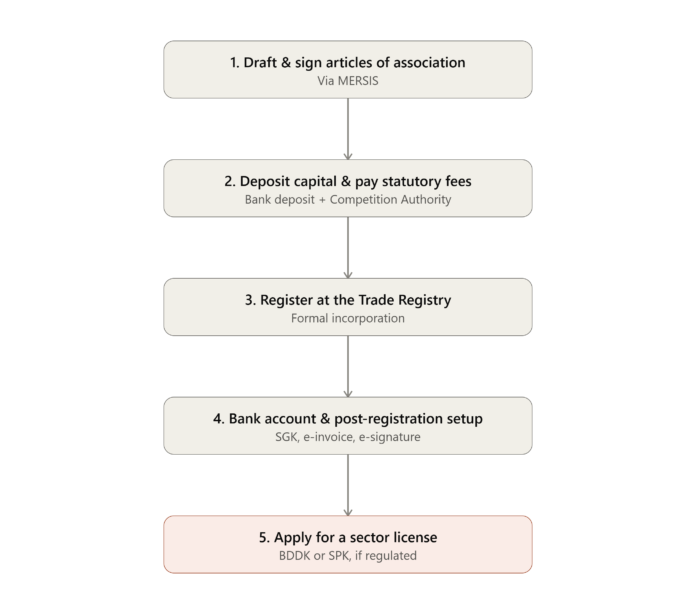
- Draft and sign the articles of association, submitted through MERSİS (Turkey’s centralized electronic company registration system). All founders — or their authorized representatives — must appear before the relevant Trade Registry Directorate or a notary to complete signature approval.
- Deposit capital and pay statutory fees: For an A.Ş., at least one-quarter of the committed cash capital must be deposited into a bank account opened in the company’s name before registration. Separately, 0.04% of the company’s capital must be paid into the Competition Authority’s (Rekabet Kurumu) bank account.
- Register at the Trade Registry Directorate, which formally incorporates the company and certifies its commercial books.
- Complete post-registration setup: open the company’s operating bank account (releasing any blocked capital for an A.Ş.), register as an employer with the Social Security Institution (SGK) if hiring staff, and obtain the mali mühür (financial seal) or e-signature required for Turkey’s mandatory e-invoice and e-ledger systems.
- Apply for a sector-specific license, if the company will conduct regulated fintech activity — this step runs on its own separate timeline with BDDK or SPK, entirely apart from the corporate registration above.
Documentation Requirements for Foreign Shareholders
When the founding shareholder is a foreign company rather than an individual, Turkish authorities require several documents to be apostilled, translated into Turkish by a certified translator, and notarized:
- The foreign parent company’s trade registry certificate from its home jurisdiction
- A founders’ declaration signed by the foreign company’s authorized representatives
- A formal resolution from the foreign company’s authorized governing body approving the establishment of the Turkish subsidiary
- The signed articles of association for the new Turkish entity
Engaging a Turkish legal counsel or licensed accountant (mali müşavir) experienced with foreign-invested company formation is standard practice, since even minor documentation errors can extend an already multi-step process.
Residence Permits, Work Permits, and Company Formation Are Separate Matters
A common misconception among foreign founders is that establishing a company requires Turkish residency. It does not — a foreign individual or company can register a Turkish company without ever holding a residence permit. However, if a founder intends to live in Turkey to run the business day-to-day, a residence permit is required, and a separate work permit is required to be legally employed by or draw a salary from the Turkish company. These are immigration matters entirely distinct from the corporate registration process, and should be planned on their own timeline.
The Foreign Investment Notification Obligation
Under Law No. 4875, foreign-invested companies are required to periodically report statistical information about their capital and activities to the Ministry of Industry and Technology’s General Directorate of Incentive Implementation and Foreign Investment. This is a notification requirement, not a permit or approval process — it does not gate the company’s ability to operate, but compliance is mandatory and ongoing.
Frequently Asked Questions
Can a foreign national own 100% of a fintech company in Turkey? Yes, in most sectors. Turkey’s Foreign Direct Investment Law grants foreign investors the same rights as domestic investors, including full ownership, in sectors that aren’t explicitly restricted.
Do I need a residence permit to set up a company in Turkey? No. Company formation does not require Turkish residency. A residence permit is only needed if you plan to live in Turkey, and a separate work permit is needed to be employed by the company you establish.
What’s the minimum capital to start a company in Turkey? A Limited Şirket requires a minimum of 10,000 TL. An Anonim Şirket requires a higher minimum capital, along with additional governance requirements — and is generally the required structure for companies pursuing a BDDK or SPK financial license.
Is setting up the company the same as getting a fintech license? No, these are two separate processes. Company registration under the Turkish Commercial Code can be completed relatively quickly. A sector-specific license from BDDK or SPK for banking, payments, e-money, or crypto asset services is a separate, typically much longer process with its own capital, governance, and technical review requirements.
Does a foreign-owned company have any special ongoing reporting obligations in Turkey? Yes. Under Law No. 4875, foreign-invested companies must periodically report capital and activity statistics to the Ministry of Industry and Technology. This is a notification obligation, not an approval gate.
This article is provided for informational purposes and does not constitute legal advice; foreign founders should consult qualified Turkish legal and accounting counsel before starting the incorporation process. For more on Turkey’s regulatory environment, see our guide to Turkey’s fintech regulatory framework.

