BtcTurk Hisse has expanded its “Use Instantly” feature—previously introduced for Borsa İstanbul—to U.S. stock exchanges, enabling users to access their funds immediately upon selling shares on NASDAQ and the New York Stock Exchange (NYSE).
Under traditional brokerage models, investors could only access proceeds from foreign share sales after the standard settlement process was fully completed. With this new feature, the sales amount is credited to the investment account the moment the transaction executes, allowing users to redeploy the funds into other assets or use them as cash. The feature is provided for U.S. markets at no extra cost.
Through a single application and account, BtcTurk Hisse users can seamlessly trade on Borsa İstanbul, NASDAQ, and NYSE. The platform’s fractional share feature also allows users to invest in more than 2,000 U.S. stocks with any desired amount, independently of full share prices. Additional platform offerings include instant access to ETFs and TEFAS funds, IPO participation, share credit facilities, 24/7 Turkish Lira deposits and withdrawals, and live customer support.
Commenting on the expansion, BtcTurk Hisse CEO Fatih Otluoğlu stated that the company remains a leader in transforming retail investment processes: “We are breaking new ground once again by extending our ‘Use Instantly’ feature—which we first introduced to Turkey for Borsa İstanbul—to now cover U.S. investment instruments as well.”
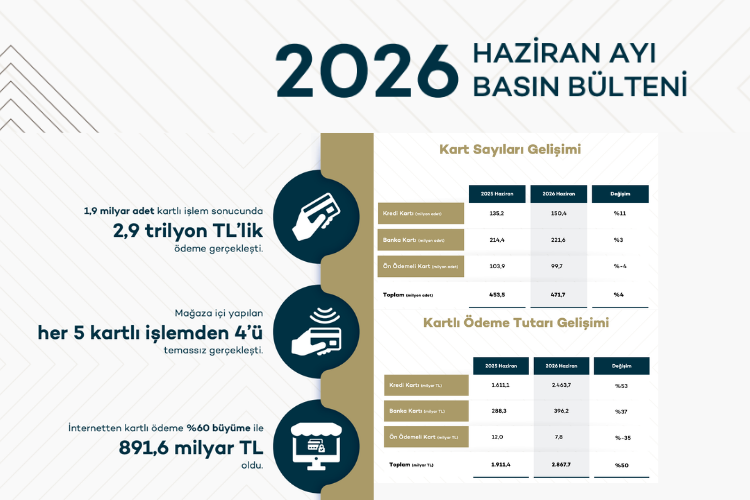
Bankalararası Kart Merkezi (The Interbank Card Center of Turkey-BKM) has announced its card payment statistics for June 2026. During the month, a total of 2.9 trillion TL worth of card transactions, amounting to 1.9 billion operations, were recorded.
Key Highlights from the June 2026 Data:
Card Counts: Total card numbers rose by 4% year-on-year to reach 471.7 million. This figure consists of 150.4 million credit cards (up 11%), 221.6 million debit cards (up 3%), and 99.7 million prepaid cards (down 4%) compared to June 2025.
Payment Volumes: Combined card spending grew by 50% year-on-year to 2,867.7 billion TL. Credit cards accounted for 2,463.7 billion TL of this total, while debit cards contributed 396.2 billion TL and prepaid cards made up 7.8 billion TL.
Transaction Volumes: Total payment transactions increased by 14% to reach 1.9 billion (1,943.2 million) operations.
E-Commerce Growth: Online card spending experienced a 60% annual growth, climbing to 891.6 billion TL and representing 31% of total card payments. Online transaction counts grew by 17% to 260.7 million.
Contactless Adoption: Contactless payment transactions increased by 13% to 1,300.7 million units, with spending values jumping 45% to 939.3 billion TL. Data shows that 4 out of every 5 in-store card payments (81%) were completed via contactless methods.
CaixaBank in Spain has successfully completed a real-world payment initiated by an AI agent acting on behalf of a human cardholder. The transaction used the Intelligent Commerce framework and Agentic Ready programme developed by project partner Visa. The bank said the pilot used real card data on standard merchant systems secured by existing tokenisation, ID verification, and fraud monitoring systems from Visa, together proving “the viability of payments initiated by AI agents within the current infrastructure”.
Visa launched its Agentic Ready programme in Europe in March this year to help financial institutions test and validate agent-initiated transactions. Further afield, Visa has already tested agentic commerce with the likes of DBS and Santander.
Meanwhile, competing network Mastercard claims to have completed the first agentic payment transaction in France last week, working in partnership with Crédit Agricole and Worldline.
CaixaBank, which is headquartered in Valencia and serves around 12 million cardholders, is currently investing €5 billion through its 2025 to 2027 Cosmos technology strategy, which focuses on integrating generative AI to automate internal workflows and transaction processing.
Late last year, the banking group also established its Artificial Intelligence Office for project compliance and governance, and has begun rolling out conversational AI agents across digital channels to handle digital customer onboarding for approximately 40 retail products.
Former Monzo CEO Tom Blomfield has joined AI research firm Anthropic as part of co-founder Tom Brown’s compute team, effective immediately. To take up the opportunity, Blomfield has taken a leave of absence from his general partner position at technology start-up accelerator Y Combinator, where he has worked since 2021.
Blomfield is best known for co-founding UK challenger bank Monzo in 2015 alongside Jonas Huckestein, Jason Bates, Paul Rippon, and Gary Dolman. He served as the bank’s first CEO until June 2020, when he transitioned to president as TS Anil took over as chief executive.
Blomfield departed Monzo in 2021, noting that the demands of scaling the company during the global pandemic had affected his mental health. His earlier ventures include co-creating Boso.com, and UK fintech GoCardless, which was acquired by Dutch paytech Mollie last year for $1.1 billion.
Announcing his move to Anthropic, the developer of generative AI assistant Claude, Blomfield writes on X, “Powerful AI has the potential to improve the life of every human on earth and, as we enter the early stages of recursive self-improvement, availability of compute becomes one of the most important issues to solve.”
Brazil-based digital bank Nubank, which serves over 135 million customers worldwide, has promoted Livia Chanes to CEO for Latin America, effective immediately.
In Chanes’ expanded role, country managers Armando Herrera in Mexico and Marcela Torres in Colombia will report directly to her. In addition, Chanes will also continue in her position as CEO of Nubank Brazil, a role she has held since the beginning of 2024.
Having initially joined the challenger as VP of products in 2020 from Itaú Unibanco, Chanes became country manager for the Brazilian division in H2 2022. Under her leadership, Nubank’s Brazilian arm added more than 50 million new customers, reaching 115 million users or over 60% of the country’s adult population. The operation also introduced several new credit products and launched NuCel, its mobile phone service, which now serves more than one million customers.
Commenting on her promotion, Chanes notes: “My commitment is to ensure that Mexico and Colombia benefit from everything we’ve built in Brazil.” She adds: “We’re already the largest private financial institution by number of customers in Brazil, but we know we still have enormous opportunities to grow across our different segments.”
Samsung Electronics has strengthened its financial services footprint in the United States with the introduction of its first credit card, the Samsung Galaxy Card, issued by Barclays and operating on the Visa network. The card enables users to handle the entire journey—from application to account management—directly through Samsung Wallet.
The Samsung Galaxy Card allows users to apply, track expenses, and redeem rewards seamlessly via Samsung Wallet. According to Reuters, the card offers 5% cash back on Samsung purchases, additional rewards for transactions made through Samsung Pay, and various perks across other spending categories.
The launch positions Samsung in more direct competition with Apple Pay within the U.S. digital payments market. Technology firms and financial institutions are tightening the integration between digital wallets and financial products to anchor smartphones at the core of payment and wealth management. Doug Villone, Head of Cards and Partnerships at Barclays US Consumer Bank, noted that the digital card is designed to deliver a streamlined payment experience for consumers managing financial transactions on mobile devices.
Expansion Signals from Samsung
Sih Lee, Head and Vice President of Samsung Electronics North America Fintech Business, highlighted that at least one Samsung device is present in 70% of U.S. households, with approximately 30% of households owning three or more Samsung products. Describing the partnership with Barclays as strategic and long-term, Lee signaled that Samsung may explore expanding its collaboration into additional financial products and services beyond credit cards in the future, provided they offer meaningful value to customers.
Barclays noted that its cooperation with Samsung could evolve into new domains over time. As part of its broader strategy to scale its U.S. credit card portfolio, the bank acquired General Motors’ credit card business in 2024, allowing customers to earn reward points across various GM models, including Buick, Cadillac, and electric vehicles. Villone stated that Barclays is actively seeking new partnership opportunities, emphasizing that alliances can expand into different sectors whenever they provide clear value to consumers.
Revolut has officially rolled out Revolut Bank Australia after securing an unrestricted Authorised Deposit-taking Institution (ADI) licence from the Australian Prudential Regulation Authority (APRA).
Representing the fintech giant’s first local banking licence in the Asia-Pacific (APAC) region, the milestone brings the company significantly closer to its long-term strategic objective of establishing the world’s first truly global bank.
Commenting on the achievement, Revolut Founder and CEO Nik Storonsky highlighted the rigorous nature of the milestone:
“Obtaining this licence in a market as highly regulated and competitive as Australia is a testament to the strength of our business model and the relentless dedication of our teams.”
Storonsky noted that securing the unrestricted ADI licence has been a primary strategic priority for the organization, expressing his gratitude and congratulations to everyone involved in delivering the landmark launch across the Australian market.
Wise reported a 25% increase in first-quarter net income on Friday, fueled by continued strong growth in cross-border transaction volumes and customer assets. The fintech company also reaffirmed its full-year outlook.
For the quarter ending June 30, net income rose to $714 million from $573.3 million. Transaction revenue climbed 27% to reach $540.9 million, while cross-border transaction volume advanced 26% year-over-year (24% on a constant currency basis) to $69.3 billion. Active customer numbers expanded by 21% to hit 11.9 million.
Customer assets saw a 31% surge, reaching $41.2 billion. Meanwhile, the cross-border take rate edged down 2 basis points to 0.50%—a deliberate move by the company to pass on savings from operational leverage to customers through lower pricing. The proportion of instant transfers improved significantly, rising to 77% from 70% a year earlier.
Wise Co-founder and CEO Kristo Kaarmann commented: “This quarter, nearly 12 million people and businesses used Wise, transferring $69.3 billion globally. These customers paid an average fee of just 50 basis points—the lowest level in Wise’s history. With 77% of transactions arriving instantly on the other side of the world, more customers are trusting Wise for their everyday financial needs, driving our customer assets up 31% to $41.2 billion.”
Looking forward, Wise reaffirmed its financial targets for fiscal year 2027 (FY27), anticipating constant-currency net income growth to land in the middle of its 15%–20% medium-term guidance range. This forecast assumes no substantial shifts in central bank rates or interest paid to customers. Additionally, the company aims for a pre-tax profit margin at the upper end of the 20%–25% range.
Expensify, Inc. has announced that the Expensify Card is now available in the United Kingdom and select European markets, with the card officially launching in Spain, Ireland, Poland, and the Netherlands.
Powered by Visa Commercial Card, the offering provides finance teams with real-time transaction visibility, automated receipt matching, and built-in spending controls. Transactions appear instantly on the Expensify platform, eliminating month-end reconciliation delays.
Key features include automated categorization via Concierge AI and spending limits designed to prevent unauthorized purchases. Virtual cards are available for single-use or time-restricted transactions. Businesses can settle balances on a daily or monthly basis and link any GBP, EUR, or US business bank account, with no minimum requirements, security deposits, personal guarantees, or credit checks needed.
The product integrates seamlessly with major accounting platforms such as QuickBooks, Xero, NetSuite, and Sage Intacct. To meet UK and EU regulatory requirements, the card includes VAT tracking and advanced statement reporting. Users can utilize the card globally with zero foreign transaction fees.
Meanwhile, Expensify’s financial performance continues to show positive momentum. Shares have climbed 32% over the past six months and recorded a 21% increase year-to-date. The company maintains a robust balance sheet with a current ratio of 3.49 and a cash position that exceeds its debt, providing ample financial flexibility for its international expansion initiatives. According to InvestingPro analysis, the stock is trading below its Fair Value, positioning it among undervalued opportunities within the fintech sector.
Expensify Founder and CEO David Barrett commented: “The Expensify Card works quietly in the background to keep business spending controlled, compliant, and ready for accounting. It serves as a pre-accounting assistant that eliminates the tedious tasks of reconciling transactions, collecting receipts, and reimbursing employees.”
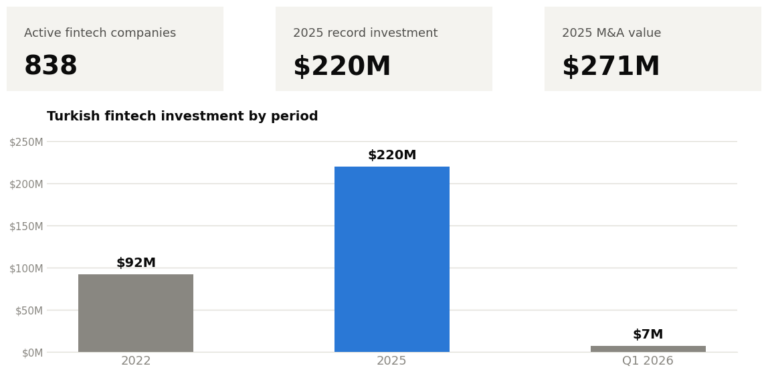
Turkey’s fintech ecosystem reached 1,076 total companies by May 2026, with 838 currently active, up from 729 companies in 2021 — a market that attracted a record $220 million in early-stage investment in 2025, even as global venture funding remained selective. This article compiles the key statistics defining the size, growth, and investment trends of Turkey’s fintech sector, drawn from Turkey’s Fintech Outlook Report, KPMG Turkey’s startup investment tracking, and MKK’s crypto market data.
Company Count and Market Structure
Metric
Figure
As of
Total fintech companies
1,076
May 2026
Active companies
838
May 2026
Inactive/dormant companies
238
May 2026
Total companies in 2021
729
2021
Largest vertical (Payments)
~305 active companies
May 2026
The growth from 729 to 1,076 companies represents roughly 48% expansion in the total company count since 2021, according to Turkey’s Fintech Outlook Report, jointly produced by the Presidency Investment Office and Startups.watch.
Investment Trends: A Multi-Year View
Turkey’s fintech investment figures vary somewhat by source and methodology, but the overall trajectory is consistent: steady growth punctuated by a standout year in 2025.
Year
Fintech investment
Source / notes
2022
~$92 million
Cited by Turkey’s Ministry of Treasury and Finance as a record at the time
2025
$220 million across 42 rounds
Reported as an all-time record for early-stage angel/VC investment into Turkish fintechs
Q1 2026
$7 million across 2 deals
Turkey’s second-most-funded startup vertical in the quarter, behind gaming
For context, the global fintech market was valued at approximately $159 billion in 2022, with projections at the time estimating roughly threefold growth over the following five years — a backdrop against which Turkey’s fintech sector has been expanding at a broadly comparable pace.
A note on Q1 2026: The $7 million figure reflects a slower quarter by deal count, not necessarily a slowdown in overall sector activity — strategic M&A activity remained active in the same period (see below), and fintech still ranked as the second-most-funded vertical in Turkey’s broader startup ecosystem for the quarter, according to the KPMG Turkey M&A and 212 “Turkey Startup Investments” report.
Mergers and Acquisitions: Consolidation in Motion
Turkish fintechs have been active acquirers, not just acquisition targets, reflecting a maturing market where scale increasingly matters:
Year
M&A activity
2024
9 acquisitions worth $447 million
2025
6 acquisitions worth $271 million
Q1 2026
Multiple notable strategic acquisitions (see below)
Notable Q1 2026 transactions include:
QNB eSolutions acquired 100% of Ödüyo, an online collections and open banking platform, for $5 million (January 2026)
Neo Yatırım acquired a 90.5% stake in Ortak, a fintech venture, for $2 million
Turkey’s Crypto Market by the Numbers
Since Turkey’s Crypto Asset Central Registry System (KVMKS) began publishing aggregate data in July 2026, the crypto segment of the fintech market has become measurable in a way it wasn’t before:
Approximately 5.6 million investors have transacted on Turkish crypto platforms at some point
Approximately 3.2 million investors hold active crypto balances
Around 1,500 distinct crypto assets are held across those balances
53 licensed Crypto Asset Service Providers (7 custody institutions, 46 trading platforms) are integrated with KVMKS as of mid-2026
International Recognition
Turkish fintechs are increasingly visible on global rankings, a signal of competitiveness beyond the domestic market:
Sipay (Payments) and Sigortam.net (Insurtech) both appeared in CNBC and Statista’s “World’s Top Fintech Companies 2026” ranking, drawn from an initial pool of 3,500 companies worldwide narrowed to 500.
Axiology, a Turkish-founded capital markets infrastructure provider serving European markets, raised funding in February 2026 from a consortium that included Turkish investors — an example of Turkish fintech talent building for international, rather than purely domestic, markets.
What These Numbers Suggest
Three patterns stand out across this data. First, the company count growth (729 to 1,076) shows sustained ecosystem expansion rather than a short-lived boom. Second, the gap between record 2025 investment ($220 million) and a quieter Q1 2026 ($7 million) is a reminder that fintech funding, like venture funding generally, moves in uneven cycles rather than smooth year-over-year lines — a single quarter shouldn’t be read as a trend reversal on its own. Third, the rise in strategic M&A activity (9 deals in 2024, 6 in 2025, and multiple notable deals already in Q1 2026) suggests consolidation is now a defining feature of the market, not just new company formation.
Frequently Asked Questions
How many fintech companies are there in Turkey? 1,076 total as of May 2026, with 838 currently active, according to Turkey’s Fintech Outlook Report.
How much funding did Turkish fintechs raise in 2025? A reported record of $220 million across 42 rounds, the highest annual figure on record for the sector.
What is the largest fintech vertical in Turkey? Payments, with approximately 305 active companies as of May 2026.
Is Turkish fintech investment slowing down in 2026? Q1 2026 saw a quieter quarter by deal count ($7 million across 2 deals), but fintech still ranked as the second-most-funded startup vertical in Turkey for the period, and strategic M&A activity remained active.
How big is Turkey’s crypto asset market? As of mid-2026, approximately 3.2 million investors hold active crypto balances across roughly 1,500 different assets, according to data published by MKK’s KVMKS registry.
This article is part of Fintech in Türkiye’s ongoing coverage of Turkey’s fintech ecosystem. For the latest company and funding news, explore our Startups & Funding section.