Home Blog Page 30

Revolut hits $115 billion valuation as it becomes the first global fintech 

Revolut confirmed on Tuesday that a secondary share sale has valued the digital bank at $115 billion, a 53 percent jump from the $75 billion it reached in November 2025. The sale priced shares at $2,017 each, according to Bloomberg. The valuation makes Revolut the most valuable private fintech company in the world by a wide margin, surpassing Stripe and eclipsing most publicly traded European banks.

A day earlier, Revolut announced it had received an authorised deposit-taking institution licence from Australia’s Prudential Regulation Authority, becoming the first global fintech to obtain a full, unrestricted ADI. The licence allows Revolut to offer savings accounts, term deposits, and lending products to the more than one million Australians already using its platform. The company said it would invest AUD$400 million in Australia over the next five years.

The secondary sale was led by returning investors Coatue, Greenoaks, Dragoneer, and Fidelity, with participation from Andreessen Horowitz, Franklin Templeton, T Rowe Price, and Nvidia’s venture arm NVentures. The round allowed existing shareholders and employees to sell portions of their stakes at the new price. CEO Nik Storonsky, who holds approximately one-third of the company’s equity, could see his personal stake valued at more than $36 billion at the new valuation.

The valuation reflects a company whose financial trajectory has accelerated sharply. Revolut reported revenue of nearly four and a half billion pounds in 2025, up 46 percent year over year, and pre-tax profit of close to two billion pounds, up 57 percent. For 2026, management has projected nine billion dollars in revenue and three and a half billion dollars in net profit.

The twin milestones in valuation and regulation landed in the same week because they are connected. Revolut received its full UK banking licence from the Prudential Regulation Authority in March 2026 after years of delays, and has since applied for a US national bank charter with the Office of the Comptroller of the Currency. It now holds banking licences in the UK, the European Economic Area through Lithuania, Mexico, and Australia, with a US application pending.

Storonsky has said the company’s IPO is approximately two years away and will be in the US, where higher liquidity and technology-friendly multiples make a listing more attractive. People familiar with Revolut’s thinking have told Bloomberg the IPO target is at least $150 billion, a figure that would make the company more valuable than Barclays, Deutsche Bank, and Societe Generale combined. The push into business banking, which Storonsky has designated his top company priority, is designed in part to justify that kind of valuation by showing institutional investors that Revolut is a full-spectrum bank, not just a consumer payments app.

The Australian licence is particularly significant because APRA’s requirements are among the most demanding of any financial regulator. Revolut said its existing Australian customers would transition from the current e-money structure to Revolut Bank Australia, gaining access to deposit protection under the Financial Claims Scheme. The company now serves more than 70 million customers across over 100 countries and has more than 500,000 retail customers in Mexico, where it launched full banking operations in January 2026.

The $115 billion valuation positions Revolut closer to its eventual IPO price than to its startup origins. Whether the company can sustain that trajectory depends on how quickly it converts banking licences into revenue-generating products across its newer markets, and whether the business banking push delivers the higher-margin growth that public market investors will demand.

Turkish Fintech Companies: How Many There Are and Who’s Building Turkey’s Fintech Ecosystem

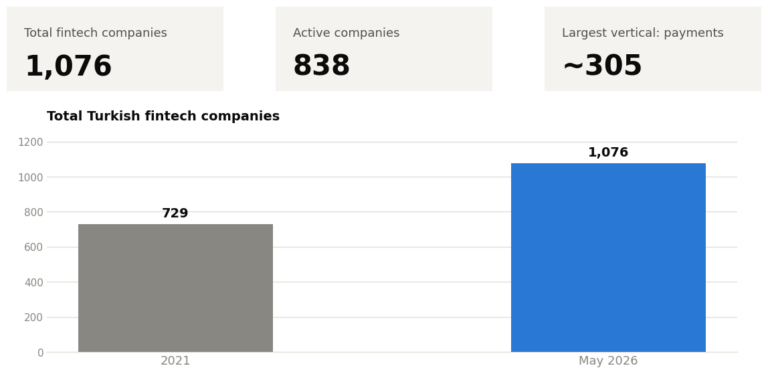
As of June 2026, Turkey’s fintech ecosystem includes 1,076 companies in total, of which 838 are currently active, according to Turkey’s Fintech Outlook Report (Türkiye Fintech Görünüm Raporu). That figure has grown substantially from 729 companies in 2021, reflecting one of the fastest-expanding fintech markets among emerging economies. Payments remains the largest single vertical, accounting for roughly 305 of the active companies, ahead of digital banking, blockchain and crypto, insurtech, regtech, wealthtech, and B2B/corporate finance.

This article breaks down what those numbers mean, then profiles notable companies across Turkey’s major fintech categories — useful both as a market overview for investors and as a reference for anyone mapping the Turkish fintech landscape.

How Many Fintech Companies Are There in Turkey? (June, 2026)

MetricFigure
Total fintech companies (May 2026)1,076
Active companies838
Inactive / dormant companies238
Total companies in 2021729
Largest verticalPayments (~305 companies)

The gap between total and active companies (238 inactive) is a normal feature of a maturing startup ecosystem — it reflects both natural attrition among early-stage ventures and consolidation as larger players acquire smaller ones. Turkish fintechs completed 9 acquisitions worth $447 million in 2024 and 6 acquisitions worth $271 million in 2025, indicating that consolidation is an active dynamic in the market rather than a sign of stagnation.

On the investment side, 2025 was a record year for early-stage funding into Turkish fintechs, with angel and venture capital investment reaching $220 million across 42 funding rounds — the highest annual total on record for the sector.

Notable Turkish Fintech Companies by Category

The list below is not exhaustive — with 838 active companies, no single article could be — but highlights well-known, internationally recognized, or category-defining companies across Turkey’s major fintech verticals.

Payments

  • Sipay — a Turkish payment infrastructure provider that has repeatedly been recognized in CNBC and Statista’s “World’s Top Fintech Companies” global ranking, most recently in the 2026 edition’s Payments category.
  • iyzico — one of Turkey’s earliest and best-known payment gateway companies, founded in 2013 and acquired by global payments company PayU in 2019.
  • Param — a payment and card infrastructure company recognized on Forbes Turkey’s Girişim 50 list of standout startups.
  • Craftgate — a payment infrastructure and orchestration platform, also recognized on Forbes Turkey’s Girişim 50 list.

Digital Banking & Digital Wallets

  • Papara — Turkey’s most internationally recognized fintech brand, with more than 20 million users. Papara has been named among the world’s top 35 neobanks by CNBC and Statista.
  • Enpara — QNB’s digital-only banking brand, one of Turkey’s longest-running branchless banking services, known for commission-free investment products.
  • Pokus — a digital wallet and card service built on Türk Telekom’s infrastructure, launched in 2021.
  • ON Dijital — Burgan Bank’s digital banking platform, which has launched AI-powered customer feedback and analytics tools as part of its digital transformation push.

Blockchain & Crypto

  • BtcTurk — one of Turkey’s largest and longest-operating cryptocurrency exchanges.
  • Paribu — a major Turkish crypto exchange serving approximately 6 million users since its 2017 launch.
  • Inveo Kripto — the blockchain-focused arm of Inveo Investment Holding Group, active in Web3 infrastructure partnerships.

Insurtech

  • Sigortam.net — an online insurance comparison and purchasing platform, which became the first Turkish company to enter CNBC and Statista’s Insurtech category in the “World’s Top Fintech Companies” global ranking, in the 2026 edition.

Regtech & Compliance

  • Sanction Scanner — an AML and compliance technology company with an API-based infrastructure serving over 800 companies across more than 70 countries, including banks, fintechs, and crypto platforms. The company won G2’s Best Governance, Risk & Compliance award in 2026.
  • TeamSec — a capital markets and structured finance fintech operating a “Securitization as a Service” model, also recognized on Forbes Turkey’s Girişim 50 list.

B2B Finance & Lending

  • Tarfin — an agri-fintech platform providing financing to farmers and agricultural businesses.
  • Figopara — a supply chain finance platform that lets companies discount e-invoices before their due date.
  • BulutTahsilat — an all-in-one financial services and collections platform built on open banking architecture.

Accounting & Financial SaaS

  • Paraşüt — a widely used accounting, invoicing, and financial management SaaS platform for Turkish SMEs and freelancers.

Why This Matters for Investors and Global Observers

Two things stand out about Turkey’s fintech company count in a global context. First, the growth trajectory — from 729 companies in 2021 to 1,076 in May 2026 — represents sustained expansion even as global fintech funding has been more selective since the highs of 2021. Second, the sector’s international recognition is increasing in parallel: two Turkish companies (Sipay and Sigortam.net) appeared in CNBC and Statista’s 2026 “World’s Top Fintech Companies” ranking, a list drawn from an initial pool of 3,500 companies worldwide narrowed to 500 across eight categories — a meaningful signal that Turkish fintechs are competing on criteria that go beyond domestic market size.

Frequently Asked Questions

How many fintech companies are there in Turkey? As of May 2026, Turkey has 1,076 total fintech companies, of which 838 are active, according to Turkey’s Fintech Outlook Report.

What is the largest fintech vertical in Turkey? Payments is the largest vertical, with approximately 305 active companies as of May 2026.

Which Turkish fintech companies are recognized internationally? Sipay (Payments) and Sigortam.net (Insurtech) both appeared in CNBC and Statista’s “World’s Top Fintech Companies 2026” global ranking. Papara has separately been named among the world’s top 35 neobanks by the same publications.

How much funding did Turkish fintechs raise in 2025? Early-stage angel and venture capital investment into Turkish fintechs reached $220 million across 42 rounds in 2025, a record for the sector.

Is the number of Turkish fintech companies still growing? Yes. The total count grew from 729 companies in 2021 to 1,076 by May 2026, alongside active consolidation activity, including $447 million in acquisitions in 2024 and $271 million in 2025.


This article is part of Fintech in Türkiye’s ongoing coverage of Turkey’s fintech ecosystem. For the latest company news and funding announcements, explore our Startups & Funding section.

400,000 bank customers join Akbanklı Kadınlar Platformu in one year

Akbank is growing its Akbanklı Kadınlar Platformu (Akbank Women’s Platform) with new benefits and partnerships. Bringing together financial solutions with health, personal development, and everyday lifestyle privileges, the platform offers a holistic response to women’s needs. Over the course of one year, 400,000 bank customers joined the platform, participation in campaigns rose by an average of 24 percent each month, and one in every five platform members made use of interest-free cash support.

Akbanklı Kadınlar Platformu, launched by Akbank to help women build financial strength and improve their quality of daily life, has completed its first year. Having seen strong interest that pushed its membership to more than four times its level in the first months after launch, the platform takes a holistic approach to addressing all of women’s needs, from education to health, and from personal development to lifestyle privileges.

In the platform’s first year, financial support was among the solutions women turned to most, easing their daily lives. Akbank has so far offered 140,000 women customers its installment overdraft solution, Taksitli Artı Para, at a favorable interest rate, with one in every five women who joined the platform using this privilege to meet their financial needs. Through this channel, the bank generated more than 1.5 billion TL in additional cost-free resources for women’s short-term cash needs.

Commenting on the platform’s first year, Akbank Deputy General Manager for Retail Banking Emre Çift said: “We see women’s financial empowerment and their active participation in financial decision-making as one of the fundamental elements of economic sustainability. That’s why we designed Akbanklı Kadınlar Platformu as an ecosystem offering holistic solutions to women’s needs across different areas of life. The scale we’ve reached in the first year clearly demonstrates the need women have for platforms that understand them and develop solutions tailored to their expectations. Going forward, through strong partnerships and privileges, we aim to add value to the lives of even more women.”

Supporting financial life

Akbanklı Kadınlar Platformu offers solutions that help women manage their income, build savings, and reach their financial goals more easily. Under the platform, women who direct their regular income to Akbank can earn up to 12,000 TL in chip-money through the Kazanan Akbanklı Kadınlar (Winning Akbank Women) program, while they can meet their short-term cash needs at no additional cost through Taksitli Artı Para, an installment overdraft solution offering favorable interest rates of up to 30,000 TL. Women looking to invest in their future are offered private pension contributions, while mothers who send their children regular allowances also gain additional benefits from these transactions. In addition, women can earn up to 2,000 TL in extra chip-money, on top of all other campaigns, by referring their friends and family to become Akbank customers.

Offering privileges from health to education, and from daily life to personal development

Beyond financial needs, Akbanklı Kadınlar Platformu also aims to support women in the areas of health, wellbeing, personal development, and social life. Platform members can benefit from preventive health services such as free mammograms, breast ultrasounds, and smear tests, as well as access to dietitian and psychologist support. Akbank Women members also receive cashback benefits on spending through online education platforms and can take advantage of discount opportunities in cosmetics, health, and beauty. Free Masterpiece art workshops, surprise gift boxes offered in partnership with Denebunu, personal assistant services, and other privileges that make daily life easier are also among the benefits the platform provides. Through partnerships developed with organizations that support women’s labor and sustainability, such as Nahıl.com and Beije, along with civil society organizations and social enterprises, the platform further contributes to strengthening women’s presence in economic and social life.

By bringing together financial and non-financial benefits designed specifically for women under a single roof, Akbanklı Kadınlar Platformu stands as Turkey’s most comprehensive women-focused banking program.

Investment funds move to Şeker Mobil with “Şekerbank Fon 360”

With the “Fon 360” menu it has integrated into Şeker Mobil, Şekerbank now offers buy-and-sell transactions and comprehensive information for all investment funds traded on Turkey’s Electronic Fund Trading Platform (TEFAS) on a single screen, providing users with a fast and easy investment experience. Through “Şekerbank Fon 360,” users are able to monitor their portfolio performance instantly and manage it more effectively.

Continuing to develop digital solutions for its customers’ needs, Şekerbank now offers access to investment funds through a single platform via the “Fon 360” menu integrated into Şeker Mobil. By making buy-and-sell transactions and comprehensive information for all investment funds traded on TEFAS accessible from a single screen, “Şekerbank Fon 360” makes the investment process faster, easier, and more user-friendly.

With “Şekerbank Fon 360,” retail customers can access a wide range of information from a single point — from price movements and value-date details of their preferred funds to fund type, theme, and daily profit-loss data. Users can also track the performance of the funds in their portfolios in real time and manage their investments more effectively.

Mustafa Aşık: “We will continue offering our customers a faster investment experience by developing our digital channels.”

Şekerbank Deputy General Manager for Retail and Digital Banking Mustafa Aşık commented on the matter, saying: “With Şekerbank Fon 360, we’re making it easy for our customers to access investment funds through a single platform. Thanks to this structure, which simplifies the investment process, our users can access the information they need faster and carry out fund buy-and-sell transactions with ease. Through this user-friendly innovation we’ve brought to life on Şeker Mobil, we’re enabling investors to manage their transactions more quickly and with greater control. Going forward, we will continue offering our customers a faster investment experience by developing our digital channels.”

Ant International raises $1.2bn Series A with Ant Group and Alibaba Group

Ant International has announced the close of its Series A funding round, raising approximately $1.2 billion in equity financing with a focus on expanding its financial services suite for small businesses.

Ant Group and Alibaba Group are the only existing investors known to have participated in the round. Ant International says it also received support from “other renowned international investment institutions”.

Funds will be used to “accelerate Ant International’s global expansion and innovation in merchant payment, account management and other inclusive financial services for SMEs and enterprises”, the announcement states.

Carved out from Ant Group in 2024, Ant International provides cross-border digital payment and growth marketing solutions to business through brands Alipay+, Antom, WorldFirst, and Bettr.

Headed by CEO Peng Yang, the independent company has amassed a network of 150 million merchants since the split, reaching more two billion user accounts across Asia, Europe, the Middle East, and Latin America primarily.

Klarna gets physical with Lululemon, launching in-store in the UK & Germany

Klarna, the global digital bank and flexible payments provider, is expanding in-store with lululemon in the UK and Germany, giving customers the same flexibility on the shop floor that they already enjoy online and marking a significant step in Klarna’s push into physical retail.

Paying in-store with Klarna at lululemon is simple. At checkout, shoppers simply scan a QR code with their phone and pay using the Klarna app. There’s no need to apply for anything in the queue or carry a separate card. In a few seconds, customers can spread the cost into interest-free payments or delay payment for a month — so they can buy what they came for, on their terms.

Klarna and lululemon have offered shoppers flexible payments online for more than five years. Bringing Klarna to the till is a natural next step in that relationship and reflects Klarna’s strategic move beyond the browser, with in-person spending estimated at about $28 trillion a year globally, nearly four times the amount spent online.

“Shopping shouldn’t be less flexible the moment you walk into a store,” said Klarna Chief Commercial Officer David Sykes. “We’ve spent years making online checkout smarter, and now we’re bringing that same freedom to the till. Whether you’re picking up your kit in person or ordering it online, you should be able to pay the way that best works for you.”

Klarna is available now in-store at lululemon in the UK and Germany, enabled through lululemon’s integration with payments platform Adyen.

Türkiye İş Bankası named best digital bank in Central and Eastern Europe by Euromoney

Euromoney, one of the most prestigious international publications in finance, held its Awards for Excellence ceremony in London, where winners were announced.

In the event, which saw more than 700 applications from over one hundred countries independently evaluated under categories such as strategy, financial performance, innovation, and customer experience, İş Bankası was named both the best digital bank in Central and Eastern Europe and the best digital bank in Turkey. The bank’s digital transformation strategy, its investments in artificial intelligence and data-driven technologies, and its innovative applications aimed at delivering a seamless customer experience were key factors behind its wins in the digital banking category.

Commenting on the awards, İş Bankası Deputy General Manager Sabri Gökmenler said, “These awards are a gratifying, concrete indication that the work we’ve been carrying out under our vision of becoming the ‘Bank of the Future’ is paying off.” Noting that the bank aims to put technology at the center of its efforts to make customers’ lives easier and expand their access to financial services, Gökmenler said the bank continues to develop İşCep in line with its super-app strategy.

Pointing out that İşCep, which reached 16 million customers in 2026, now offers a total of 857 functions, Gökmenler continued:

“To make İşCep easier to use, we redesigned the app experience with the help of AI-powered analytics and created dedicated panels for areas such as transactions, cards, investments, and personal finance management. This structure allows our customers to easily access all the services they need from a single place. Around 97 percent of our banking transactions now take place through digital channels. With our ‘Your İşCep’ approach, we offer a personalized digital experience, and with our AI-powered assistant Maxi, we’re there for our customers whenever they need us. Having surpassed 108 million interactions to date, Maxi makes banking faster, easier, and more accessible while also making a significant contribution to operational efficiency. Under our Hayatım [My Life] domain, we offer lifestyle-focused services such as Arabam [My Car], Evim [My Home], Ailem [My Family], and Seyahatim [My Travel] through mini-app partnerships. In addition, within İşCep we provide end-to-end solutions ranging from personal finance management to savings and investment transactions and loyalty programs.”

Touching on future plans, Sabri Gökmenler added, “We will continue investing in artificial intelligence, data analytics, and next-generation technologies, and keep offering our customers a smarter, easier, and more personalized banking experience.”

ON Dijital develops AI-powered platform to analyze customer feedback

Burgan Bank’s digital banking platform, ON Dijital, has launched “Feedback Radar 360,” a platform that analyzes customer feedback in real time with the support of artificial intelligence.

Processing more than 15,000 customer comments per month and developed entirely with in-house resources, the platform helps translate customer expectations into action more quickly through faster analysis.

Burgan Bank General Manager Murat Dinç noted that Feedback Radar 360 is not merely a platform for analyzing customer feedback, but a strategic tool that feeds into decision-making processes aimed at continuously improving the customer experience.

Explaining that the starting point behind Feedback Radar 360 was to understand what customers truly feel rather than reviewing their feedback one by one, and to identify the action opportunities arising from that feedback more quickly, Dinç said:

“Through the collaboration of our Customer Experience and Information Technology teams, we turned this need into a platform we developed entirely with our own resources. Today, we analyze customer feedback in real time and can identify areas for improvement much faster through insights based on sentiment, topic, and tone. Going forward, we aim to increase the touchpoints where we listen to our customers and further develop our AI-powered analysis capabilities to turn feedback into more detailed insights.”

Tether invests in Pact Labs to expand USAT’s use in payroll and payment systems

Tether has led a $7 million Series A funding round for Pact Labs, a financial infrastructure company, aiming to broaden the use of its US-regulation-compliant digital dollar, USAT, in payroll payments and everyday financial transactions.

Tether, the largest company in the digital asset ecosystem, announced that it led Pact Labs’ $7 million Series A round to expand the use cases of USAT, its US-regulation-compliant digital dollar. The round, which also included participation from Blockchange Ventures and Lasagna, will support Pact Labs’ efforts to develop its infrastructure for payroll payments, earned wage access, credit services, and everyday payments.

With this investment, Tether aims to integrate USAT directly into the financial systems used by American workers and businesses. Through the infrastructure developed by Pact Labs, companies will be able to integrate digital wallets into their systems, process payroll payments in real time, and eliminate the delays caused by traditional payment systems.

Digital transformation targeted in payroll payments

Although the US payroll system generates more than $11 trillion in transaction volume annually, much of its underlying infrastructure relies on systems developed decades ago. As a result, employees can be forced to wait days or even weeks to access wages they have already earned. The delays between pay periods can lead to additional account fees, short-term borrowing, and other financial costs.

According to Tether, USAT—backed by Pact Labs’ infrastructure—will allow employees to access their wages faster, while enabling employers and financial platforms to operate around the clock without interruption. In this way, digital dollar technology is expected to become a natural part of users’ everyday financial experience.

“One of the most important use cases for the digital dollar is payroll”

Commenting on the matter, Tether CEO Paolo Ardoino said: “Our transaction data has shown the same reality for years — a significant portion of the demand for dollar-based payment infrastructure comes from payroll. In emerging markets, workers have long turned to USDT to overcome delays in wage payments caused by inadequate local payment systems. Now we’re bringing that same approach to the US market with USAT. Because even when a system technically works, if it operates on batch-processing logic, it’s low-income workers who bear the cost the most.”

Tether USAT CEO Bo Hines added: “USAT was built for real people, and payroll is one of the clearest examples of that. Thanks to Pact Labs, we now have the infrastructure to deliver a US-regulation-compliant digital dollar to millions of American workers — faster, at lower cost, and without the need for intermediaries.”

Everyday use cases for the digital dollar are expanding

The investment forms part of Tether’s broader strategy of backing infrastructure that supports the wider adoption of the digital dollar in financial processes heavily used in daily life. As payroll remains one of the largest transaction segments within the US financial system, stablecoin technology is expected to transform the way people receive, store, and use their money.

What is TROY? Turkey’s National Payment Card System Explained

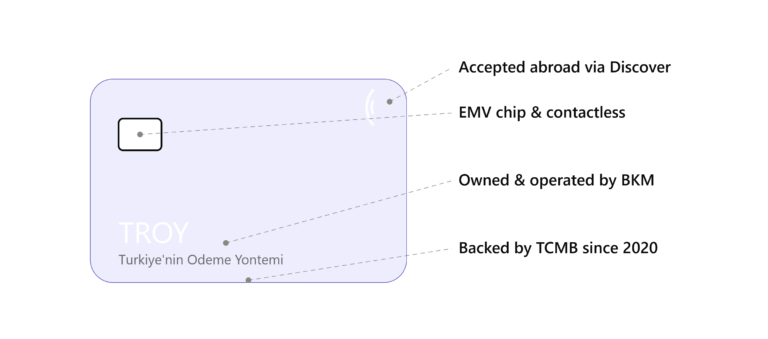
TROY (an acronym for “Türkiye’nin Ödeme Yöntemi,” or “Turkey’s Payment Method”) is Turkey’s domestic card payment scheme, developed, owned, and operated by BKM (Bankalararası Kart Merkezi A.Ş.), the Interbank Card Center. Introduced on 1 April 2016 and rolled out commercially in 2017, TROY was built to give Turkey a homegrown alternative to Visa and Mastercard — one that keeps transaction fees inside the domestic financial system and reduces reliance on foreign card networks.

Who Owns and Operates TROY

TROY belongs to BKM, and BKM’s ownership structure directly shapes who stands behind TROY. BKM’s shareholders include Turkey’s leading public and private banks — among them Halkbank, Ziraat Bankası, Garanti BBVA, Akbank, İş Bankası, Yapı Kredi, VakıfBank, QNB Finansbank, ING, and TEB — with the Central Bank of the Republic of Turkey (TCMB) holding the controlling shareholder position since 2020. This means TROY is not a separate company from BKM; it is BKM’s card scheme, operating under BKM’s institutional and regulatory backing.

Why Turkey Built a National Card Scheme

The core motivation behind TROY is financial independence. When Turkish consumers use Visa or Mastercard, a portion of every transaction fee flows to those international networks. TROY keeps that revenue inside Turkey’s financial system, while also giving the country a payment rail that isn’t exposed to the kind of geopolitical disruption that can affect access to international card networks — a concern that gained visibility after international sanctions cut off Visa and Mastercard access in some markets in recent years, prompting renewed policy attention to domestic payment infrastructure across several countries, including Turkey.

How TROY Works for Cardholders

From a user’s perspective, TROY is designed to feel identical to using a Visa or Mastercard:

  • Full EMV chip and contactless support: TROY cards work with the same tap-to-pay and chip-and-PIN infrastructure used globally.
  • Universal domestic acceptance: TROY cards function at every ATM and POS terminal in Turkey.
  • Available across card types: TROY is issued as a credit card, debit (bank) card, or prepaid card, for both individual and commercial account holders.
  • Issued through banks and e-money institutions: Consumers can obtain a TROY card through their bank’s branch network, mobile app, or internet banking — TROY works with dozens of banks and licensed e-money institutions.

Can TROY Be Used Internationally?

Yes, though with some conditions. Since a 2017 partnership with Discover, cards carrying the TROY logo can be used for international transactions through the Discover global network. Separately, some TROY cards are issued as co-badged cards, carrying both the TROY logo and a Visa or Mastercard logo, which extends acceptance to those networks’ international footprints as well. This dual approach — a pure domestic scheme plus selective international interoperability — lets TROY serve as a full replacement for everyday domestic spending while still supporting cross-border use when needed.

TROY’s Market Growth

TROY adoption accelerated significantly starting around 2022, as geopolitical disruptions to international card networks drew broader attention to domestic payment alternatives, and it continued climbing through 2025 amid renewed public interest in Turkish-owned payment infrastructure. By early 2025, TROY’s market share by card count had reached approximately 12%, according to data drawn from BKM’s shareholder base — a meaningful position for a scheme that only launched commercially in 2017, and one that continues to grow as more banks promote TROY issuance to customers.

TROY vs. Visa and Mastercard: The Key Difference

For a cardholder, day-to-day use of a TROY card looks the same as using any other card. The meaningful differences are structural, not experiential:

  • Fee flows: Domestic TROY transactions avoid the international network fees charged by Visa and Mastercard, since the entire transaction is processed within Turkey’s own infrastructure.
  • Governance: TROY’s rules, pricing, and operating policies are set domestically by BKM under TCMB’s controlling ownership, rather than by a foreign card network.
  • International reach: Visa and Mastercard offer broader native international acceptance; TROY relies on its Discover partnership and co-badged cards to extend beyond Turkey’s borders.

Frequently Asked Questions

What does TROY stand for? TROY stands for “Türkiye’nin Ödeme Yöntemi,” meaning “Turkey’s Payment Method.”

Who owns TROY? TROY is owned and operated by BKM (Bankalararası Kart Merkezi A.Ş.), whose shareholders are major Turkish banks, with the Central Bank of the Republic of Turkey (TCMB) holding the controlling stake since 2020.

Can I use a TROY card outside Turkey? Yes, in two ways: through BKM’s 2017 partnership with Discover’s international network, or by using a co-badged TROY card that also carries a Visa or Mastercard logo.

Is a TROY card the same as a debit or credit card? TROY is a card scheme, not a card type. It is available as a credit card, debit (bank) card, or prepaid card, issued through Turkish banks and e-money institutions.

What market share does TROY have in Turkey? As of early 2025, TROY held approximately 12% market share by card count, with adoption continuing to grow.


This article is part of Fintech in Türkiye’s ongoing coverage of Turkey’s payments infrastructure. For more on Turkey’s card and digital payment landscape, explore our Payments section.