Home Blog Page 29

Two Turkish names on CNBC’s “World’s Top Fintech Companies 2026” list: Sipay and Sigortam.net

The “World’s Top Fintech Companies 2026” list, jointly produced by CNBC and global research firm Statista, was released to the public on July 22. Now in its fourth edition, the study examined 3,500 financial technology companies operating worldwide, with a total of 500 companies making the list across eight categories: Payments, Neobanking, Alternative Financing, Wealth Technology, Digital Assets, Enterprise Fintech, Insurtech, and Regtech. During the evaluation process, companies’ general financial performance was analyzed alongside criteria specific to their area of operation; scoring was based on publicly available data as well as information companies self-reported during the application process. Two companies representing Türkiye stood out on the list: Sipay, in the Payments category, and Sigortam.net, in the Insurtech category.

Sipay maintains its consistency in payments

Turkish fintech venture Sipay secured a place among global giants in the Payments category of the “World’s Top Fintech Companies” list. The company had also made the list in previous years, demonstrating a consistent, recurring presence. Sipay’s success this year shows that a Turkey-based payment infrastructure provider has stood out among thousands of competitors worldwide and maintained its international recognition.

Sigortam.net makes the list for the first time

The second Turkish representative, Sigortam.net, made it onto this prestigious list for the first time, in the Insurtech category. The company’s strong showing in this category signals that Türkiye’s digitalization push in insurance technology is also gaining international recognition.

With these two companies, Türkiye continues to make its mark on the global fintech stage. The full list can be accessed on CNBC’s website.

İş Bankası claims digital crown at Euromoney summit

Türkiye İş Bankası won the title of Central and Eastern Europe’s best digital bank for the second consecutive year at Euromoney’s Awards for Excellence. The bank also received the “Turkey’s Best Digital Bank” award.

Awards for Excellence and the evaluation process

Euromoney’s Awards for Excellence, held by one of the most prestigious international publications in finance, were presented at a ceremony in London. More than 700 applications from over one hundred countries were independently evaluated under categories including strategy, financial performance, innovation, and customer experience.

İş Bankası was named the best digital bank in both Central and Eastern Europe and Turkey. Its digital transformation strategy, its investments in AI and data-driven technologies, and its innovative applications aimed at delivering a flawless customer experience were key factors behind the wins.

İş Bankası’s digital transformation strategy

İş Bankası Deputy General Manager Sabri Gökmenler said: “These awards are a gratifying, concrete indication that the work we’ve been carrying out under our vision of becoming the ‘Bank of the Future’ is paying off.” He noted that the bank aims to put technology at the center of its efforts to make customers’ lives easier and expand access to financial services.

Gökmenler said the bank continues to develop İşCep in line with its super-app strategy. Having reached 16 million customers in 2026, İşCep now offers a total of 857 functions.

Innovations in the İşCep app

Gökmenler said the app experience was redesigned with the help of AI-powered analytics to make İşCep easier to use, with dedicated panels created for areas such as transactions, cards, investments, and personal finance management.

This structure allows customers to easily access all the services they need from a single place. Around 97 percent of the bank’s transactions now take place through digital channels.

AI-powered services

A personalized digital experience is offered through the “Your İşCep” approach. With the AI-powered assistant Maxi, customers can get support whenever they need it.

Having reached more than 108 million interactions to date, Maxi makes banking faster, easier, and more accessible while also making a significant contribution to operational efficiency.

Lifestyle-focused services and end-to-end solutions

Lifestyle-focused services under the Hayatım domain, such as Arabam, Evim, Ailem, and Seyahatim, are offered through mini-app partnerships. İşCep also provides end-to-end solutions ranging from personal finance management to savings and investment transactions and loyalty programs.

Plans for the future

Sabri Gökmenler said: “We will continue investing in artificial intelligence, data analytics, and next-generation technologies, and keep offering our customers a smarter, easier, and more personalized banking experience.”

Kraken says simpler options can unlock crypto’s next derivatives market

Kraken has launched cash-settled bitcoin  and ether (ETH) options, positioning the product as the first step in a broader push to grow, rather than simply compete for, the crypto options market.

The exchange on Thursday introduced European-style, USD-settled options on bitcoin and ether through Kraken Pro, initially via request-for-quote (RFQ). The contracts are available to eligible international clients outside of Europe, North America, and Australia, with a European rollout planned for a later date.

Alexia Theodorou, Kraken’s director of derivatives, said the exchange sees crypto options as an underpenetrated segment compared with traditional financial markets, where options account for a much larger share of derivatives trading.
“Crypto options activity is still a fraction of what it is in traditional markets, but the gap is closing as professional and institutional capital continues to move into digital assets,” Theodorou told CoinDesk in an interview.
Kraken’s launch comes as competition in crypto derivatives intensifies, with exchanges and traditional financial firms racing to expand their offerings as institutional demand grows.

Derivatives account for the vast majority of crypto trading volumes, but options remain a relatively small corner of the market, dominated by a handful of established venues including Deribit, CME Group and Binance. New entrants are increasingly betting that broader adoption of options will follow the institutionalization of digital assets.
The move is the latest step in Kraken’s transformation from a crypto exchange into a broader financial platform offering trading, payments and other digital asset services.

UniCredit Poland taps Flagright for financial crime prevention tech

UniCredit has tapped financial crime compliance regtech Flagright to enhance its financial crime prevention workflows in Poland.

The regtech will support the bank’s Polish entity with customer screening, risk scoring, transaction monitoring, and case management, providing the unit with an end-to-end overview of financial crime operations.

The entire governance process is set to benefit from “quality assurance, audit logs, notifications, and advanced workflows”, with the integration of “configurable controls built for modern banking operations”, according to a statement from the vendor. UniCredit’s Polish entity, which operates in one of the bank’s oldest-standing markets, joins a growing list of financial institutions partnering Flagright for its financial crime prevention solutions. In February, Lithuania’s SME Bank announced a collaboration with the regtech for its transaction monitoring services.

German regtech Hawk appoints Eli Chamoun as president and CRO

German regtech Hawk has named Eli Chamoun as its new president and chief revenue officer (CRO), effective immediately.

Chamoun brings over two decades of experience to the role and previously spent 18 years at NICE Actimize, a US-based provider of financial crime, risk, and compliance solutions for financial institutions.

He first joined the company as a financial compliance solutions architect in 2006, and rose through the ranks before eventually landing the position of global vice president and global head of sales in 2020. In January 2025, he parted ways with the firm to join third-party risk management platform SecurityScorecard as chief revenue officer.

In his new role, Hawk says Chamoun will lead “global revenue strategy and operations, as well as deepen relationships with banks, payment companies and partners, and scale and develop the go-to-market team”.

Established in 2018, Hawk provides a range of AI-powered AML, screening, and fraud checker services for financial crime detection. According to Tracxn, the regtech has raised a total of $83 million in funding to date, including a $17 million Series B raise in 2023, which was extended twice in 2024, and a $56 million Series C in 2025.

Virgosol sustains growth in first half with AI platform RabbitQA

Virgosol maintained its growth momentum in the first six months of 2026. Expanding its partner network through new collaborations with leading players in the fintech, banking, insurance, and technology sectors, the company also received three separate international awards for its AI-driven products and customer solutions. Having doubled the share of product revenue in its total turnover, Virgosol aims to accelerate its global growth in the second half of the year with RabbitQA, its multi-agent AI platform that manages digital product quality end to end.

A developer of digital product quality solutions, Virgosol sustained its growth in the first half of 2026 through strategic partnerships and a product-focused approach. Having doubled the share of product revenue within its total turnover compared to the same period last year, Virgosol expanded its customer base and strengthened its partner network by bringing leading corporate players from the fintech, banking, insurance, and technology sectors into its portfolio. Having reinforced its product and project success with national and international awards earned in the first half of the year, the company will focus in the coming period on increasing RabbitQA’s visibility in international markets and developing new partnerships, particularly in Europe.

Barbaros: “We’re bringing the technologies we develop in Türkiye to the world”

Virgosol Co-Founder and Co-CEO Arzu Barbaros assessed the company’s performance in the first half of 2026 as follows:

“In the first six months of 2026, we didn’t just grow our financial indicators — we also took important steps that boosted our product development capacity, expanded our partner network, and supported our global goals. Our collaborations with leading institutions in the finance and technology sectors, in particular, were among the key drivers of our growth.

The awards we won in three different categories at The AI Awards 2026 in the first half of the year, along with our earlier success at the European Software Testing Awards and our consecutive appearances on the Deloitte Technology Fast 50 Türkiye list, were important indicators of the recognition our technologies have received both nationally and internationally.

Our focus now is on growing our flagship product, RabbitQA, in international markets and extending the expansion we began with our Berlin office into new countries. We aim to turn the discussions we’re having with global partners into concrete collaborations in the second half of the year, entering 2027 with a much stronger global structure. We are moving forward with determination in line with our vision of turning the technologies we develop in Türkiye into products preferred worldwide.”

What is BRSA (BDDK)? Turkey’s Banking Regulation Authority Explained

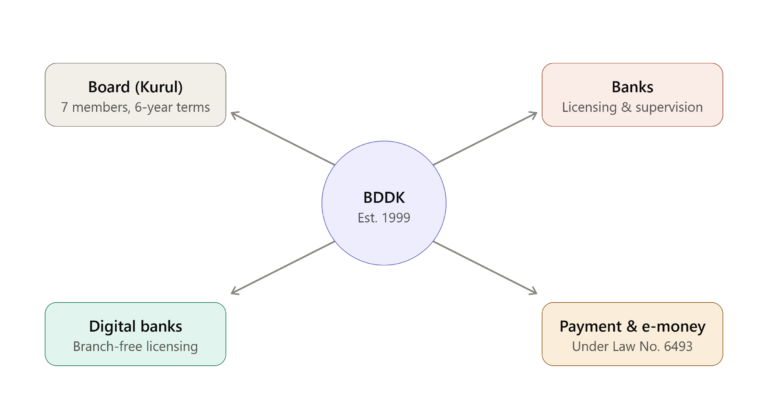
BRSA (Bankacılık Düzenleme ve Denetleme Kurumu, “Banking Regulation and Supervision Agency,” commonly known by its Turkish acronym BDDK) is Turkey’s independent regulator for banks and much of the country’s licensed financial technology sector, including digital-only banks and payment and e-money institutions. Established on 23 June 1999 under Law No. 4389, with its authority expanded and consolidated under Banking Law No. 5411 in 2005, BDDK operates as a public legal entity with financial and administrative autonomy — meaning no other government body, official, or individual is legally permitted to instruct it on its regulatory decisions.

BDDK’s Legal Mandate

Article 93 of Banking Law No. 5411 sets out BDDK’s core objectives: ensuring confidence and stability in financial markets, safeguarding the proper functioning of the credit system, and protecting the rights and interests of depositors and savers. These objectives sit above BDDK’s more visible day-to-day function — licensing and supervising banks — as the underlying rationale for everything the agency does.

Organizational Structure: Board and Presidency

BDDK is composed of two bodies:

  • The Banking Regulation and Supervision Board (Kurul): BDDK’s top decision-making body, made up of a Chairman, a Second Chairman, and five additional members — seven in total. Board members are appointed by Presidential decision for six-year terms.
  • The Presidency (Başkanlık): The administrative and executive arm that carries out the Board’s decisions and manages BDDK’s day-to-day regulatory and supervisory operations.

BDDK’s leadership saw changes in early 2026: under Presidential Decision No. 2026/44, published in the Official Gazette on 6 February 2026, Yakup Asarkaya was appointed Second Chairman of the Board, while Olcay Turan and Social Security Institution President Raci Kaya were appointed as Board members — a reshuffling of the Board’s composition that continued under Şahap Kavcıoğlu’s chairmanship.

What BDDK Actually Regulates

For anyone tracking Turkey’s fintech sector, BDDK’s remit extends well beyond traditional branch banking:

  • Traditional banks: No bank can be established in Turkey — domestic or foreign-owned — without BDDK’s permission. This includes ongoing supervision of capital adequacy, governance, and risk management once a bank is operating.
  • Digital-only banks: BDDK has issued specific licensing provisions for branch-free digital banks, distinct from traditional branch-based licensing, reflecting the growth of neobank-style models in Turkey.
  • Payment and e-money institutions: Under Law No. 6493, BDDK is the licensing authority for Payment Institutions and Electronic Money Institutions — the license category that covers most non-bank fintech companies handling customer funds or facilitating payments, including many companies in Turkey’s payments and open banking ecosystem.

This means a large share of Turkey’s fintech sector — not just banks in the traditional sense — falls under BDDK’s direct licensing and supervisory authority.

BDDK’s Independence, in Practice

The legal language establishing BDDK’s independence is unusually direct for a Turkish regulatory body: no organ, authority, office, or person may give instructions aimed at influencing the institution’s decisions. In practice, this is reflected in BDDK’s financial structure as well — the agency funds itself from its own budget rather than depending on general government appropriations, and any budget surplus at year-end is transferred to the general treasury rather than the reverse. This financial and legal separation is intended to keep supervisory decisions — including licensing approvals, capital requirements, and enforcement actions — insulated from short-term political pressure.

BDDK vs. Turkey’s Other Fintech Regulators

BDDK is one of four main regulators shaping Turkey’s fintech environment, alongside the Capital Markets Board (SPK), the Financial Crimes Investigation Board (MASAK), and the Central Bank (TCMB) — each with a distinct jurisdiction, as covered in our guide to Turkey’s fintech regulatory framework. The simplest way to distinguish BDDK’s role: if a company is a bank, a digital bank, a payment institution, or an e-money institution, BDDK is very likely the primary licensing authority — separate from SPK’s jurisdiction over crypto and capital markets, or MASAK’s cross-cutting AML oversight.

Frequently Asked Questions

What does BDDK stand for? Bankacılık Düzenleme ve Denetleme Kurumu, translated as the Banking Regulation and Supervision Agency (BRSA).

When was BDDK established? 23 June 1999, under Law No. 4389, with its powers later expanded under Banking Law No. 5411 in 2005.

Does BDDK only regulate traditional banks? No. BDDK also licenses digital-only banks and, under Law No. 6493, is the licensing authority for Payment Institutions and Electronic Money Institutions — covering a large portion of Turkey’s non-bank fintech sector.

How many members are on BDDK’s Board? Seven: a Chairman, a Second Chairman, and five additional members, each appointed by Presidential decision for six-year terms.

Is BDDK independent from the Turkish government? Yes, by law. BDDK is a public legal entity with financial and administrative autonomy, and no government organ or official is legally permitted to instruct it on its regulatory decisions.


This article is part of Fintech in Türkiye’s ongoing coverage of Turkey’s fintech regulatory landscape. For more on how Turkey’s regulators work together, explore our Regtech & Compliance section.

How Foreign Investors Can Open a Bank Account in Turkey

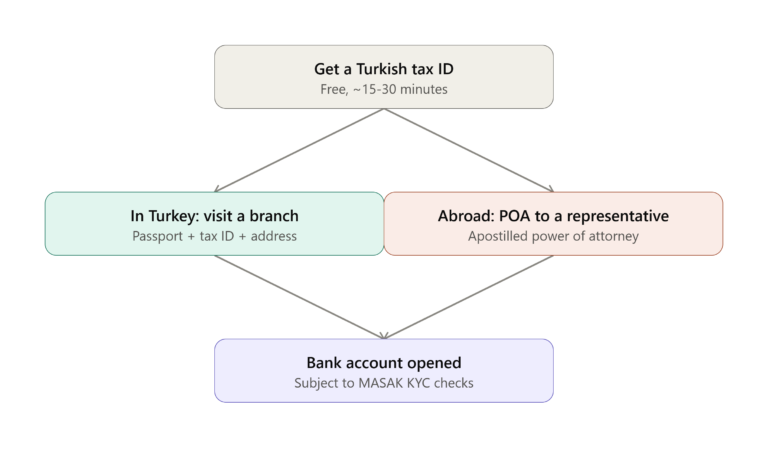
Foreign nationals can legally open a bank account in Turkey, whether or not they hold Turkish residency, and no single law prohibits it — but the process isn’t uniformly regulated, so requirements vary from bank to bank. The one universal prerequisite is a Turkish tax identification number, which any foreign national can obtain for free from a local tax office in about 15–30 minutes using only a passport. From there, the path differs depending on whether you’re opening the account in person in Turkey or arranging it remotely from abroad through a representative.

Step 1: Get a Turkish Tax Identification Number

Before approaching any bank, obtain a Vergi Kimlik Numarası (Tax Identification Number) from a Vergi Dairesi (Tax Office). This is:

  • Free
  • Fast — typically 15 to 30 minutes
  • Simple — a passport is generally sufficient
  • Available online for some nationalities via Turkey’s Interactive Tax Office portal (ivd.gib.gov.tr)

No Turkish bank will open an account without this number — it is the foundational document the entire process depends on.

Step 2: Gather the Required Documents

Requirements vary by bank, but the documents most consistently requested are:

  • A valid passport (some banks request a Turkish translation)
  • The Turkish tax identification number obtained in Step 1
  • A correspondence address: this can be a Turkish residence address (proven via a residence document or a utility bill) or, for non-residents, proof of an address in the account holder’s home country
  • A Turkish mobile phone number, requested by most banks for verification and account alerts

A separate document — the Yabancı Kimlik Numarası (Foreign Identification Number) — is different from the tax number and is only issued to foreign nationals who have held Turkish residency for at least six months. It is not required for basic account opening, though holding one can simplify some banks’ processes. Foreign nationals under temporary protection status (such as Syrian nationals) use their temporary protection ID card in place of this number.

Step 3: Choose the Right Bank

Because there’s no unified national regulation dictating exactly how foreign nationals must be onboarded, individual banks set their own internal criteria — and in practice, this makes bank selection a meaningful decision rather than a formality:

  • State-owned banks with broad foreign-national experience, such as Ziraat Bankası, are frequently cited as the most accessible option for non-residents, including property buyers without a residence permit.
  • Some private banks apply stricter internal policies, in some cases effectively requiring a residence permit even though Turkish banking law does not mandate one.
  • Branches in heavily touristed districts (such as central Istanbul neighborhoods popular with property buyers) sometimes informally limit the number of foreign-national accounts they process in a given period; a suburban or less tourist-dense branch can move faster.
  • Minimum opening deposits vary by bank and branch — some branches have been reported to request deposits in the range of 30,000 TL, though this is not a universal requirement.

Opening an Account Without Being in Turkey

For foreign investors who cannot travel to Turkey in person, remote account opening is possible through a Power of Attorney (POA) arrangement — the practical default method for non-resident account opening:

  1. The foreign investor grants a notarized, apostilled Power of Attorney to a representative in Turkey (commonly a lawyer), explicitly authorizing that representative to open a bank account on their behalf.
  2. The representative attends the bank branch in person, presenting the apostilled POA along with the investor’s identity and address documentation.
  3. The bank completes account opening under its standard in-person identity verification procedures, satisfied through the representative rather than the account holder’s physical presence.

This route allows a foreign investor to have a functioning Turkish bank account — useful for receiving property sale proceeds, managing business operations, or handling international transfers — without ever setting foot in the country during the setup process.

Personal Accounts vs. Corporate Accounts

If you’re opening an account for a business rather than yourself personally, the required documentation expands:

  • Tax plate (vergi levhası)
  • Signature circular (imza sirküleri), confirming who is authorized to sign on the company’s behalf
  • Trade registry record (ticaret sicil kaydı), proving the company’s legal registration

There’s an important sequencing detail worth flagging here: as covered in our guide to setting up a fintech company in Turkey, an Anonim Şirket must have at least a quarter of its committed cash capital deposited into a company bank account before the company is formally registered at the Trade Registry. Turkish banks accommodate this by opening a special pre-registration account for a “company under formation” (kuruluş halinde şirket), based on the draft articles of association — this is opened first, funded, then converted into the company’s standard operating account once registration is complete.

Why This Process Involves More Scrutiny Than It Might Elsewhere

Turkish banks apply anti-money-laundering (AML) know-your-customer procedures to all account openings, foreign or domestic, under MASAK’s regulatory framework. For foreign nationals — particularly non-residents opening accounts remotely — banks may apply enhanced due diligence, since cross-border account relationships carry a higher inherent AML risk profile under international standards. This is a routine compliance step rather than a barrier specific to any nationality, and it’s the same regulatory logic that governs KYC requirements across Turkey’s licensed payment institutions and crypto platforms.

Frequently Asked Questions

Do I need a residence permit to open a bank account in Turkey? No. Turkish banking law does not require a residence permit to open an account, though some individual banks apply internal policies that make the process easier with one.

What is the first thing I need before opening a bank account in Turkey? A Turkish Tax Identification Number (Vergi Kimlik Numarası), obtained free of charge from any tax office using just a passport.

Can I open a Turkish bank account without traveling to Turkey? Yes, through a notarized, apostilled Power of Attorney authorizing a representative — typically a lawyer — to open the account on your behalf at a branch in Turkey.

Which banks are considered most accessible for foreign, non-resident account holders? Ziraat Bankası and DenizBank are commonly cited as accessible options for non-residents, though requirements and ease of process vary by bank and even by branch.

Is a Yabancı Kimlik Numarası required to open a bank account? No. This is a separate identification number issued only to foreign residents of at least six months, and it is not a prerequisite for opening a basic bank account — a tax identification number is what’s actually required.


This article is provided for informational purposes and does not constitute legal or financial advice; requirements vary by bank and can change, so confirm current procedures directly with your chosen bank or a qualified Turkish legal advisor. For more on doing business in Turkey as a foreign investor, explore our Startups & Funding section.

Setting Up a Fintech Company in Turkey: What Foreign Founders Need to Know

Foreign nationals and foreign companies can establish and fully own a fintech company in Turkey, under the same rules that apply to domestic investors. This “national treatment” principle is set out in Turkey’s Foreign Direct Investment Law (Law No. 4875), which permits 100% foreign ownership in most sectors, does not require a residence permit to found a company, and requires only a notification — not a separate approval — to the Ministry of Industry and Technology once the company is registered. What foreign founders do need to plan for carefully is the two-layer structure that applies to any regulated fintech: setting up the underlying company, and separately obtaining the sector-specific license required to operate.

Two Separate Processes: Company Formation vs. Fintech Licensing

It’s worth separating these clearly upfront, because founders often conflate them:

  1. Company formation — registering a legal entity in Turkey under the Turkish Commercial Code (TTK). This is a standard corporate process available to any business, fintech or otherwise.
  2. Sector-specific licensing — if the company will conduct regulated activity (banking, payments, e-money, crypto asset services, investment services), it must additionally obtain a license from the relevant regulator (BDDK, SPK) before beginning that activity, as covered in our guide to Turkey’s fintech regulatory framework.

A company can complete step one in a matter of weeks; step two, for a regulated financial license, typically takes considerably longer and involves capital adequacy, governance, and technical infrastructure review.

Choosing a Company Structure: Ltd. Şti. vs. A.Ş.

Turkey’s Commercial Code allows several company forms, but two dominate in practice:

  • Limited Şirket (Ltd. Şti.): The most commonly used structure for small and mid-sized businesses. Requires at least one shareholder (up to a maximum of 50), a minimum capital of 10,000 TL, and limits shareholder liability to their committed capital contribution.
  • Anonim Şirket (A.Ş.): The preferred structure for larger-scale investment, easier share transfers, and future fundraising or public listing. A.Ş. requires a higher minimum capital than Ltd. Şti. and additional governance formalities.

For regulated fintech activity, the choice usually isn’t optional. BDDK and SPK licensing regimes for banks, payment institutions, e-money institutions, and crypto asset service providers generally require the licensed entity to be structured as an Anonim Şirket, given its clearer governance and capital structure. Founders planning to eventually apply for a financial license should generally incorporate as an A.Ş. from the outset, even if it means a larger initial capital commitment than a Ltd. Şti. would require.

Step-by-Step: Registering the Company

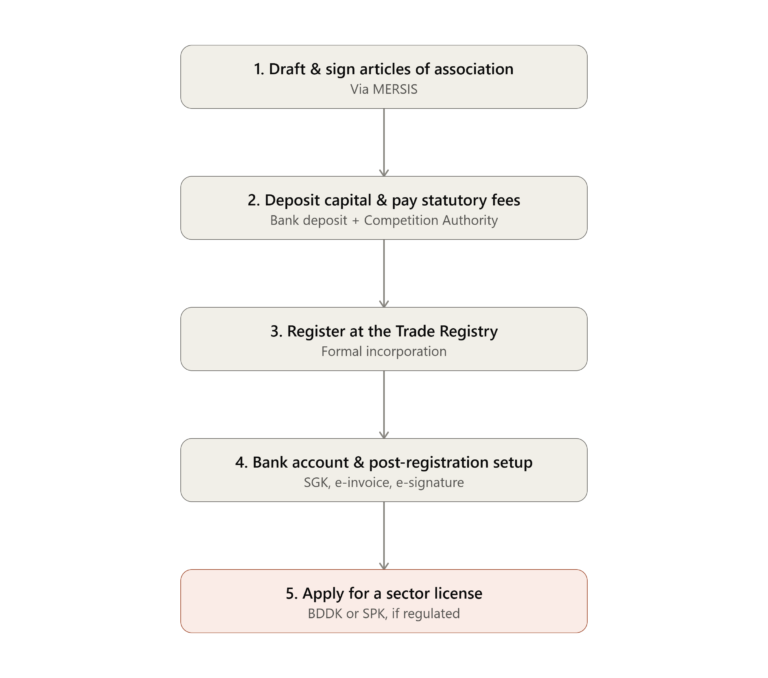
  1. Draft and sign the articles of association, submitted through MERSİS (Turkey’s centralized electronic company registration system). All founders — or their authorized representatives — must appear before the relevant Trade Registry Directorate or a notary to complete signature approval.
  2. Deposit capital and pay statutory fees: For an A.Ş., at least one-quarter of the committed cash capital must be deposited into a bank account opened in the company’s name before registration. Separately, 0.04% of the company’s capital must be paid into the Competition Authority’s (Rekabet Kurumu) bank account.
  3. Register at the Trade Registry Directorate, which formally incorporates the company and certifies its commercial books.
  4. Complete post-registration setup: open the company’s operating bank account (releasing any blocked capital for an A.Ş.), register as an employer with the Social Security Institution (SGK) if hiring staff, and obtain the mali mühür (financial seal) or e-signature required for Turkey’s mandatory e-invoice and e-ledger systems.
  5. Apply for a sector-specific license, if the company will conduct regulated fintech activity — this step runs on its own separate timeline with BDDK or SPK, entirely apart from the corporate registration above.

Documentation Requirements for Foreign Shareholders

When the founding shareholder is a foreign company rather than an individual, Turkish authorities require several documents to be apostilled, translated into Turkish by a certified translator, and notarized:

  • The foreign parent company’s trade registry certificate from its home jurisdiction
  • A founders’ declaration signed by the foreign company’s authorized representatives
  • A formal resolution from the foreign company’s authorized governing body approving the establishment of the Turkish subsidiary
  • The signed articles of association for the new Turkish entity

Engaging a Turkish legal counsel or licensed accountant (mali müşavir) experienced with foreign-invested company formation is standard practice, since even minor documentation errors can extend an already multi-step process.

Residence Permits, Work Permits, and Company Formation Are Separate Matters

A common misconception among foreign founders is that establishing a company requires Turkish residency. It does not — a foreign individual or company can register a Turkish company without ever holding a residence permit. However, if a founder intends to live in Turkey to run the business day-to-day, a residence permit is required, and a separate work permit is required to be legally employed by or draw a salary from the Turkish company. These are immigration matters entirely distinct from the corporate registration process, and should be planned on their own timeline.

The Foreign Investment Notification Obligation

Under Law No. 4875, foreign-invested companies are required to periodically report statistical information about their capital and activities to the Ministry of Industry and Technology’s General Directorate of Incentive Implementation and Foreign Investment. This is a notification requirement, not a permit or approval process — it does not gate the company’s ability to operate, but compliance is mandatory and ongoing.

Frequently Asked Questions

Can a foreign national own 100% of a fintech company in Turkey? Yes, in most sectors. Turkey’s Foreign Direct Investment Law grants foreign investors the same rights as domestic investors, including full ownership, in sectors that aren’t explicitly restricted.

Do I need a residence permit to set up a company in Turkey? No. Company formation does not require Turkish residency. A residence permit is only needed if you plan to live in Turkey, and a separate work permit is needed to be employed by the company you establish.

What’s the minimum capital to start a company in Turkey? A Limited Şirket requires a minimum of 10,000 TL. An Anonim Şirket requires a higher minimum capital, along with additional governance requirements — and is generally the required structure for companies pursuing a BDDK or SPK financial license.

Is setting up the company the same as getting a fintech license? No, these are two separate processes. Company registration under the Turkish Commercial Code can be completed relatively quickly. A sector-specific license from BDDK or SPK for banking, payments, e-money, or crypto asset services is a separate, typically much longer process with its own capital, governance, and technical review requirements.

Does a foreign-owned company have any special ongoing reporting obligations in Turkey? Yes. Under Law No. 4875, foreign-invested companies must periodically report capital and activity statistics to the Ministry of Industry and Technology. This is a notification obligation, not an approval gate.


This article is provided for informational purposes and does not constitute legal advice; foreign founders should consult qualified Turkish legal and accounting counsel before starting the incorporation process. For more on Turkey’s regulatory environment, see our guide to Turkey’s fintech regulatory framework.

3.2 million people in Türkiye hold 140 billion TL in crypto assets

Türkiye’s Central Securities Depository (MKK) has begun publishing baseline data on the country’s crypto asset market through its Crypto Asset Central Registry System (KVMKS), making the figures available on its website.

According to MKK, indicators on crypto assets — compiled from data reported to KVMKS by crypto asset service providers — will now be updated daily and shared with the public via the “MKK Market Data” section of the institution’s corporate website.

A message of trust

Ekrem Arıkan, MKK General Manager and Board Member, said: “In line with the responsibility we’ve taken on in our role as a Data Storage Institution and the public interest we aim to serve, we’ve begun making this data available to all market participants under the principle of transparency. We will ensure that developments in crypto markets can be tracked under MKK’s assurance.” Arıkan added: “According to data obtained from the platforms, of all investors who have invested in crypto assets, approximately 3.2 million currently hold a balance. These holdings include roughly 1,500 different crypto assets, which, based on their most recent trading prices, have a combined market value of 140.76 billion lira.”