
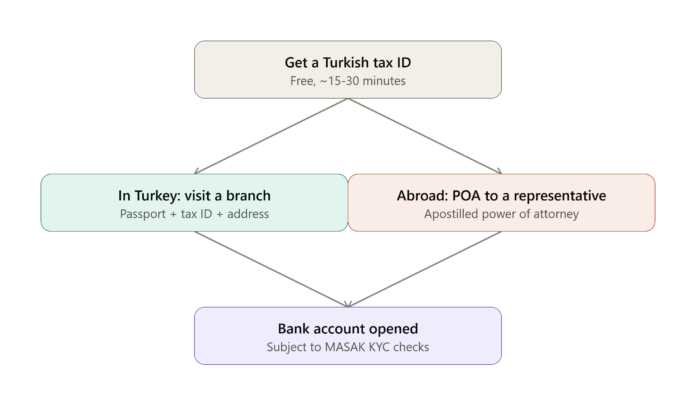
Foreign nationals can legally open a bank account in Turkey, whether or not they hold Turkish residency, and no single law prohibits it — but the process isn’t uniformly regulated, so requirements vary from bank to bank. The one universal prerequisite is a Turkish tax identification number, which any foreign national can obtain for free from a local tax office in about 15–30 minutes using only a passport. From there, the path differs depending on whether you’re opening the account in person in Turkey or arranging it remotely from abroad through a representative.
Step 1: Get a Turkish Tax Identification Number
Before approaching any bank, obtain a Vergi Kimlik Numarası (Tax Identification Number) from a Vergi Dairesi (Tax Office). This is:
- Free
- Fast — typically 15 to 30 minutes
- Simple — a passport is generally sufficient
- Available online for some nationalities via Turkey’s Interactive Tax Office portal (ivd.gib.gov.tr)
No Turkish bank will open an account without this number — it is the foundational document the entire process depends on.
Step 2: Gather the Required Documents
Requirements vary by bank, but the documents most consistently requested are:
- A valid passport (some banks request a Turkish translation)
- The Turkish tax identification number obtained in Step 1
- A correspondence address: this can be a Turkish residence address (proven via a residence document or a utility bill) or, for non-residents, proof of an address in the account holder’s home country
- A Turkish mobile phone number, requested by most banks for verification and account alerts
A separate document — the Yabancı Kimlik Numarası (Foreign Identification Number) — is different from the tax number and is only issued to foreign nationals who have held Turkish residency for at least six months. It is not required for basic account opening, though holding one can simplify some banks’ processes. Foreign nationals under temporary protection status (such as Syrian nationals) use their temporary protection ID card in place of this number.
Step 3: Choose the Right Bank
Because there’s no unified national regulation dictating exactly how foreign nationals must be onboarded, individual banks set their own internal criteria — and in practice, this makes bank selection a meaningful decision rather than a formality:
- State-owned banks with broad foreign-national experience, such as Ziraat Bankası, are frequently cited as the most accessible option for non-residents, including property buyers without a residence permit.
- Some private banks apply stricter internal policies, in some cases effectively requiring a residence permit even though Turkish banking law does not mandate one.
- Branches in heavily touristed districts (such as central Istanbul neighborhoods popular with property buyers) sometimes informally limit the number of foreign-national accounts they process in a given period; a suburban or less tourist-dense branch can move faster.
- Minimum opening deposits vary by bank and branch — some branches have been reported to request deposits in the range of 30,000 TL, though this is not a universal requirement.
Opening an Account Without Being in Turkey
For foreign investors who cannot travel to Turkey in person, remote account opening is possible through a Power of Attorney (POA) arrangement — the practical default method for non-resident account opening:
- The foreign investor grants a notarized, apostilled Power of Attorney to a representative in Turkey (commonly a lawyer), explicitly authorizing that representative to open a bank account on their behalf.
- The representative attends the bank branch in person, presenting the apostilled POA along with the investor’s identity and address documentation.
- The bank completes account opening under its standard in-person identity verification procedures, satisfied through the representative rather than the account holder’s physical presence.
This route allows a foreign investor to have a functioning Turkish bank account — useful for receiving property sale proceeds, managing business operations, or handling international transfers — without ever setting foot in the country during the setup process.
Personal Accounts vs. Corporate Accounts
If you’re opening an account for a business rather than yourself personally, the required documentation expands:
- Tax plate (vergi levhası)
- Signature circular (imza sirküleri), confirming who is authorized to sign on the company’s behalf
- Trade registry record (ticaret sicil kaydı), proving the company’s legal registration
There’s an important sequencing detail worth flagging here: as covered in our guide to setting up a fintech company in Turkey, an Anonim Şirket must have at least a quarter of its committed cash capital deposited into a company bank account before the company is formally registered at the Trade Registry. Turkish banks accommodate this by opening a special pre-registration account for a “company under formation” (kuruluş halinde şirket), based on the draft articles of association — this is opened first, funded, then converted into the company’s standard operating account once registration is complete.
Why This Process Involves More Scrutiny Than It Might Elsewhere
Turkish banks apply anti-money-laundering (AML) know-your-customer procedures to all account openings, foreign or domestic, under MASAK’s regulatory framework. For foreign nationals — particularly non-residents opening accounts remotely — banks may apply enhanced due diligence, since cross-border account relationships carry a higher inherent AML risk profile under international standards. This is a routine compliance step rather than a barrier specific to any nationality, and it’s the same regulatory logic that governs KYC requirements across Turkey’s licensed payment institutions and crypto platforms.
Frequently Asked Questions
Do I need a residence permit to open a bank account in Turkey? No. Turkish banking law does not require a residence permit to open an account, though some individual banks apply internal policies that make the process easier with one.
What is the first thing I need before opening a bank account in Turkey? A Turkish Tax Identification Number (Vergi Kimlik Numarası), obtained free of charge from any tax office using just a passport.
Can I open a Turkish bank account without traveling to Turkey? Yes, through a notarized, apostilled Power of Attorney authorizing a representative — typically a lawyer — to open the account on your behalf at a branch in Turkey.
Which banks are considered most accessible for foreign, non-resident account holders? Ziraat Bankası and DenizBank are commonly cited as accessible options for non-residents, though requirements and ease of process vary by bank and even by branch.
Is a Yabancı Kimlik Numarası required to open a bank account? No. This is a separate identification number issued only to foreign residents of at least six months, and it is not a prerequisite for opening a basic bank account — a tax identification number is what’s actually required.
This article is provided for informational purposes and does not constitute legal or financial advice; requirements vary by bank and can change, so confirm current procedures directly with your chosen bank or a qualified Turkish legal advisor. For more on doing business in Turkey as a foreign investor, explore our Startups & Funding section.

