Home Blog Page 7

Apple Pay eyes India rollout with Axis Bank, sources say

Apple (AAPL.O), opens new tab is poised to launch Apple Pay in India next month with Axis Bank’s (AXBK.NS), opens new tab credit cards, three sources ​familiar with the matter said, as it works to expand support ‌among the country’s lenders.

The launch, starting with a single major banking partner, would help the US company offer its payment service in the world’s most populous country, one of the ​few major economies where it is not available. Mumbai-based Axis Bank is the ​fourth-largest credit card issuer in India.

Apple Pay has also been ⁠in discussions with Axis Bank’s larger private sector rivals HDFC Bank (HDBK.NS), opens new tab and ICICI ​Bank (ICBK.NS), opens new tab but they are yet to agree commercial terms, two of the sources ​said.

All three sources spoke on condition of anonymity as the talks are private. Apple and HDFC did not respond to requests for comment from Reuters. ICICI and Axis said no ​comment when contacted by Reuters.

Apple Pay allows iPhone users to make tap-and-pay ​purchases using tokenised card details stored in their devices, without opening a separate payments app.


Microsoft, Marvell, and Utimaco unveil cloud payment HSM service

Microsoft, Marvell, and Utimaco have launched Azure Payment HSM v2, a cloud-native payment security platform for financial institutions. According to the official press release, the service is intended for banks, payment processors, and other financial institutions seeking a hardware-backed, compliant foundation for securing payment transactions, without having to deploy or operate physical HSM infrastructure themselves.

A managed alternative to on-premises HSM infrastructure

Azure Payment HSM v2 is delivered as a fully managed service through Microsoft Azure. It is designed to let financial institutions and payment providers secure payment transactions, protect sensitive payment assets, and maintain control over cryptographic keys, while meeting PCI security, compliance, audit, performance, and operational requirements. According to the companies, the platform removes the cost and complexity associated with deploying or managing dedicated payment HSM infrastructure, which has traditionally required hardware housed in customer-owned data centres.

Regulatory pressure and scaling demands

The companies cited growing regulatory obligations, including PCI PIN Security and PCI HSM requirements, together with regional data sovereignty rules, as factors driving demand for the new platform. Rising transaction volumes and fraud risks have also exposed limitations in traditional payment HSM deployments, which the companies described as costly, operationally complex, and difficult to scale across regions.

The offering brings together three components. Utimaco’s Atalla Payments Module provides cryptographic software supporting card issuance, PIN translation, mobile payments, and key management, and is deployed across global payment networks. Marvell’s LiquidSecurity HSMs are built for high transaction throughput in dense, multi-tenant cloud environments. Microsoft Azure delivers the combined offering as a managed cloud service, allowing customers to scale capacity according to demand.

Velocity raises USD 38 mln Series A for stablecoin treasury

Velocity has raised USD 38 million in a Series A round led by Dragonfly and FirstMark to expand its stablecoin treasury and settlement platform. The US-based company, which works with merchants, payment providers, fintechs, and financial institutions, said the funding will support the modernisation of enterprise treasury operations built on stablecoin infrastructure. The round also drew participation from Activant Capital, Capital One Ventures, QED Investors, Coinbase Ventures, Wintermute Ventures, and Ripple. Founded in 2025, Velocity has now raised close to USD 50 million since May of that year.

Platform capabilities and market positioning

Velocity’s platform is designed to let chief financial officers and treasury teams hold, move, and settle funds using stablecoin infrastructure while continuing to operate within existing treasury frameworks. The company combines stablecoin rails with local banking connections, compliance tools, custody, liquidity management, and settlement orchestration. According to the company, this approach is intended to give businesses access to faster settlement and reduced prefunding requirements without requiring changes to core treasury systems.

The company has positioned its offering around a shift in how stablecoins are used commercially. While stablecoins were initially adopted primarily to speed up money movement, Velocity said businesses are increasingly applying stablecoin-based systems to address liquidity management, reduce trapped working capital, and improve cross-border operations.

Investor rationale and sector context

The investor group spans digital asset specialists, enterprise software investors, and traditional financial services firms. Dragonfly said its backing reflects Velocity’s position at the intersection of established payments and banking infrastructure and newer stablecoin networks, adding that it expects enterprise and institutional demand to be a primary driver of stablecoin adoption going forward.

FirstMark, whose portfolio includes Shopify, Airbnb, and Pinterest, framed its investment around the broader potential of stablecoins to change how money moves in the same way the internet altered the movement of information. QED Investors, which has backed payments companies across multiple markets, said infrastructure that integrates into existing treasury workflows is more likely to gain traction than standalone stablecoin tools, pointing to Velocity’s approach of embedding stablecoin settlement into processes treasury teams already use.

Ramp launches UK operations after Billhop deal

Ramp, a US-based corporate finance platform, has made its expense management, procurement, bill payment, and treasury software available to UK businesses. The launch is Ramp’s first expansion outside North America since it entered Canada in July 2026, and follows several months of preparation to secure regulatory standing in the region.

Regulatory groundwork through Billhop

Ramp’s UK entry rests on its March 2026 acquisition of Billhop, a payments platform based in Sweden with an additional presence in the UK. The deal gave Ramp regulated payments authorisation in both the UK and the EU, a prerequisite for offering corporate card and payment services directly to businesses in these markets rather than through a third-party partner. Ramp said it now operates offices in London and Stockholm, with European customers having gone live on the platform during a prior beta phase.

UK companies have reportedly been onboarding onto Ramp since the summer of 2026. Among them is UK-based AI voice technology company ElevenLabs, which runs bill payments, corporate cards, and AI token spend tracking on the platform; according to Ramp, automation covers 99% of invoices and 99.8% of card transactions for the company, saving its three-person finance team around 24 hours a month. UK-based Attio has also adopted Ramp’s corporate cards and expense tools to consolidate its finance operations.

Ramp is also working with Visa to support its corporate card offering for UK businesses, combining its spend management software with Visa’s payments network. More than 70,000 companies, including Shopify and Virgin Voyages, currently use Ramp’s platform; the company has stated that its median customer saves 5% on expenses and grows revenue by 16% in its first year on the platform.

AI-related spend under scrutiny

The UK launch coincides with what Ramp describes as a shift in the type of spending finance teams need to monitor. The company reports that AI-related spending among its customers has grown roughly 21-fold since June 2025, with its highest-spending customers seeing costs rise by 50% or more per quarter. Unlike traditional expense categories, token-based AI spend is usage-based and spread across multiple providers, models, teams and API keys, making it harder for finance departments to track.

Jacob Wallenberg, VP, International Expansion at Ramp, said that Ramp’s token spend tools break down costs by model and team, separate cost of goods sold from operating expenditure, and flag anomalies automatically.

ConnectPay launches Serdis core banking platform

ConnectPay has launched Serdis, an AWS-native core banking platform built in-house, now available to other European EMIs and financial institutions.

The system took over ConnectPay’s entire live operations in July 2025 and is now being offered to other financial institutions as an independent product under the Serdis brand. The name derives from the Lithuanian word šerdis, meaning ‘core’ – the essential part of a system.

Most core banking engines are developed by software vendors rather than by the regulated institutions that operate them. ConnectPay’s approach differs in that Serdis was built and tested in live production by an active EMI before being made available externally. According to the company, because ConnectPay itself operates under regulatory obligations, compliance updates required for its own operations are incorporated into the platform and extended to Serdis clients.

The company said that the platform was designed to address operational constraints encountered while relying on third-party systems, including limitations around safeguarding accounts, regulatory reporting, and dependency on external vendor roadmaps.

Migration executed without downtime

ConnectPay ran Serdis in parallel with its previous core banking provider for nine months before switching over. In July 2025, the company migrated its full live business, including annual turnover of EUR 14 billion, onto the new platform in a single-weekend cutover, with no customer-visible downtime, according to the company.

Tadas Bakutis, CTO of ConnectPay, who led the migration, said the exercise demonstrated that a financial institution could take control of its core transactional infrastructure without disrupting existing users, and noted that infrastructure ownership was becoming more relevant as instant payment requirements and resilience standards increase across the sector.

Industry research cited by ConnectPay indicates that a significant share of Tier 1 banks continue to operate on legacy core banking systems. This comes as regulatory scrutiny of third-party infrastructure risk in the financial sector increases under the EU’s Digital Operational Resilience Act (DORA), which sets requirements for the resilience of ICT systems used by financial entities.

Revolut plans dual listing in New York and London

Revolut has confirmed for the first time that it is exploring a dual stock market listing in New York and London.

Revolut founder Nik Storonsky said that the company wants any future listing to include the US, citing the market’s liquidity and the scale of its institutional investor base. The comments mark the first public acknowledgement from Revolut that a dual listing on the Nasdaq and the London Stock Exchange is under consideration, rather than a US-only admission.

US market favoured for liquidity

According to the executive, the US offers a broader pool of buyers, including institutional investors, hedge funds, fund managers, and individual investors, compared with smaller markets where fewer participants would be competing for the company’s shares. The executive said this dynamic was the primary reason for favouring the US as part of any listing plan, while confirming that a London Stock Exchange listing would run alongside it.

A London listing would place Revolut among the UK’s largest publicly traded companies. The fintech was valued at approximately USD 115 billion in a recent private secondary share sale, a valuation that would exceed those of established London-listed firms such as Barclays, BP and GSK. The company has previously indicated that any listing would not take place before 2028.

Regulatory background and prior scepticism

According to Financial Times, Revolut’s Nik Storonsky has previously expressed reservations about a London listing, pointing to the stamp duty charged to UK investors trading shares. In 2024, the executive said the London Stock Exchange could not compete with its US counterparts, having earlier stated in 2023 that a UK listing held little appeal.

The company has also been critical of UK regulators in the past. Revolut waited several years to receive a full UK banking licence, a process that involved addressing concerns around the adequacy of its risk and control functions.

Amazon and Openbank Pay launch flexible payments in Poland

Amazon and Santander’s digital consumer finance platform, Openbank Pay, have launched flexible payment solutions for customers shopping on Amazon.pl. The service allows shoppers to finance purchases either through a short-term deferred payment option or through instalment plans, extending a partnership between the two companies that has already been rolled out in other European markets, including Germany, Austria, and Spain.

Financing options and eligibility

Under the new arrangement, Polish customers shopping on Amazon can choose to pay within 30 days, interest-free, for purchases of between EUR 18 and EUR 236. Alternatively, clients can spread payments in instalments over three to 60 months for purchases ranging from EUR 23 to EUR 2,950. To use the service, customers select Openbank Pay as a payment method on the product page or at checkout, fill in an application, and then receive a decision online.

The financing options apply to most product categories on Amazon.pl, including electronics, computers, toys, home improvement, and kitchen items. However, they do not apply to Amazon gift cards, grocery products, specific digital goods such as music, video, e-books, apps, and game downloads, or pre-order and out-of-stock items.

According to the companies, the new payment methods will be rolled out progressively to eligible customers over the coming weeks.

Extension of an existing European partnership

The Poland launch builds on previous rollouts of Openbank Pay’s service with Amazon in other European markets, extending the availability of instalment-based and deferred payment financing to additional users across the region. Similar options were provided to Spanish Amazon customers back in September 2025, though the instalment period is limited to four to 40 months.

UniBank and Mastercard launch cross-border tool for Panama SMEs

UniBank has partnered with Mastercard to launch Mi Negocio sin Frontera, a cross-border payments solution for Panamanian SMEs. According to the official press release, the offering extends UniBank’s existing Mi Negocio proposition with new functionality aimed at reducing friction in cross-border transactions and improving visibility over the movement of funds.

Addressing a gap in SME cross-border payments

Panama occupies a position in regional trade and financial services due to its logistics and banking infrastructure. As local companies expand their supplier and customer relationships abroad, cross-border payment capabilities have become a factor in maintaining operational efficiency and business continuity.

According to a 2026 study conducted by Mastercard and FXC Intelligence, SMEs account for more than 40% of import payments across Latin America. The same research found that three out of four surveyed SMEs said unpredictable payment timing had directly affected their working capital, complicating cash flow management and business planning. The study also indicated that 95% of SMEs open to changing providers said they would consider moving other banking services within twelve months, pointing to a broader appetite among smaller businesses for improved payment infrastructure.

With this in mind, Mi Negocio sin Frontera is built on Mastercard Move, Mastercard’s set of money movement capabilities, and connects bank accounts, cards, and other receiving points to widen the payment options available to businesses. Through the platform, UniBank customers can send payments to more than 50 countries, including destinations in Central America, the US, Europe, and Asia. Transfers are processed with next-day or near-real-time availability, depending on the receiving system in the destination market.

The solution is positioned to reduce the manual processes traditionally associated with international transfers, giving SMEs greater transparency and predictability over incoming and outgoing funds.

Card payments in Turkey approach TL 3 trillion in August, according to BKM data

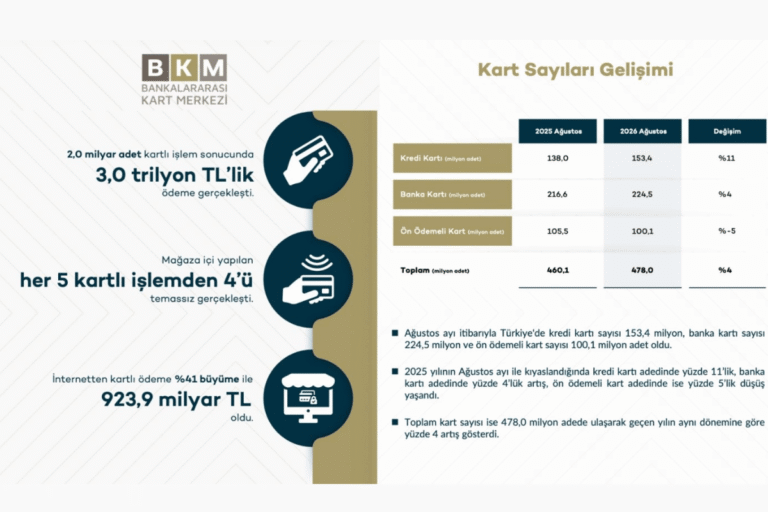
According to August 2026 data from the Interbank Card Center (BKM), the volume of card payments in Turkey rose 39% year-on-year to TL 2.99 trillion. With transaction count exceeding 2 billion and online card payments growing 41%, August stood out as a strong month for the card payment ecosystem.

Card count reaches 478 million, credit card growth leads the way

As of August 2026, the total number of cards in Turkey increased 4% year-on-year to 478 million. The number of credit cards grew 11% to 153.4 million, while debit cards rose 4% to 224.5 million. Prepaid cards saw a 5% decline, falling to 100.1 million. The double-digit growth in credit cards signals that consumers are increasingly turning to credit cards as their preferred payment method.

Total card payment volume approaches TL 3 trillion threshold

Total payments made via credit, debit, and prepaid cards in August reached TL 2,990.4 billion, up from TL 2,146.3 billion in the same period last year. Credit card payments grew 40% to TL 2,537 billion, while debit card payments also rose 40% to TL 445.9 billion. Prepaid card transaction volume declined 43% to TL 7.5 billion.

In terms of transaction count, total card payments grew 11% to nearly 1.99 billion. Credit card transactions rose 12% to 1,169.5 million, debit card transactions increased 13% to 789.1 million, and prepaid card transactions fell 39% to 33.2 million.

Online card payments grow 41%

Online card payments rose 41% year-on-year to TL 923.9 billion, up from TL 654.3 billion in the same period last year, once again confirming the continued growth of e-commerce and digital shopping. Online payments accounted for 30% of total card payments, while the number of online transactions increased 13% to 255.8 million.

81% of in-store payments are contactless

The use of contactless methods in in-store card payments remained high. Four out of every five in-store card transactions in August were contactless, with the contactless payment rate holding steady at 81%. The number of contactless transactions grew 9% year-on-year to 1,335.7 million, while the contactless payment volume rose 42% to TL 1,039.9 billion.

Gülçin Aytemizel Telatar appointed as Ant International’s Turkey Country Manager

Global fintech giant Ant International has appointed Gülçin Aytemizel Telatar as its Turkey country manager. Telatar took up the role in July 2026.

Prior to joining Ant International, Telatar served as General Manager and Board Member at Starpay, where she led the process of obtaining an electronic money institution license from the Central Bank of the Republic of Turkey.

Telatar is also among the founding board members of the Türkiye Fintech Association, a role she continues to hold. Commenting on her new position, she stated that she will focus on bringing Ant International’s innovative technologies to Turkey, building strong partnerships, and creating new opportunities for the country.

Singapore-based Ant International houses Alipay+, a global payment gateway connecting more than 2 billion consumer accounts and over 150 million merchant partners through a single integration, and Antom, a merchant payment service enabling businesses in more than 50 countries to accept payments in over 100 currencies.