
Home Blog Page 25

Cenk Bayrakdar of Revo Capital: “We Will Back More Than 30 Tech Startups Over the Next Five Years”

Originally published in: Fintech Dünyası magazine, 2026 June issue (Turkish edition) — adapted and translated for Fintech in Türkiye


Quick Answer

Revo Capital, one of Turkey’s largest technology-focused venture capital funds, closed the second round of its Fund III at $100 million in 2026 and plans to invest in more than 30 technology startups over the next five years. Founded in 2013, Revo now manages over $250 million in assets, has made 54 investments and 18 exits, and says more than half of all international follow-on investment into Turkish startups between 2021 and 2025 went to its portfolio companies. Founding Partner and Managing Director Cenk Bayrakdar spoke with Fintech Dünyası about the fund’s growth-stage strategy, the metrics it uses to evaluate scalable growth, and why Turkish startups are increasingly built as global-first companies from day one.


Fintech Dünyası: Revo Capital positions itself as a fund focused on growth-stage technology startups. What are the most critical advantages and risks of investing at this stage?

Cenk Bayrakdar: The biggest advantage of investing in growth-stage technology startups is that you can see much more clearly whether product-market fit is real, whether the sales cycle is repeatable, and whether the founding team is actually capable of building a company — and a culture — at scale.

Roughly 1,000 new startups are founded in Turkey every year, and the ecosystem has grown at approximately 12% annually since 2013. Turkey is now home to more than 11,000 active startups. But only 3.4% of companies that raise a seed round go on to reach Series A in Turkey. That figure stands at 16% in the United Kingdom and 21% in Germany. Revo Capital exists precisely to close that investment gap.

Founded in 2013, Revo today manages more than $250 million in fund size, with 54 investments and 18 exits, making it one of Turkey’s leading and largest technology-focused venture capital funds. We closed the second closing of Fund III at $100 million in 2026, and we’re targeting investments in more than 30 technology startups over the next five years.

On the risk side, the growth stage remains a critical period. Higher valuations, competition from global players, regulatory complexity, and the much higher cost of mis-scaling are all real risks. But when paired with the right founder, we believe the Series A/B band in Turkey remains one of the most capital-efficient stages available.

Fintech Dünyası: How do you measure “scalable growth” potential in your portfolio companies? Which metrics matter most to you?

Cenk Bayrakdar: We don’t look at scalable growth through a single KPI — we look at the trajectory of sustainable growth. Revenue growth matters, but what really matters is how efficiently that growth is achieved. Net revenue (not gross or contracted ARR), profit margin, customer acquisition cost, payback period, contract size, net revenue retention, cash burn efficiency, and the share — and growth — of international revenue in total revenue are among our core indicators.

Beyond that, the founding team’s capacity to manage growth and work transparently with investors is just as critical. One of the things that sets Revo apart is that we stay actively engaged after we invest. Through a corporate network of more than 600 C-level executives and relationships with over 750 global VCs, we help our portfolio companies gain access to customers, investors, and business development opportunities.

Over half of all investment into Revo’s portfolio between 2021 and 2025 came from international investors.

International investors are no longer looking at Turkey’s macro picture alone — if they see a global-first company with a strong engineering team and a hard-currency revenue model, they will invest. Turkey today has more than 11,000 active startups, and the ecosystem has attracted a combined $6.5 billion in investment over just the past five years.

Revo’s portfolio companies have raised over $3.5 billion in follow-on investment since 2021, of which 92% came from international investors — meaning more than 50% of all investment into the Turkish ecosystem between 2021 and 2025 went into Revo’s portfolio. In 2025 alone, we facilitated more than 60 strategic, high-conversion-potential customer introductions for our portfolio companies. Over the past three years, we’ve also led more than 25 C-level hiring processes for our portfolio.

For us, the quality of growth isn’t just about what shows up in a spreadsheet — it’s about whether a company can win global customers, build a repeatable sales model in new markets, and become more operationally efficient as it scales.

Under Fund III, Revo has invested approximately $15 million across 14 startups to date.

Fintech Dünyası: Revo Capital’s portfolio has a notable track record of successful global expansion. In your view, what are the most critical inflection points in a startup’s globalization journey?

Cenk Bayrakdar: Our investment thesis has changed significantly over the past five years. We used to invest in companies “founded in Turkey with a vision to go global.” Today, we focus much more on companies built as global companies from day one — typically structured under a US, UK, or Netherlands-based holding company, with strong engineering and R&D teams based in Turkey.

Turkey has genuinely become a strong technology production hub. The country has more than 300,000 active software developers and produces roughly 100,000 engineering graduates a year. On top of that, more than 20,000 Turkish software and AI engineers currently work in the US, a Turkish diaspora of more than 400,000 people, and thousands of globally experienced entrepreneurs together form a serious talent pool.

Today, 84% of our Fund II portfolio consists of globally headquartered structures, and around 70% of portfolio revenue comes from hard-currency international sources. Under Fund III, we’ve invested approximately $15 million across 14 startups so far, 10 of which were structured as global-first companies from inception. Most of these companies are focused on generating hard-currency revenue and building global sales organizations from the very start.

[Editor’s note: “Global-first” refers to startups incorporated abroad — typically in the US, UK, or Netherlands — from founding, with Turkey serving as the engineering and R&D base rather than the commercial headquarters. This structure is increasingly common among Turkish-founded technology companies seeking international investment.]

The most critical issue in globalization isn’t simply “selling the product abroad” — it’s building the right sales model for the right geography. The US offers a single, deep market, while Europe is far more fragmented. The MENA region, in particular, is creating significant opportunities for fintech, compliance, and cybersecurity companies. For example, Onlayer, one of our Fund II portfolio companies, has grown rapidly in the Gulf region with its merchant risk and compliance infrastructure built for banks and payment institutions. FileOrbis has gained strong traction in MENA thanks to data localization and regulatory requirements in the region.

Fintech Dünyası: We’re seeing Turkish startups attract more international investment in recent years. What are the key dynamics behind this shift?

Cenk Bayrakdar: I think the most important shift is that startups coming out of Turkey are now being evaluated on their global revenue potential. International investors are no longer looking at Turkey’s macro picture alone — if they see a global-first company with a strong engineering team and a hard-currency revenue model, they will invest.

Turkey today has more than 11,000 active startups, and the ecosystem has attracted a combined $6.5 billion in investment over the past five years alone. Revo’s portfolio companies have raised more than $3.5 billion in follow-on investment since 2021, 92% of it from international investors — meaning more than 50% of all investment into the Turkish ecosystem between 2021 and 2025 went into Revo’s portfolio.

Midas is one of the best examples of this. Revo was one of the company’s first institutional VC investors; it later raised a combined $140 million from international investors — a $45 million Series A led by Portage in 2024, followed by an $80 million Series B led by QED Investors in 2025. Midas now has more than 4 million users, and in addition to trading access on Turkish and US exchanges, the company will offer access to European exchanges starting in 2026. This shows that platforms coming out of Turkey are no longer viewed as purely local success stories, but as globally scalable technology companies.

[Editor’s note: Midas is a Turkish investment and brokerage app offering retail access to domestic and international stock markets.]

Fintech Dünyası: How would you describe the relationship you build with your portfolio companies? To what extent are you involved in management processes, and what kind of strategic guidance do you provide?

Cenk Bayrakdar: We see our relationship with portfolio companies less as a classic “board seat” relationship and more as a strategic partnership. We don’t get involved in day-to-day operations, but we work very closely with founders on critical areas like senior hiring, global expansion, customer acquisition, and investor relations.

One of the things that sets Revo apart is our focus on ecosystem-building. Our Building Bridges event now brings together more than 650 attendees, over 380 companies, and investors from multiple countries. Through the annual events we co-host with Microsoft, we connect our portfolio companies directly with CEOs, CIOs, and enterprise technology leaders. We want founders to see us not just as a source of capital, but as a platform for market access, credibility, and global network — because for us, creating value isn’t just about investing. It’s about accelerating our companies’ path to global scale.


Frequently Asked Questions

How much has Revo Capital invested through Fund III so far? As of 2026, Revo Capital has invested approximately $15 million across 14 startups through Fund III, following a $100 million second closing.

How many startups does Revo Capital plan to invest in over the next five years? Revo Capital plans to invest in more than 30 technology startups over the next five years, according to Founding Partner and Managing Director Cenk Bayrakdar.

What share of investment into Turkish startups has gone to Revo Capital’s portfolio? Revo’s portfolio companies raised more than $3.5 billion in follow-on investment between 2021 and 2025, of which 92% came from international investors — representing more than 50% of all investment into the Turkish startup ecosystem in that period.

Why are Turkish startups increasingly structured as “global-first” companies? Founders and investors are structuring companies under US, UK, or Netherlands-based holding entities from inception to access international capital and customers more easily, while keeping engineering and R&D teams in Turkey, which offers a large, cost-competitive technical talent pool.


This article is based on an interview originally conducted by Fintech Dünyası in Turkish. It has been translated and adapted for an international audience by Fintech in Türkiye.
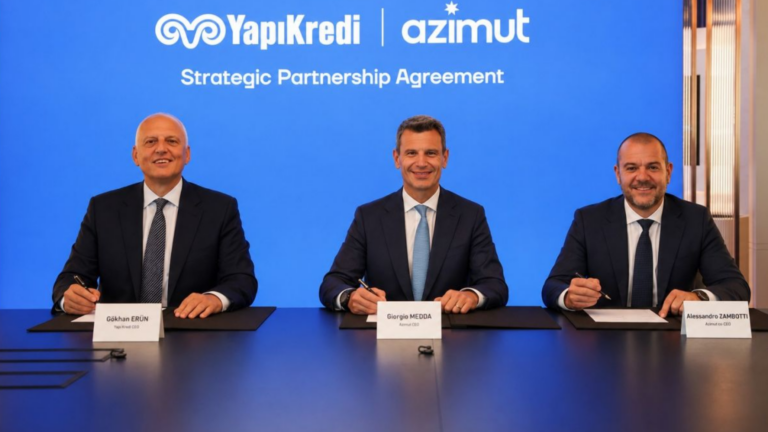

Yapı Kredi transfers Yapı Kredi Portföy shares to Azimut Group

Yapı ve Kredi Bankası has disclosed, through Turkey’s Public Disclosure Platform (KAP), that it has signed a share transfer agreement and a post-sale distribution agreement protocol regarding the sale of its shares in Yapı Kredi Portföy Yönetimi AŞ.

According to the disclosure, a share transfer agreement was signed under which the bank’s 12.65 percent stake in Yapı Kredi Portföy Yönetimi AŞ and its 87.32 percent stake in Yapı Kredi Yatırım Menkul Değerler AŞ, together with shares held by other shareholders, will be transferred to AZ International Holdings SA (AZ Holdings), part of Azimut Group. The total transaction value, subject to adjustments and corrections, was calculated at 16.392 billion lira. The disclosure noted that, following the transaction, the bank’s shareholding in Yapı Kredi Portföy Yönetimi AŞ will come to an end.

Yapı Kredi CEO Gökhan Erün said the agreement represents an important milestone in the bank’s strategic growth journey. “This collaboration, an important step in our bank’s leadership vision in asset management, will reinforce our pioneering position in the sector while creating unprecedented value for our customers. We will combine Yapı Kredi’s strong service model and distribution power with Azimut’s international investment expertise,” Erün said.

Azimut Holding CEO Giorgio Medda commented: “By joining forces with Yapı Kredi, one of the leading players in the Turkish banking sector and a partner that shares our commitment to driving growth through innovation, Azimut once again confirms its position as the asset management partner of choice for leading financial institutions.”

TCMB launches “Payment and Electronic Money Institution Account Ownership Inquiry” service

In a statement, the Central Bank of the Republic of Türkiye (TCMB) noted that it is responsible for regulating and supervising the payments sector under Law No. 6493, and that it continues its work to ensure the sector operates in a secure, uninterrupted, effective, and efficient manner.

As part of these efforts, TCMB announced that, following work carried out with relevant stakeholders, it has developed the “Payment and Electronic Money Institution Account Ownership Inquiry” service.

The statement read: “Through this service, which will be accessible via the e-Devlet [e-Government] portal, individuals will be able to find out which payment and electronic money institutions they hold accounts with, and will also be able to use this service on behalf of individuals whose heirs they are. Information on authorized payment and electronic money institutions is published and kept up to date in the ‘Payment Services’ section of TCMB’s website.”

Akbank provided 2.913 trillion TL in credit support to Turkish economy in first half of 2026

Commenting on Akbank’s second-quarter 2026 financial performance, General Manager Kaan Gür said: “In the second quarter, uncertainties stemming from geopolitical developments caused notable volatility in global markets and commodity prices. While the effects of this volatility were observed domestically in inflation, the external balance, and the budget, the policy measures proactively taken by our economic administration allowed domestic financial markets to follow a relatively calmer course. Throughout this process, Akbank and the Turkish banking sector continued, as always, to provide strong support to the country’s economy.”

“We provided 2.913 trillion TL in credit support to our economy in the first half of 2026”

Gür continued: “In the first half of 2026, we raised the credit support we provided to our economy to a total of 2.913 trillion TL, of which 2.233 trillion TL was cash lending. Our total deposits reached 2.511 trillion TL, while our assets reached 4.012 trillion TL. With our strong consolidated capital adequacy ratio of 16.4 percent, we continued to support the growth and development of the real sector. In the first half of 2026, our bank generated consolidated net profit of 34.333 billion TL after 12.623 billion TL in tax expenses. I would like to thank my colleagues for their successful performance, and all our stakeholders, especially our customers, for the trust they have placed in us.”

Ctrl Alt secures MiFID licence to launch tokenised services in Europe

UK-based tokenisation infrastructure provider Ctrl Alt Technologies has been given the greenlight to operate across Europe as it secures a Markets in Financial Instruments Directive (MiFID) licence from the Central Bank of Ireland (CBI).

Ctrl Alt states the authorisation will enable it to offer regulated tokenised investment products, including securities, to institutions, asset managers, and capital allocators throughout Ireland and, subsequently, the European Economic Area (EEA).

The licensing reflects a growing trend in the digital assets sector, with firms seeking to expand their services under strict regulatory oversight. At the start of the month, Coinbase revealed that it had also secured a MiFID licence in the UK, and only days ago, HSBC announced it was taking the next step in the UK’s Digital Securities Sandbox (DSS) – a regulated environment created to test new technologies, like distributed ledger technology (DLT).

Ctrl Alt, in partnership with SEI Investments, also enrolled in the DSS in April 2025.

Founded in 2022 by Matt Ong, Ctrl Alt helps financial institutions tokenise assets that have traditionally been illiquid or hard to access, like real estate, private credit, funds, and commodities. In the past four years, Ctrl Alt has tokenised over $1.5 billion in assets, offering an end-to-end service covering origination, structure, issuance, and distribution.

The MiFID licence strengthens Ctrl Alt’s global regulatory standing, building on the virtual asset service provider (VASP) licence it secured in the UAE in June 2025, and more recently, the direct Financial Conduct Authority (FCA) authorisation it obtained in April this year.

New consortium launches with $15m to fund Bitcoin security and resilience

A newly formed consortium of financial institutions and Bitcoin companies aimed at supporting the long-term security and resilience of the Bitcoin network has officially launched. The consortium, known as the Bitcoin Security Consortium, is made up of nine institutions active in the Bitcoin ecosystem: Anchorage Digital, ARK Invest, BlackRock, Block, Blockstream, Coinbase, Fidelity Digital Assets, Galaxy, and Strategy.

According to an official statement, the consortium “intends to publish and maintain material on Bitcoin’s security, updated as developments warrant, and to continue funding and supporting the developer community”.

The statement adds that the group does not “develop or direct Bitcoin’s protocol, takes no position on specific protocol changes, and does not speak for Bitcoin or its developers”.

To kickstart the initiative, the consortium has collectively pledged $15 million over the next three years to “help fund and support the developers and researchers already working on Bitcoin’s security, including the long-term work of preparing Bitcoin for a potential era of quantum computing”. Each member has control over who receives their pledged funds.On the topic of quantum computing, the consortium notes: “Large-scale quantum computers capable of threatening Bitcoin’s cryptography do not exist today, and credible estimates place such capability years away. Preparing post-quantum protections is nonetheless a meaningful long-term priority, and one the Bitcoin technical community is already actively working on.

“The Consortium aims to support that work and to provide a grounded reference point for investors, the public, and the media as the field develops.”

X Launches “X Money” banking service for U.S. premium subscribers

Elon Musk’s social media platform X has rolled out its X Money banking service to all U.S. Premium and Premium+ subscribers on Monday, as part of the billionaire entrepreneur’s vision to transform the platform into an “everything app.”

With this new release, the product—which had been tested by a limited group of users in the highest subscription tier since late June—is now accessible to a broader audience.

X Money allows users to hold balances, make peer-to-peer (P2P) payments, pay bills, execute bank transfers, and send checks via mail without ever leaving the X application.

Deposits are held at New Jersey-based Cross River Bank, which also powers various other financial technology applications. Funds in the accounts are insured up to $250,000 by the Federal Deposit Insurance Corporation (FDIC).

Elon Musk has repeatedly stated for years that he aims to turn X into a platform similar to China-based WeChat. Combining messaging, shopping, and payment services into a single application, WeChat is widely regarded as a cornerstone of consumer spending in China.

Additionally, a post shared from the official X Money account announced that deposits will offer an annual yield of up to 6%.

Turkey centralizes cybersecurity: Parliament transfers key BTK powers to Cybersecurity Presidency

A new regulation recently adopted by the TBMM transfers numerous authorities previously held by the Information Technologies and Communication Authority (BTK) to the Cybersecurity Presidency. Submitted by the Justice and Development Party (AK Parti) as a 30-article omnibus bill, the legislation encompasses various regulations ranging from retired pensions to the public personnel regime while introducing a radical transformation in cybersecurity.

Article 28 of the regulation directly modifies the organizational structure of the Cybersecurity Presidency, which operates under the Presidency of the Republic. The objective of this amendment is to expand the agency’s mandate and bring certain sectors directly under its control and supervision. While the bill has drawn mixed reactions from the public, it shifts many regulatory authorities previously managed by the internet regulator BTK over to the Cybersecurity Presidency. This shift has fueled discussions centered on the “centralization of cybersecurity,” as internet regulation powers move directly to an institution under the Presidency. The legislation ultimately solidifies Turkey’s approach to internet and cybersecurity governance maintained since the 2010s.

Digital Gaming and Domain Names Shift to the Presidency

Among the most widely discussed provisions of the law is the integration of cybersecurity activities related to digital gaming platforms into the Presidency’s jurisdiction. Additionally, the legislation grants the Cybersecurity Presidency the authority to determine strategies and regulate internet domain names.

In situations where delay is deemed risky, the Presidency can—upon the request of security and intelligence agencies or on its own initiative—issue precautionary measures. Access providers, data centers, and content providers are mandated to enforce these decisions within two hours. For instance, during emergencies like cyber attacks, the Presidency holds the power to enact precautionary decisions regarding internet infrastructure.

While official TBMM documents do not exhaustively list “cases where delay is risky,” the text refers to reasons outlined in the “Freedom of Communication” provision of the Constitution. Under Article 22 of the Constitution, freedom of communication may only be restricted based on the following grounds:

  • National security
  • Public order
  • Prevention of crime
  • General health
  • General morals
  • Protection of the rights and freedoms of others

However, the law does not explicitly detail the specific measures the Cybersecurity Presidency may utilize in such scenarios. The exact methods—such as bandwidth throttling, DNS blocking, IP blocking, or URL blocking—remain unspecified, sparking civil society concerns over “ill-defined precautionary powers”. Highlighting these worries, the internet monitoring association Engelli Web noted in a statement: “Additionally, Article 60/10 of Law No. 5809, which has been the sole explicit legal basis for bandwidth throttling until now, is being repealed. Thus, a named and specific provision-based throttling power is paved to be replaced by an ill-defined and content-unspecified ‘precautionary’ power”.

What Powers Does BTK Lose?

A striking aspect of the new law is that BTK relinquishes a substantial portion of its foundational operational authorities in the realm of cybersecurity. While the legislation does not abolish BTK, it transfers duties directly tied to cybersecurity to the newly established Cybersecurity Presidency. Consequently, BTK will maintain its existence solely as the regulatory authority for the electronic communications sector.

According to official TBMM documentation, responsibilities in the following areas will be centralized under the Cybersecurity Presidency:

  • Domain name management authorities
  • Cybersecurity duties concerning internet infrastructure
  • Responsibilities integral to cybersecurity under communication detection and analysis
  • Cybersecurity-related duties previously assigned to BTK under the Cybersecurity Law, Electronic Communications Law, and other relevant legislation

Furthermore, all IT infrastructures, data centers, software, movable assets, vehicles, equipment, electronic records, documents, rights, obligations, and personnel utilized by BTK to perform these duties will be transferred to the Cybersecurity Presidency within three months.

Kaspersky uncovers new cyberattack toolset used in espionage campaigns

Kaspersky’s Global Research and Analysis Team (GReAT) has identified a new cyberattack toolset deployed by the Advanced Persistent Threat (APT) group known as Mirage Kitten. Details of the discovery were shared at Kaspersky’s annual Cybersecurity Weekend event for the Middle East, Türkiye, and Africa (META) region.

According to the company, researchers found that the group has targeted a range of victims across the Middle East and Africa, including organizations in Egypt, small and medium-sized businesses and public institutions in Jordan and Tanzania, aviation entities in Pakistan, telecommunications companies in Ethiopia, and financial-sector organizations in Burkina Faso.

The newly uncovered toolset consists of three custom-built programs. At its core is a previously undocumented Windows backdoor named NightLedger, which shares code structure and behavioral traits with malware previously linked to the group — similarities that led researchers to attribute it to Mirage Kitten. NightLedger allows attackers to remotely control compromised systems, execute commands, view and exfiltrate files, and capture screenshots.

NightLedger is accompanied by two covert tunneling tools, ArcBridge and BridgeHead, which turn infected computers into intermediary nodes, routing traffic from the attackers’ own servers through the victim’s machine. This makes the traffic appear as though it originates from within the victim’s network, allowing attackers to bypass network security controls and maintain undetected access over extended periods.

The first of these tools was detected in April during attacks targeting victims in the Middle East. In most cases, how attackers initially gained access to the targeted systems remains unclear.

Kaspersky GReAT researchers found that BridgeHead was used in post-compromise activity on systems belonging to victims in Egypt as well as within the infrastructure of an aviation and aerospace organization in Pakistan. In these cases, the intrusions followed targeted phishing attacks consistent with methods the group has used previously — including recruitment-themed messages impersonating trusted brands and hiring platforms, as well as fake video-conferencing pages designed to redirect victims to malicious archive files hosted on third-party file-sharing services.

“Organizations and security teams need to strengthen their capabilities”

Commenting on the findings, Kaspersky GReAT Senior Security Researcher Omar Amin said the latest discoveries show that Mirage Kitten continues to expand its malware arsenal in support of targeted cyberespionage operations across the Middle East and Africa.

Amin noted that another notable aspect of the campaign is the group’s continued use of tunneling tools as part of its operational toolkit, adding that this approach allows attackers to bypass network controls, maintain covert access to compromised environments, and make detection considerably more difficult. Given the long-running and sophisticated nature of these techniques, he said, organizations and security teams need to incorporate these findings into their threat assessments and strengthen their detection and response capabilities.

İşNet Launches New Cybersecurity Service: “Phishing Simulation”

İşNet has announced its new service, “Phishing Simulation,” designed to enhance employee awareness and resilience against human-centric cyber attacks. By controlled simulation of real-world attack scenarios, the solution measures employee awareness levels regarding phishing while helping organizations mitigate security risks.

As digitalization accelerates, cyber attacks are becoming increasingly targeted and persuasive. Social engineering tactics executed via email, SMS, messaging applications, or phone calls rank among the most critical security vulnerabilities for organizations due to their potential for rapid, severe consequences. Attackers specifically target employee behavior to compromise passwords, card details, identity data, and corporate access credentials.

Data from Verizon’s “2025 Data Breach Investigations Report” (DBIR) underscores the critical role of the human factor in data breaches, demonstrating that phishing and credential harvesting remain among the most prevalent threats facing organizations.

Key Features of İşNet Phishing Simulation

  • Behavioral Analysis: The service enables organizations to measure employee awareness against social engineering risks, identify vulnerable behaviors, and pinpoint security gaps with clarity. It supplies measurable security data to help minimize human-error risks and prevent potential data breaches.
  • Realistic Scenarios: Utilizing tailor-made, realistic scenarios, employees learn firsthand how to respond during actual cyber incidents. Ready-to-use, sector-specific templates cover categories such as delivery notifications, invoice alerts, password reset requests, human resources notifications, and CEO fraud (executive spoofing).
  • Multi-Lingual Support: Backed by a platform offering Turkish and multi-lingual support, simulation campaigns can be customized for organizations across various scales and industries, translating theoretical security training into permanent corporate culture through experiential learning.
  • Comprehensive Management Reporting: Simulation processes track employee behavior in real time, delivering granular reports to management. Metrics include click-through rates, credential submission rates, password-sharing attempts, suspicious email reporting rates, and department-specific security trends. This empowers leadership to monitor security culture accurately and back mitigation actions with quantifiable data.

Commenting on the new offering, İşNet Deputy General Manager Murat Dereli stated:

“In cybersecurity, the human factor must be treated as an integral part of operational security discipline alongside awareness campaigns. An organization’s resilience against attacks is strengthened not only through technology investments but also by measuring, analyzing, and continuously developing employee behavior. With our Phishing Simulation service, we offer organizations both a measurable testing environment and a sustainable security awareness framework.”

Regulatory and Compliance Support

The İşNet Phishing Simulation service also aids organizations in fulfilling awareness and monitoring requirements mandated by regulations such as the KVKK (Personal Data Protection Law) as well as standards like ISO 27001 and PCI DSS.

Offering end-to-end management—complete with automated campaign tools, deep analytics infrastructure, departmental metrics, and trend analysis—İşNet aims to better equip organizations against human-centric cyber threats while building sustainable workforce awareness.