Home Blog Page 26

Visa strengthens protection against cyber threats with new Visa Threat Intelligence Platform

Visa has launched the Visa Threat Intelligence Platform (VTIP), a new solution designed to help financial institutions detect cyber threats that could lead to fraud and financial losses earlier and respond to them more effectively. According to the company, fraud commonly emerges as a downstream result of prior cyber incidents, with the process often beginning well before any payment transaction takes place — through data breaches, credential theft, or system exploitation. Cyberattacks that expose payment information can occur at any point within the payment ecosystem.

Compromised payment data that changes hands on illicit platforms can lead to financial losses and operational disruption. Developed to help financial institutions act against cyber threats, the platform draws on the same advanced cybersecurity capabilities Visa uses to protect its own global network.

Visa validated the platform’s effectiveness by testing it against real cyberattacks on its own systems before making these proven capabilities available to customers, aiming to help organizations across the payment ecosystem become better prepared against next-generation threats.

Built specifically for the needs of financial institutions

The Visa Threat Intelligence Platform was developed specifically for the financial sector. It helps security, fraud, and risk management teams focus directly on threats tied to payment risk, without getting lost among scattered data sources. By bringing together cybersecurity data and financial intelligence, VTIP gives institutions clearer visibility into the connection between cyber incidents and the fraud risks they can lead to.

Among the platform’s features are threat intelligence offering malware-related breach indicators specific to the financial sector, vulnerability intelligence that helps institutions prioritize the exposures they face, and brand intelligence that helps detect brand impersonation. The platform also provides digital identity intelligence to guard against senior executives and employees being personally targeted, while compromised payment information detected on the dark web is enriched with insights drawn from VisaNet and turned into actionable financial intelligence.

By bringing together cybersecurity and fraud intelligence, the company said it is helping financial institutions reduce the likelihood that cyber incidents translate into fraud. Visa noted that it has invested more than $13 billion in technology over the past five years to reduce fraud and strengthen network security.

Commenting on the launch, Visa Türkiye General Manager Samile Mümin said the Visa Threat Intelligence Platform helps financial institutions detect risks earlier — before they turn into fraud or financial loss — and respond to them more precisely.

Circle strikes deal to acquire IBM’s blockchain patent portfolio

Stablecoin issuer and blockchain infrastructure provider Circle has acquired IBM’s blockchain patent portfolio. The financial terms of the deal have not been disclosed. The portfolio consists of over 680 patent families and nearly 1,000 issued patents across the globe.

The patents span foundational blockchain technology, banking, financial services, insurance, enterprise infrastructure, supply chain verification, and secure cloud operations.

On the deal, Circle says: “The expanded IP position directly supports Circle’s foundation for building the internet financial system, including USDC, Circle Payments Network, Arc, and a growing suite of onchain products and agentic financial tools.”

Circle adds that following the acquisition, the two companies “also plan to explore additional commercial opportunities”. In January, Circle revealed that it was supporting the Government of Bermuda’s plans to become “the world’s first fully on-chain national economy” by providing it with digital asset infrastructure and tools.

Garanti BBVA brings its banking experience to ChatGPT

The ChatGPT app experience BBVA launched in Italy and Germany is now coming to Türkiye through Garanti BBVA. As one of the first financial institutions to be included in ChatGPT’s app directory, Garanti BBVA is giving users direct access to up-to-date information on its banking products and services within a chat experience.

Garanti BBVA has taken a new step in extending its digital banking experience to generative AI platforms. The Türkiye leg of the ChatGPT app experience BBVA launched in Italy and Germany has now been rolled out through Garanti BBVA. As one of the first financial institutions featured in ChatGPT’s app directory, Garanti BBVA is enabling users to access up-to-date information on its banking products and services directly within the ChatGPT chat experience.

By adding the Garanti BBVA app to their ChatGPT conversations, users will be able to get information on a wide range of topics, from credit cards and loans to investment products and digital banking services. This will allow customers to access the information they need quickly and easily within the ChatGPT experience. The app will provide information on products and services but will not access personal or financial data, nor carry out any customer-specific transactions.

Commenting on the matter, Garanti BBVA Deputy General Manager Ceren Acer Kezik said: “Technology and innovation are, for us, one of the most important tools not just for digitalization, but for shaping the future of banking. Generative AI is redefining how people access information and interact with digital services. By being present on the digital platforms our customers already use, we aim to make the banking experience a natural part of their daily lives. By bringing this experience, first launched by the BBVA Group in Europe, to Türkiye, we’re now connecting the Garanti BBVA app with our users on ChatGPT. We believe this new step will open up new possibilities for the interaction between financial services and artificial intelligence. As we have done until now, we will continue turning new technologies into tangible value for our customers, developing innovative experiences that drive transformation in banking, and rolling out applications that will shape the future of the industry.”

How can users access the Garanti BBVA app through ChatGPT?

After logging into ChatGPT, users can open the Apps section in the left-hand menu, select the Garanti BBVA app, and connect it to their ChatGPT account by choosing “Install App.” Once the connection is complete, users can interact with the app in any conversation by starting with “@GarantiBBVA,” giving them direct access to up-to-date information on Garanti BBVA’s products, services, and banking processes through ChatGPT.

Pionr announces new subsidiary Mark Pay

Mark Pay, a new venture operating in payments and digital lending, has launched an integrated financial services platform for SMEs. The company positioned the platform as a solution to the delayed collections and complex loan processes SMEs commonly face.

In its announcement, Mark Pay said the most common problem businesses encounter is delays in collections, procurement, and credit processes. Through its licensed infrastructure via Ödeal and Pay’nkolay, the company offers next-day collections at 0 percent commission, while its partnership with Fibabanka provides access to digital loans of up to 1 million TL through a single application, without requiring collateral. The platform also allows funds collected through the Mark Card to be transferred to suppliers commission-free. The company said all of these services are offered through a single panel and a single contract.

Pionr Founder and CEO Yakup Sezer comments

Noting that Mark Pay is a brand launched under venture capital firm Pionr, Pionr Founder and CEO Yakup Sezer announced the platform’s launch, saying: “At the far end of commerce there’s a single shop, and there, things should be simple: sell, get paid, move on. Mark exists exactly for that.”

TeklifimGelsin reveals financial behavior of credit-seeking users in first half of 2026

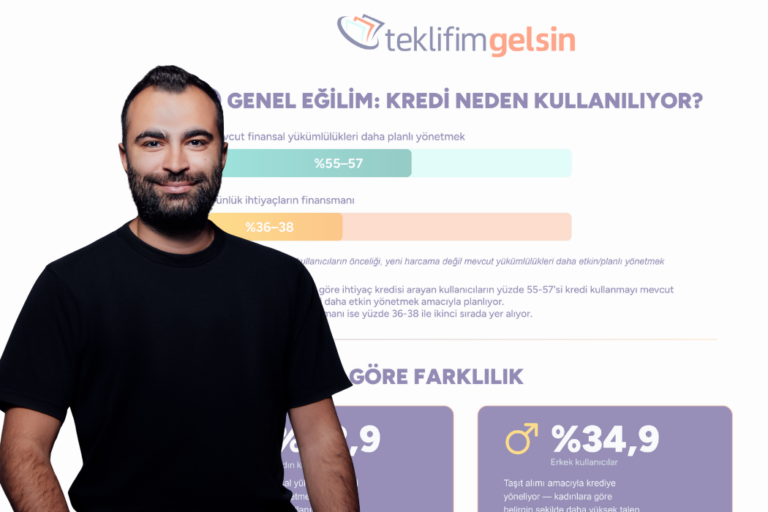
Personalized financial platform TeklifimGelsin examined the financial behavior of users seeking loans in the first half of 2026. The research found that consumers’ primary motivation for taking out loans was managing their existing financial obligations in a more planned way, rather than financing new spending. The results also shed light on how loan-seeking motivations vary by gender, income group, and seasonal needs.

According to TeklifimGelsin’s data, between 55 and 57 percent of users seeking personal loans in the first half of 2026 — the figure varying by month — planned to use the loan to manage their existing financial obligations more effectively. Financing daily needs ranked second, cited by 36 to 38 percent of users. The data shows that consumers are increasingly managing their budgets more carefully in the face of rising costs, prioritizing the consolidation of different financial obligations under a single structure in order to simplify their payment plans and maintain financial balance.

Women focus on financial balance, men on vehicle purchases

The research also found that loan-seeking motivations differ by gender. While 62.9 percent of female users sought personal loans to manage their existing financial obligations in a more planned way, this figure stood at 53.2 percent among men.

Male users, meanwhile, showed higher demand for vehicle-purchase loans. While 34.9 percent of men sought loans for vehicle purchases, this figure was 22.3 percent among women. Men also showed higher rates of seeking loans for planned expenses such as holidays and weddings compared to women.

Holiday and wedding expenses are planned in advance

TeklifimGelsin’s data for the first half of 2026 shows that consumers do not leave their seasonal spending to the last minute. Demand for holiday loans stood at 12.6 percent in January, rising through the spring months to reach 17.1 percent in April — the highest level in the first half of the year. This pattern indicates that financing plans for summer holidays are made months in advance.

A similar trend was observed in wedding financing. Demand for wedding loans peaked at 11.5 percent in January before declining as summer approached, falling to 8.8 percent in June. The data indicates that financing for summer weddings is largely planned in the earlier months of the year.

Looking at age groups, the 25-34 age bracket stands out in wedding financing. According to the research, this age group alone accounts for 46.3 percent of total wedding loan volume, ranking first.

Another notable finding in holiday loans concerns users aged 55 and above. While the 25-34 age group maintains its lead in holiday loan volume, the 18.7 percent share held by users aged 55 and above shows that retirees also prefer to plan and finance spending aimed at their quality of life.

Financial priorities shift according to income group

The research also shows that loan purposes vary by income level. Demand for holiday loans reached its highest level, at 20.8 percent, in the upper-income (A) group, falling to as low as 9.8 percent in the lowest-income group (E). Demand for education loans was likewise highest in the upper-income (A) group, at 20.2 percent, declining to around 15 percent in the middle- and lower-income groups (C1, C2, D).

The tendency to manage financial obligations more effectively also varies across income groups. This figure stood at 48 percent in the upper-income group (A), compared to 58.4 percent in the lower-middle-income group (C2) — a result indicating that consumers prioritize financial planning regardless of income level.

The picture shifts when it comes to wedding financing. Of total demand for wedding loans, 32.9 percent came from the middle-income group (C1) and 29.9 percent from the lower-middle-income group (C2), indicating that the burden of wedding financing is concentrated mainly in middle-income groups.

Commenting on the research, TeklifimGelsin CEO İhsan Cem Zararsız said: “Our data for the first half of 2026 shows that consumers are now turning to credit not just to finance new spending, but to manage their budgets more efficiently. Our users prefer to consolidate their various financial obligations into a more sustainable structure in order to simplify their payment plans. This approach points to a strengthening trend of financial awareness and informed decision-making. At TeklifimGelsin, we continue to support our users through our Credit Report product, which we offer free of charge on first use, helping them evaluate the financing options best suited to their needs, develop their financial literacy, and make more informed financial decisions.”

Unlimit and Xiaomi GetApps expand payments partnership

Unlimit and Xiaomi GetApps have expanded their partnership to combine cross-border payments with global app distribution for game studios.

The expanded agreement combines Unlimit’s cross-border payment infrastructure with GetApps’ distribution network, allowing game studios and developers to manage user acquisition and financial operations through a single arrangement.

Under the terms of the expansion, game studios and developers working with Unlimit gain access to preferential rates and dedicated opportunities on GetApps, intended to reduce distribution costs and support user acquisition. In turn, GetApps partners and developers can use Unlimit’s business accounts and payment services, including IBAN accounts and cross-border settlement, to manage their financial operations and fund expansion into new markets. The two companies describe the arrangement as connecting distribution and payment infrastructure that studios have typically had to manage separately.

Market context

According to the official press release, the mobile gaming sector was valued at USD 157.6 billion in 2025 and is projected to reach USD 256.2 billion by 2030, according to Grand View Research, implying annual growth of more than 10%. As studios expand into new markets to capture this growth, cross-border payment processing has remained largely manual: LexisNexis Risk Solutions research cited by the companies puts the average global straight-through processing rate for cross-border business payments at 26%, meaning most transactions require manual intervention. For studios operating across multiple jurisdictions, this creates operational overhead that the expanded partnership is intended to address on both the distribution and payments side.

Sergejs Dupleca, Head of Business Growth and Partnerships at Unlimit, said the collaboration reflects the company’s aim to connect the infrastructure that game studios and digital businesses need to operate internationally, describing the extension of the GetApps relationship as a continuation of an existing partnership rather than a new initiative.

Salt Edge invests in Sientia, an Open Banking ad platform

Salt Edge, an Open Banking and Open Finance platform with 13 years of experience in the sector, has invested in Sientia, a payment-linked advertising platform. The investment allows the two companies to jointly explore how Open Banking data can be applied beyond established use cases such as account information and payment initiation, extending it into loyalty, rewards, and marketing services.

Combining bank data access with loyalty technology

Salt Edge provides infrastructure that lets businesses securely connect to and access financial data from over 2,700 financial institutions across Europe and the UK. Through this connectivity, Sientia obtains real-time access to transaction and balance data, alongside enriched financial insights, which it applies to build personalised reward programmes and offers for advertisers, publishers, and financial institutions. Sientia already works with brands including Adidas, Ocado, Lyle & Scott, Hawksmoor, Honest Burger, and Poolhouse, as well as publishers such as Capillary Technologies.

Sina Saidinayer, Co-founder at Sientia, said the business sought a partner that understood how to build services on top of Open Banking connectivity, rather than one offering data access alone. The official pointed to Salt Edge’s reach into more than 5,000 banks globally and described the investment as validation for combining loyalty services with Open Banking infrastructure for advertisers, publishers, and financial brands.

Ilia Dragan, Chief Product Officer at Salt Edge, said the investment reflects the company’s approach of supporting businesses that develop new applications for Open Banking data, adding that combining customer-consented transaction insights with loyalty and marketing use cases represents a developing direction for the ecosystem.

Nu México to begin operating as a bank from 6 August

Nu México has received CNBV authorisation to operate as a bank from 6 August 2026, after completing a technical migration. The transition follows a planned technical migration of Nu México’s SOFIPO infrastructure, scheduled for 5 August 2026. During this window, certain services, including SPEI transfers and in-app access to balance checks and statement downloads, will be temporarily unavailable. Debit and credit card operations will continue to function without interruption, and customer funds will remain accessible throughout the process.

In addition, Nu México said it will notify users of the migration window one week in advance via email and in-app messaging, allowing customers to plan transactions accordingly. Support will remain available by phone during the suspension period.

Regulatory background

Nu México previously operated as a SOFIPO (Sociedad Financiera Popular), a category of regulated non-bank financial institution in Mexico that allows deposit-taking and lending activities under a lighter regulatory framework than full banking licences. Securing CNBV authorisation to operate as a commercial bank represents a change in regulatory status, bringing the entity under the supervisory framework applied to licensed banks in the country.

Nu entered the Mexican market in 2019 and, according to the company, currently serves close to 15% of the country’s adult population. Since its entry, customers have saved an estimated USD 2.8 billion in fees, annual dues, and transfer costs, based on figures provided by the company covering the period since 2019.

The company also cited internal survey data indicating that nearly 60% of its Mexican customers report using less cash since becoming Nu customers, while 86% describe the impact of the service on their finances as high, particularly in relation to financial stability and control.

Western Union to shut down its digital banking service

Western Union has announced that it is discontinuing Western Union Digital Bank. Under the company’s General Terms and Conditions, all Western Union Digital Bank accounts will be closed two months after users receive their closure notice.

On the closure date, users will lose access to the Western Union Digital Bank app, and the debit card linked to their account will be deactivated. Customers will receive a confirmation once their account has been closed.

What customers are being asked to do

Ahead of their account closure date, Western Union is advising customers to withdraw or transfer any remaining funds, and to notify anyone using their Western Union Digital Bank IBAN — including employers, service providers, or family members — of alternative banking details, in order to avoid disruption to incoming payments such as salaries, benefits, pensions, or transfers, as well as outgoing payments such as direct debits, bill payments, and subscriptions.

Customers are also being encouraged to download or save any account statements or transaction history they wish to keep before their account is closed, and Premium subscribers are being asked to cancel their subscription before the closure date. Customers who prefer not to wait can close their account earlier through the app, via the Profile > Close Account menu.

The company noted that once an account is closed, any payments sent to the associated IBAN may be rejected or returned to the sender, and that any remaining funds will be handled in accordance with applicable laws, regulations, and the account’s General Terms and Conditions.

Multiverse Computing becomes Europe’s newest unicorn

Spanish artificial intelligence company Multiverse Computing has announced that it has completed a €500 million Series C funding round at a €2 billion valuation. The round marks the largest AI funding round in Spanish history and makes the company Europe’s newest unicorn.

Founded in 2019 by Enrique Lizaso Olmos, Román Orús, Alfonso Rubio-Manzanares, and Samuel Mugel, the company is a global leader in AI model compression. It uses techniques derived from quantum computing to run large language models at less than half the cost and energy consumption.

Multiverse Computing has grown its annualized revenue more than tenfold since its Series B round in June 2025, with sales in the first quarter of 2026 up 96 times year-on-year.

The new round was led by Forgepoint Capital, BNPP SIVF, and Bullhound Capital, and with this investment the company has officially become Europe’s newest unicorn.