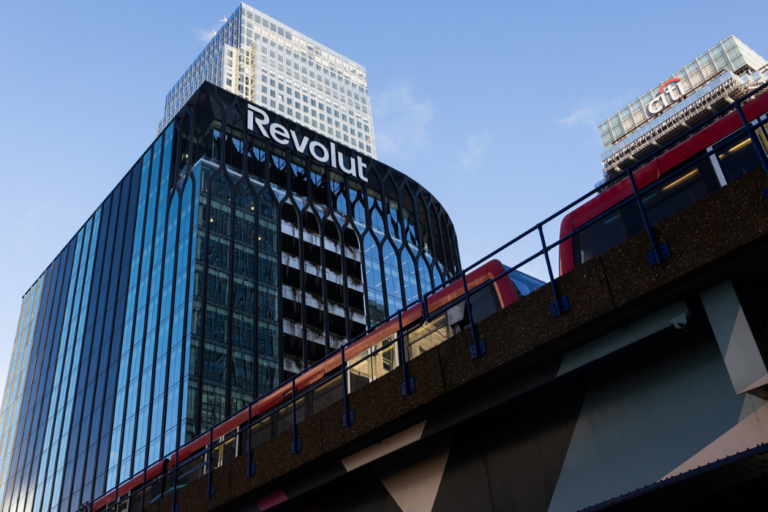
Revolut is weighing whether a physical store could eventually come to the UK, as the fintech monitors the success of its first face-to-face presence in Barcelona.
The fintech is “actively” exploring whether a shopfront in its home market could help build brand awareness and trust, according to the bank’s UK chief executive, Francesca Carlesi. The face-to-face Barcelona offering — which Revolut insists is a “store”, not a branch — aims to create a high-visibility space that makes the brand tangible and the product easier to discover. “We’re going to see how it goes, and definitely this will be a pilot that I will also be looking at very carefully, and then decide [whether it’s] something we can do in the UK or not,” Carlesi said. “Don’t be surprised [if at some point] we have a very cool store somewhere,” she added.
The potential move comes after Revolut secured a full UK banking licence in March, allowing for stickier lending products and larger deposits.
Any plans for a UK opening would not be in the “short or medium term”, the fintech said, given its immediate focus on the Barcelona pilot.
Revolut has not yet disclosed the services it plans to offer from its Barcelona store, which it opted for as its pilot location because of the city’s local density, global relevance, tourism and innovation.
The opening date for the outlet in Spain is expected to be later this year or next, depending on how quickly construction advances.
But having a physical presence is not “a silver bullet” for growing brand awareness, Carlesi said. “One thing we’re never going to do is roll out branches,” she said.
A spokesperson for Revolut added: “As with any new initiative, we continuously evaluate global market dynamics and consumer trends to inform our broader strategy.”
Other lenders are also experimenting with their high street presence as the number of bank branches in the UK continues to fall.
In one move away from typical branches, Santander saw a near 200 per cent rise in monthly account openings across five of its UK bank branches after they transitioned to work cafés.
Santander runs work cafés in Barcelona and London, among more than 200 such establishments it has opened globally.
Checkout.com, a leading global digital payments company, today announced that it has been granted in-principle approval for a Stored Value Facilities (SVF) licence by the Central Bank of the UAE (CBUAE). The regulatory milestone will allow Checkout.com to introduce issuing capabilities alongside its existing acquiring services in the UAE on a single platform built for performance.
With complex payments flows often operating across borders, enterprise merchants increasingly require the ability to accept funds and manage new payment experiences for customers, partners and their own teams.
Checkout.com offers acquiring and issuing as modular solutions, so merchants can adopt either one independently based on their needs. For those that choose both, bringing acquiring and issuing together will provide a more connected way to manage the movement of money across their businesses, with shared data, simpler operations and greater opportunities to improve performance.
Through Checkout.com’s unified platform, businesses will be able to link acquiring, issuing and business account capabilities, so they can fund cards directly from acquired balances. This removes the operational burden of pre-funding card programmes, improves liquidity and provides businesses with greater visibility and control over their funds.
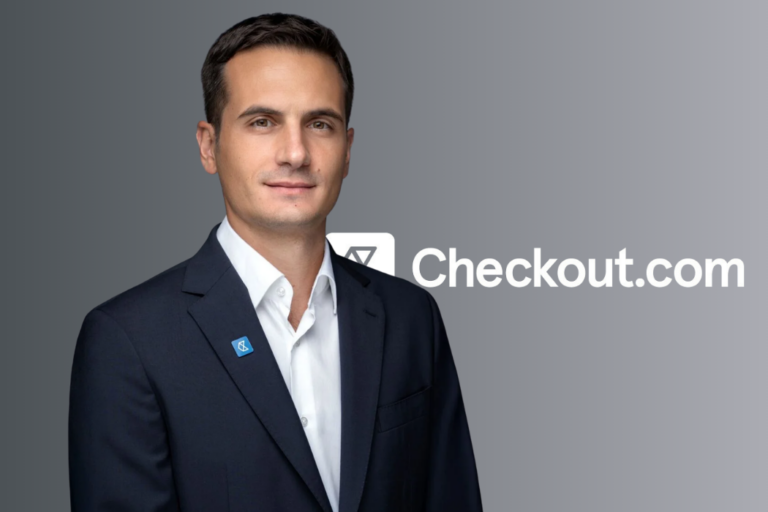
Remo Giovanni Abbondandolo, General Manager for MENA at Checkout.com, comments: “The UAE has firmly established itself as a leading global fintech hub, with a high level of digital adoption and a forward-looking regulatory environment that makes it an exceptional place for businesses to innovate and grow. On behalf of Checkout.com, I would like to thank the Central Bank of the UAE for its continued support and close collaboration throughout this process.
“This milestone moves us closer to providing UAE merchants with a truly unified payments platform, bringing acquiring and issuing together with performance at the centre of the equation. Once operational, this connected approach will help merchants reduce complexity, improve liquidity and create new payment experiences for their customers, partners and teams.”
Checkout.com has built significant momentum across the MENA region, with total processing volume growing 62% year-on-year between 2024 and 2025. For Checkout.com, today’s announcement aligns with the UAE’s FinTech Strategy, implemented by CBUAE, and is a significant step towards delivering the full breadth of its global payments proposition to merchants in the country.
Following the retirement of current CEO Javier Ferrer, Banco Popular has named Jorge Garcia as chief executive, Lidio Soriano as CFO, and Luis Sousa as CRO.
Puerto Rico’s Banco Popular has announced that it will promote executive vice president and chief financial officer Jorge Garcia to president and CEO, following the retirement of Javier D. Ferrer, which is set to take place on 31 August.
Ferrer closes this chapter in his career having spent over 12 years at the bank. Since joining in 2014 as chief legal officer, he has held numerous leadership roles, including chief operating officer and president.
In a parting message, Ferrer shares, “With the satisfaction of seeing Popular solid, united, and moving forward with a clear purpose and strategy, I’m announcing my retirement”. He continues: “As I begin this next chapter, I look forward to focusing on my health and spending meaningful time with my family and friends.”
Moka United has restructured its organizational setup in line with its strong and sustainable growth targets in payment systems and financial technology, both in Türkiye and globally.
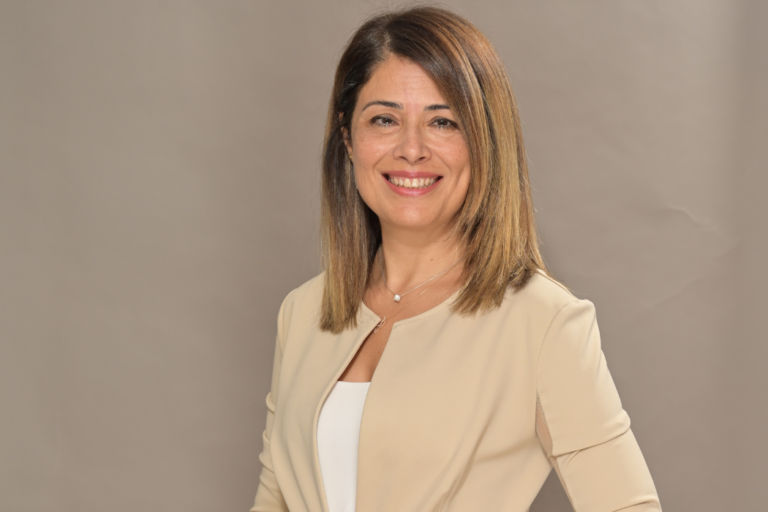
As part of the new structure, Gizem Moral, who brings years of experience in technology, strategic transformation, and growth management, has been appointed General Manager. Meanwhile, Halim Memiş, who had previously served as General Manager of Moka United, will now lead the group’s UK-based subsidiary.
Gizem Moral to lead Moka United’s new chapter
With roughly 30 years of experience in strategic transformation, growth, product development, and customer-centric business models within technology companies and the entrepreneurship ecosystem, Gizem Moral has led companies through scaling, transformation, and sustainable growth journeys in various CEO and senior executive roles across different sectors. In her new role, Moral will lead the growth vision, strategic transformation, and international development of Moka United’s organization in Türkiye and globally.
Halim Memiş to lead the growth of RUUT, the group’s UK-based strategic brand
Halim Memiş, who played a key role in Moka United’s growth journey to date, will now focus on the international growth of RUUT, the group’s UK-based subsidiary brand.
Built on Moka United’s strong financial technology infrastructure, RUUT offers digital finance solutions to businesses and individuals in the United Kingdom and is positioned as one of the key pillars of the group’s global growth strategy. Drawing on his experience in payment systems, digital banking, and the fintech sector along with his international vision, Halim Memiş will lead RUUT’s scaling in the European market, starting with the UK.
Vezne24 Tahsilat Sistemleri ve Ödeme Hizmetleri A.Ş. issued a statement regarding media and public reports about the termination of its payment services operating license by the Central Bank of the Republic of Türkiye (TCMB), following a decision published in the Official Gazette. The company said the statement was necessary to ensure the matter is understood accurately, transparently, and in full.
According to the statement, Vezne24’s payment services operating license was terminated not due to an administrative penalty, supervisory sanction, or any regulatory violation, but entirely as a result of the company’s own decision and its application to TCMB requesting the return of its license.
Legal and regulatory framework of the decision
As explicitly stated in the TCMB decision published in the Official Gazette, the cancellation of the operating license took place under Article 16, Paragraph 1(b) of Law No. 6493 on Payment and Securities Settlement Systems, Payment Services and Electronic Money Institutions, which covers cases in which “the payment institution notifies the Bank that it has explicitly waived this authorization or has ceased its operations.”
The company noted that the process was carried out through its own voluntary decision to waive its license authority and its notification to the relevant authorities of its decision to cease operations.
Vezne24’s license return and strategic rationale
The company said the underlying factor behind the decision was a global strategic decision taken by its parent company. Euro Exchange Group, the sole shareholder of Vezne24, decided to halt its operations in the Turkish market and exit the country as part of its global operational restructuring and strategic vision.
In line with its strategy to wind down its Turkey operations, the company said it applied to the relevant authority to initiate the license waiver process and fulfilled its legal obligations in full before returning its license to TCMB.
Vezne24 Tahsilat Sistemleri ve Ödeme Hizmetleri A.Ş. said it had fully met all its legal, administrative, and financial obligations both during its period of operation and throughout the license return process, and stated that it has no outstanding debts or grievances related to user receivables, fund obligations, or business partnerships.
Türkiye Finans Katılım Bankası has announced an expansion of its digital banking services and fee-free transaction options for SMEs. The bank allows SME customers to carry out a wide range of banking transactions via mobile and internet banking without visiting a branch, and does not charge fees for EFT and money transfer transactions conducted through digital channels.
According to the announcement, SME customers can apply for installment-based commercial financing through digital channels, carry out EKAP and e-letter of guarantee transactions, and submit requests for cards, POS terminals, checkbooks, and credit limits. In addition, financial leasing, Export Proceeds Acceptance Certificate (İBKB) creation, Direct Debiting System (DBS) and Commercial Financing System (TFS) transactions, as well as Findeks check reports, Findeks risk reports, and fee package transactions, can also be carried out through the same digital channels.
Commenting on the matter, Türkiye Finans Katılım Bankası Deputy General Manager for Retail and SME Banking Emre Ertürk said SMEs represent a key pillar of the country’s economy in terms of production, employment, and export capacity, adding that the digital solutions developed by the bank allow customers to meet many of their needs — from financing to collateral, and from cash management to payment transactions — quickly and without visiting a branch.
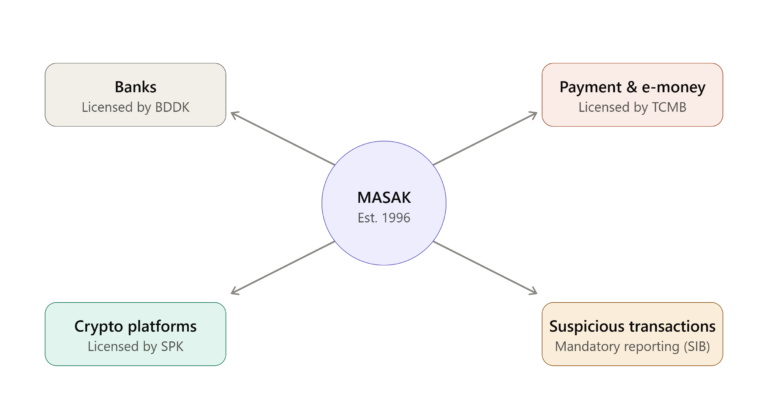
MASAK (Mali Suçları Araştırma Kurulu, “Financial Crimes Investigation Board”) is Turkey’s central authority for combating money laundering, terrorism financing, and the financing of weapons of mass destruction proliferation. Operating under the Ministry of Treasury and Finance, MASAK doesn’t license financial institutions itself — instead, it sets and enforces anti-money-laundering (AML) and know-your-customer (KYC) obligations that cut across every other regulator’s jurisdiction, applying to banks, payment and e-money institutions, and crypto asset service providers alike, regardless of which agency issued their operating license.
Origins and Legal Basis
MASAK was established in 1996 under Law No. 4208, Turkey’s original anti-money-laundering law. Its scope expanded over time to include counter-terrorism financing, and its modern legal foundation is Law No. 5549 on the Prevention of Laundering Proceeds of Crime, which took effect in 2006. This law remains the primary statute governing MASAK’s authority today, covering not just money laundering but also the financing of terrorism and, more recently, the financing of weapons of mass destruction proliferation.
What MASAK Actually Does
MASAK’s core function is best described as an intelligence pipeline: it collects large volumes of data from obligated institutions and public bodies, processes that data into actionable intelligence, and channels the results to the judicial and administrative authorities responsible for prosecution or enforcement. MASAK itself does not typically prosecute cases — it identifies and escalates them.
Key functions include:
Collecting suspicious transaction reports (STRs) from obligated institutions
Analyzing financial data for patterns consistent with money laundering, terrorism financing, or proliferation financing
Conducting administrative investigations and sectoral risk assessments
Referring cases to judicial authorities (courts) or administrative bodies for enforcement action
Coordinating national AML/CFT policy through the Coordination Board for Combating Financial Crimes (Mali Suçlarla Mücadele Koordinasyon Kurulu), which evaluates draft AML legislation and aligns implementation strategy across agencies
Who Is Obligated to Report to MASAK
Turkish law casts a wide net over who must comply with MASAK’s requirements. “Obligated parties” (yükümlüler) include both financial institutions and certain non-financial businesses:
Banks
Payment institutions and electronic money institutions
Crypto Asset Service Providers
Other financial intermediaries (brokerages, insurance companies, etc.)
Certain non-financial businesses and professions, including dealers in precious metals, stones, and jewelry
Being an obligated party carries a specific practical consequence: it creates a legal duty to make reasonable inquiries into a customer’s identity and the source of their funds — a duty that applies regardless of the size of the business or its transaction volume, though the requirement to formalize a compliance program and appoint a dedicated compliance officer generally scales with an institution’s size, per sector-specific guidance.
Core Obligations for Regulated Fintechs
For a fintech company classified as an obligated party, MASAK compliance generally involves:
Suspicious Transaction Reports (Şüpheli İşlem Bildirimi, ŞİB): a mandatory, confidential legal report filed with MASAK whenever there is suspicion — or reasonable grounds to suspect — that funds involved in a transaction originate from illegal activity.
Threshold-based reporting: obligated parties must report transactions exceeding an amount set periodically by the Ministry of Treasury and Finance, regardless of whether suspicion is involved.
Record retention: institutions must retain documentation related to STRs, internal escalations to compliance officers, and the written justification for any decision not to file a report on a reviewed transaction.
Group-level information sharing: under Article 5/2 of Law No. 5549, companies within the same financial group are permitted to share customer identification, account, and transaction information with each other for compliance purposes — the legal basis that allows a banking or fintech group to operate a shared risk database or blacklist across its subsidiaries.
MASAK’s Role Across Turkey’s Fintech Regulatory Landscape
MASAK’s authority is deliberately cross-cutting rather than sector-specific, which is what makes it distinct from Turkey’s other main regulators:
Banks, licensed by BDDK, are directly obligated to MASAK.
Payment and electronic money institutions, licensed and supervised by TCMB under Law No. 6493 (following the transfer of relevant licensing authority from BDDK to the Central Bank), are equally obligated to MASAK’s AML framework.
Crypto Asset Service Providers, licensed by SPK under Law No. 7518, are treated as obligated parties as well — including compliance with the international Travel Rule for cross-border crypto transfers, in force since 2025.
In practice, this means MASAK compliance isn’t something a fintech can satisfy once and move on from at licensing — it’s a continuous, parallel obligation that runs alongside whatever primary license (BDDK, TCMB, or SPK) governs the company’s core activity, as covered in our guide to Turkey’s fintech regulatory framework.
Frequently Asked Questions
What does MASAK stand for? Mali Suçları Araştırma Kurulu, translated as the Financial Crimes Investigation Board.
When was MASAK established? In 1996, under Law No. 4208. Its current legal foundation is Law No. 5549, which took effect in 2006.
Does MASAK license financial institutions? No. MASAK does not issue operating licenses. Licensing is handled by BDDK (banks), TCMB (payment and e-money institutions), and SPK (crypto asset service providers and capital markets). MASAK’s authority is AML/CFT compliance, which applies across all of them.
What is a Suspicious Transaction Report (ŞİB)? A confidential legal report that obligated institutions must file with MASAK when there is suspicion, or reasonable grounds to suspect, that a transaction involves funds from illegal activity.
Does MASAK’s authority only apply to banks? No. MASAK’s authority extends to payment and e-money institutions, crypto asset service providers, other financial intermediaries, and even certain non-financial businesses such as precious metals and jewelry dealers.
This article is part of Fintech in Türkiye’s ongoing coverage of Turkey’s fintech regulatory landscape. For more on how Turkey’s regulators work together, explore our Regtech & Compliance section.
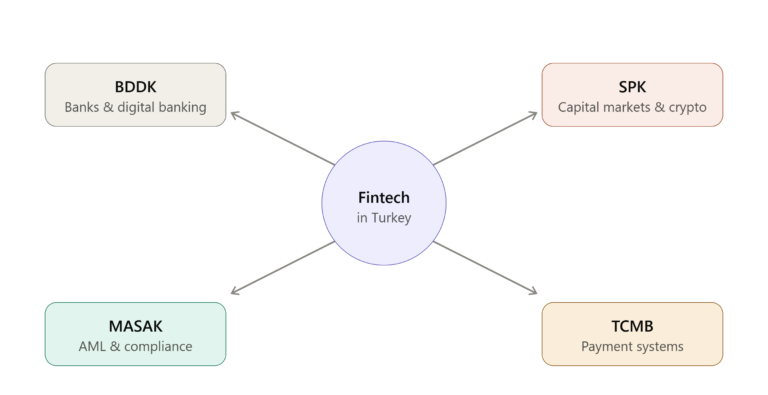
Turkey regulates fintech through four main authorities working under a shared legal framework: the Banking Regulation and Supervision Agency (BDDK/BRSA) for banks and digital banking, the Capital Markets Board (SPK/CMB) for capital markets and crypto assets, the Financial Crimes Investigation Board (MASAK) for anti-money-laundering compliance, and the Central Bank of the Republic of Turkey (TCMB) for payment systems and monetary policy. No single “Turkish PSD2” or unified fintech law exists — instead, several distinct laws layer together, each administered by the regulator with jurisdiction over that activity. For foreign investors and fintech founders evaluating Turkey, understanding how these pieces fit together is the essential first step.
Payment systems (FAST), open banking infrastructure, monetary policy, digital Turkish Lira
These four bodies don’t operate in isolation — a single fintech product often falls under more than one regulator simultaneously. A crypto exchange, for example, needs an SPK license to operate, but is also treated as an obligated party under MASAK’s AML framework, and if it offers payment features, TCMB regulations on crypto payments apply as well.
The Core Legal Framework
Turkey’s fintech regulation rests on several distinct laws rather than one comprehensive statute:
Banking Law No. 5411: The foundational law governing banks and BDDK’s supervisory authority, including the licensing framework digital-only banks operate under.
Law No. 6493 (Payment and Securities Settlement Systems, Payment Services and Electronic Money Institutions Law): The primary law for payment institutions and e-money institutions, with TCMB and BDDK issuing secondary regulations under its authority — this is the legal basis for open banking and payment licensing.
Capital Markets Law No. 6362, as amended by Law No. 7518 (2024): Gives crypto assets formal legal recognition and creates the Crypto Asset Service Provider (KVHS) license category under SPK.
Law No. 5549: The foundational AML law that gives MASAK its authority over obligated financial institutions, including banks, payment institutions, and crypto platforms.
Law No. 6698 (KVKK): Turkey’s data protection law, closely modeled on the EU’s GDPR, which applies to any fintech handling personal financial data.
Licensing Pathways for Fintech Companies
The license a fintech company needs in Turkey depends entirely on what it does:
Digital banking: Requires a full banking license from BDDK, with capital and governance requirements broadly aligned with those for traditional banks, though BDDK has issued specific provisions addressing branch-free digital banks.
Payments and e-money: Requires a Payment Institution or Electronic Money Institution license under Law No. 6493, issued by BDDK, with technical infrastructure requirements and TCMB oversight for participation in national payment rails like FAST.
Crypto asset services: Requires a Crypto Asset Service Provider (KVHS) license from SPK under Law No. 7518, plus mandatory integration with MKK’s KVMKS central registry system and MASAK AML compliance.
Investment and wealthtech: Falls under SPK’s broader capital markets licensing regime, with specific requirements depending on whether the company provides investment advice, portfolio management, or brokerage-adjacent services.
Recent Developments Shaping the Regulatory Environment
Turkey’s fintech regulatory environment has moved into a more structured, supervision-heavy phase heading into 2026, which foreign investors should read as a market maturity signal rather than a warning sign:
SPK established a dedicated Financial Technologies Department (Finansal Teknolojiler Dairesi), reflecting growing institutional focus on fintech and crypto within the capital markets regulator, rather than treating these as a peripheral concern.
TCMB temporarily suspended the operating licenses of several payment and e-money institutions in October 2025, and license revocations affecting some providers followed — part of a broader tightening of governance, internal control, and compliance expectations across the sector. Industry commentary heading into 2026 frames this shift as fintechs needing to move from “we built the product” to “we built the institution,” with regulatory compliance treated as core institutional design rather than an afterthought.
A coordinated multi-agency supervision framework was introduced under Presidential Circular No. 2025/18, bringing MASAK, TCMB, BDDK, the telecommunications regulator (BTK), and security units together under a shared action plan targeting illegal betting and gambling — with POS infrastructure, agent networks, and digital wallets brought under closer joint scrutiny for transparency and public safety purposes.
TCMB’s Digital Turkish Lira project continued advancing through its second phase, with reported progress on programmable payments, offline transaction capability, and interoperability testing with other countries’ digital currency systems.
What This Means for Foreign Investors
Two takeaways matter most for anyone assessing Turkey from outside the country:
First, the licensing bar is real but navigable. Turkey does not offer a lightweight registration regime for fintechs the way some jurisdictions do — banking, payment, and crypto licenses all involve capital adequacy requirements, governance standards, and technical infrastructure review (in the case of crypto platforms, by TÜBİTAK). This makes market entry slower than in more permissive regimes, but it also means licensed competitors face the same bar, and consumer and institutional trust in licensed providers tends to be correspondingly higher.
Second, supervision is intensifying, which changes what “compliant” means in practice. The wave of license suspensions and revocations in late 2025, combined with SPK’s new dedicated fintech department, signals that Turkish regulators are moving from initial licensing toward active, ongoing supervision. A foreign fintech entering Turkey today should plan for compliance and governance infrastructure as a core product requirement from day one — not something to build only once regulators ask questions.
Frequently Asked Questions
Is there a single fintech law in Turkey, like the EU’s PSD2? No. Turkey regulates fintech through several distinct laws — the Banking Law, Law No. 6493 for payments, Capital Markets Law as amended by Law No. 7518 for crypto, and Law No. 5549 for AML — each administered by the relevant regulator, rather than one unified fintech statute.
Which regulator do I need to talk to first as a foreign fintech founder? It depends on your product. Digital banking and payment institutions fall primarily under BDDK; crypto and investment products fall under SPK; and any product handling customer funds will also need to address MASAK’s AML requirements regardless of which primary regulator applies.
Has Turkey’s fintech regulation gotten stricter recently? Yes. Late 2025 saw temporary license suspensions and revocations for some payment and e-money institutions, alongside SPK’s creation of a dedicated Financial Technologies Department — both signals of a shift toward more active ongoing supervision rather than one-time licensing checks.
Does Turkey have an open banking framework? Yes, built primarily on Law No. 6493, with TCMB leading API standardization following the transfer of relevant authority from BDDK, enabling licensed third parties to access account data and initiate payments with customer consent.
Is Turkey’s regulatory environment fintech-friendly for foreign investors? Turkey combines a genuine, testable licensing pathway with increasingly active supervision — a market structure that rewards companies that treat compliance as core infrastructure rather than an afterthought, and that has continued attracting record early-stage investment (a reported $220 million across 42 rounds in 2025) despite the more demanding regulatory bar.
This article is provided for informational purposes and does not constitute legal advice; foreign investors should consult qualified Turkish legal counsel before entering the market. For more on Turkey’s fintech regulatory landscape, explore our Regtech & Compliance section.
Türkiye Kalkınma ve Yatırım Bankası (TKYB) has announced its financial results for the second quarter of 2026. In the second quarter, the bank grew its asset size to 214.6 billion TL and its loan volume to 126.4 billion TL. Maintaining strong asset quality, TKYB posted a six-month net profit of more than 5 billion TL.
Türkiye Kalkınma ve Yatırım Bankası disclosed its financial results for the first six months of 2026 through Turkey’s Public Disclosure Platform (KAP). The bank’s total assets reached 214.6 billion TL.
While the bank’s loan volume reached 126.4 billion TL, the ratio of gross non-performing loans to total loans — a key indicator of asset quality — stood at 0.52 percent. The bank’s average return on equity came in at 30 percent, while net profit rose 31 percent year-on-year to surpass 5 billion TL.
Bringing international resources together with Turkey’s investments
Noting that the bank strengthened its partnerships with international development finance institutions through new funding agreements in the first half of the year, TKYB General Manager İbrahim Öztop said the financing secured would be channeled into investments supporting Turkey’s production capacity and green transition. “We signed loan agreements worth 100 million euros with the European Investment Bank, 200 million euros with the World Bank, $350 million with the Japan Bank for International Cooperation, and 200 million euros with the French Development Agency,” Öztop said. “These resources, secured from international financial institutions, span a wide range of investment areas — from SMEs’ clean energy and energy efficiency investments to infrastructure projects, from low-carbon production to initiatives strengthening women’s role in economic life. Through these partnerships, we will continue to expand our international financing capacity while contributing to Turkey’s sustainable growth and competitiveness.”
Adding value to strategic projects through our investment banking activities
Noting that the bank effectively continued its investment banking activities in the first half of the year, Öztop said: “As part of the projects we’re carrying out with the Privatization Administration, we successfully completed the auction process for the privatization tender of Tekirdağ Çeşmeli Port. In capital markets, we facilitated a total of 1.8 billion TL in sukuk issuance for Vakıf Leasing, contributing to companies’ access to alternative financing sources. Through the financial advisory services we provide to the private sector, we also continued to support the investment processes of enterprises.”
Continuing to create long-term value for the entrepreneurship ecosystem
Noting that support provided to the entrepreneurship ecosystem through the Turkey Development Fund continued to grow in the second quarter, Öztop said: “We made investments in ventures operating in the fields of data science, marketing technologies, energy technologies, and artificial intelligence. We also added a venture operating in advanced technology to our Innovative and Advanced Technologies Venture Capital Fund portfolio. We launched OİB VCF, established in partnership with Turkey’s Ministry of Trade and the Uludağ Automotive Industry Exporters’ Association, whose formation we announced in the first quarter of the year. Through OİB VCF, which is aimed at technology ventures in the automotive sector, we’ve brought a new fund to the venture capital ecosystem.”
Öztop noted that total resources channeled into the entrepreneurship ecosystem through the Turkey Development Fund have reached $95.9 million to date, and said the bank would continue supporting Turkey’s technology and innovation ecosystem through new investments and sub-funds.
Steadfastly continuing our work in line with our sustainable development goals
Noting that the bank has steadfastly continued its work in the environmental, social, and governance areas in line with Turkey’s sustainable development goals, Öztop said: “As of June 2026, sustainability-themed loans made up 96 percent of our loan portfolio, while the share of climate-focused financing in our portfolio reached 56 percent. Through the renewable energy projects we have financed, we have contributed to reducing greenhouse gas emissions by approximately 4 million tons. In line with our sustainable finance approach, we will continue directing our resources toward investments that create long-term value, contributing to strengthening our country’s low-carbon, competitive, and resilient economic structure.”
Türkiye’s Central Securities Depository (MKK) has begun publishing baseline data on the country’s crypto asset market — recorded through its Crypto Asset Central Registry System (KVMKS) — on www.mkk.com.tr.
According to the data, the total number of investors who have made a transaction on crypto asset platforms in Türkiye to date has reached approximately 5.6 million. The number of investors currently holding a balance stands at around 3.2 million, while the crypto assets held in investor balances have a combined market value of 140.76 billion lira.
Through KVMKS, which securely records transaction and balance data, as well as portfolio and investor information held in the systems of Crypto Asset Service Providers (KVHS) under MKK’s assurance, a comprehensive infrastructure for detailed analysis and reporting has now been introduced.
Data on crypto assets — compiled from information reported to KVMKS by service providers — is now shared through MKK’s “MKK Market Data” screen, which is updated and published daily on the institution’s corporate website.
Figures on total market value, investor numbers, the number of crypto assets held in balances, and the number of crypto asset trading platforms registered with MKK are published through the MKK Market Data screen. Going forward, MKK also plans to share more detailed KVMKS data with the public through its Data Analysis Platform (VAP).
Commenting on the matter, MKK General Manager and Board Member Dr. Ekrem Arıkan said: “Through KVMKS, which we developed as a system that can serve as a global example in crypto asset regulation, we began recording information on crypto assets that are not subject to a centralized issuance process or registry system last year, through integrations we established with KVHS providers. The market data generated from these records is analyzed for use by relevant institutions, and where suitable for public disclosure, it is classified and prepared for publication thanks to our advanced digital infrastructure. In line with the responsibility we’ve taken on in our role as a Data Storage Institution and the public interest we aim to serve, we’ve begun making this data available to all market participants under the principle of transparency. In doing so, we will ensure that developments in crypto markets — a subject of considerable public interest — can be tracked under MKK’s assurance.”
Noting that interest in crypto asset investment is quite high in Türkiye, Dr. Arıkan added: “As of July 15, 2026, a total of 53 KVHS providers — comprising 7 custody institutions and 46 platforms listed on the Capital Markets Board’s (SPK) List of Active KVHS Providers — have successfully completed their membership processes with our institution. According to data reported to KVMKS by these providers, the total number of investors who have made a transaction on the platforms to date stands at approximately 5.6 million. Of these, 797,696 are new investors who received a registry number from MKK for the first time through KVMKS, while approximately 4.8 million were investors already registered with MKK beforehand. According to data obtained from the platforms, of all investors who have invested in crypto assets, approximately 3.2 million currently hold a balance. These holdings include roughly 1,500 different crypto assets, which, based on their most recent trading prices, have a combined market value of 140.76 billion lira. This data is current as of today and, as with other markets, is automatically updated at each day’s market close and shared the following day through our MKK Market Data screen. These calculations are based on data reported by KVHS providers through KVMKS.”